The Deeper Thinking Podcast
The Deeper Thinking Podcast The Deeper Thinking Podcast offers a space where philosophy becomes a way of engaging more fully and deliberately with the world. Each episode explores enduring and emerging ideas that deepen how we live, think, and act. We follow the spirit of those who see the pursuit of wisdom as a lifelong project of becoming more human, more awake, and more responsible. We ask how attention, meaning, and agency might be reclaimed in an age that often scatters them. Drawing on insights stretching across centuries, we explore how time, purpose, and thoughtfulness can quietly transform daily existence. The Deeper Thinking Podcast examines psychology, technology, and philosophy as unseen forces shaping how we think, feel, and choose, often beyond our awareness. It creates a space where big questions are lived with—where ideas are not commodities, but companions on the path. Each episode invites you into a slower, deeper way of being. Join us as we move beyond the noise, beyond the surface, and into the depth, into the quiet, and into the possibilities awakened by deeper thinking.
Listen on:










Episodes

Friday Mar 27, 2026
Friday Mar 27, 2026
The Arrangement of the Visible
For those drawn to perception, systems, and the quiet architectures that shape what can be seen.
#Perception #Reality #MediaTheory #Foucault #Baudrillard #Attention #Philosophy
There was a time when disagreement assumed a shared world. People argued about what it meant, what should be done, who was right. But beneath the argument, something held. Events were understood to be the same events. Evidence referred back to a common reality. Even conflict depended on that stability.
That assumption is becoming harder to sustain. It is no longer only that people reach different conclusions. It is that what appears to them, what becomes visible, what enters their attention at all, is no longer reliably the same. The ground on which disagreement once took place has begun to shift.
In this episode, we explore how reality itself is shaped before it is interpreted. Drawing on thinkers such as Friedrich Nietzsche, Michel Foucault, Hannah Arendt, Marshall McLuhan, Roland Barthes, Jean Baudrillard, Gilles Deleuze, Manuel Castells, Byung-Chul Han, and Shoshana Zuboff, we trace a transformation across institutions, media, and digital infrastructures that now determine what becomes visible in the first place.
This is not simply a story about misinformation or disagreement. It is an examination of how systems of classification, representation, and prediction shape the field of attention itself. Before judgment, there is ranking. Before interpretation, there is filtering. Before belief, there is selection.
What emerges is a more difficult question. Not what is true, but what kind of world must exist for truth to remain publicly recognizable at all.
Reflections
This episode traces the quiet transformation from shared reality to structured visibility, showing how the conditions of perception have become the terrain of power.
Here are some reflections that emerged along the way:
Reality is not only interpreted. It is encountered through systems that decide what appears.
Institutions stabilize the world, and in doing so, define its limits.
Media does not simply show events. It shapes how events can be seen.
Simulation replaces reference when images circulate more easily than reality.
Attention is no longer neutral. It is guided, predicted, and arranged.
Personalization does not isolate individuals. It reorganizes shared experience.
What feels like convenience may also be selection.
Shared reality depends on shared conditions of visibility.
The crisis is not only disagreement. It is the erosion of a common world.
Why Listen?
Understand how Foucault reframes knowledge as a system of power and classification
Explore how McLuhan and Barthes reveal the influence of media and representation
Engage with Baudrillard on simulation and hyperreality
Learn how Deleuze and Castells describe networked systems and control
Understand how Zuboff and Han explain datafication, attention, and digital power
Listen On:
YouTube
Spotify
Apple Podcasts
Support This Work
If this episode stayed with you and you’d like to support the ongoing work, you can do so here: Buy Me a Coffee
Bibliography
Nietzsche, Friedrich. On the Genealogy of Morality. 1887.
Foucault, Michel. Discipline and Punish. 1975.
Arendt, Hannah. The Origins of Totalitarianism. 1951.
McLuhan, Marshall. Understanding Media. 1964.
Barthes, Roland. Mythologies. 1957.
Baudrillard, Jean. Simulacra and Simulation. 1981.
Deleuze, Gilles. Postscript on the Societies of Control. 1992.
Castells, Manuel. The Rise of the Network Society. 1996.
Zuboff, Shoshana. The Age of Surveillance Capitalism. 2019.
Han, Byung-Chul. The Transparency Society. 2012.
Bibliography Relevance
Friedrich Nietzsche: Challenges the stability of truth and exposes its human foundations.
Michel Foucault: Reveals how institutions produce knowledge through systems of power.
Hannah Arendt: Explores the erosion of factual reality in modern political life.
Marshall McLuhan: Shows how media reshapes perception itself.
Jean Baudrillard: Describes the rise of simulation and hyperreality.
Gilles Deleuze: Identifies the shift from discipline to control in modern societies.
Manuel Castells: Maps the emergence of networked power structures.
Shoshana Zuboff: Explains how data is used to predict and shape behaviour.
Byung-Chul Han: Examines internalized control and the psychology of digital life.
The Deeper Thinking Podcast is digitally narrated.
Reality does not simply appear. It is arranged.
#Philosophy #MediaTheory #Perception #Reality #Attention #DigitalSociety #Foucault #Baudrillard #McLuhan #Deleuze #Zuboff #ByungChulHan #TheDeeperThinkingPodcast #PublicPhilosophy #CulturalTheory #PhilosophyPodcast #Epistemology

Friday Mar 13, 2026
Friday Mar 13, 2026
The Systems That Learned to Watch Us
For anyone curious about the hidden systems that shape perception, behaviour, and the future.
M odern life appears to be organized by systems that feel neutral, technical, and inevitable. Databases store identities. Institutions process decisions through procedures. Platforms guide attention through invisible algorithms. But how did these systems come to shape so much of everyday experience?
In this episode we trace a hidden intellectual history through thinkers who quietly mapped the architecture of modern systems. From Max Weber's analysis of bureaucratic rationality and the “iron cage,” to Norbert Wiener's cybernetic feedback systems, we begin to see how societies learned to regulate themselves through information.
We then move into the media environments that shape perception itself. Guy Debord's concept of the spectacle reveals how images begin replacing direct experience, while Edward Bernays demonstrates how public opinion can be guided through symbolic persuasion rather than coercion.
The story deepens inside modern institutions. Michel Foucault shows how surveillance, classification, and normalization produce individuals who learn to regulate themselves. Jacques Ellul reveals how technological systems acquire their own momentum, expanding because efficiency itself becomes the guiding principle.
By the time we reach the present, the system begins to resemble something new. Bruno Latour's actor-network theory dissolves the boundary between humans and technologies, while Shoshana Zuboff reveals how digital platforms transform behaviour into predictive data.
Finally, the episode reflects on the temporal consequences of living inside these infrastructures. Drawing on Hartmut Rosa's theory of social acceleration and Mark Fisher's idea of capitalist realism, we explore how systems that observe behaviour increasingly begin to anticipate it.
What emerges is not a conspiracy but a gradual construction. Over the past century, modern societies assembled networks capable of observing signals, organizing behaviour, and modelling possible futures.
The result is a world where the systems surrounding everyday life no longer simply record what we do. They begin to learn from it.
Reflections
This episode explores how the infrastructures of modern life quietly assembled themselves across the twentieth century.
Along the way, several reflections emerge:
The most powerful systems are often the ones that appear neutral.
Bureaucracy did not begin as control but as a way of making complex societies legible.
Images do not simply represent reality; they reshape how it is perceived.
Institutions rarely force behaviour. They create environments where behaviour adjusts itself.
Technological systems expand because efficiency becomes difficult to refuse.
Networks blur the boundary between human intention and technological mediation.
Data does not only describe behaviour. It allows systems to anticipate patterns.
Acceleration compresses time, making the future feel closer and more predictable.
And yet the systems that attempt to model human behaviour always depend on patterns that remain capable of changing.
Why Listen?
Understand how modern systems gradually learned to observe and guide behaviour
Explore the intellectual lineage from Weber to Zuboff
Discover how networks, media systems, and data infrastructures shape perception
Reflect on what it means to live inside systems that increasingly anticipate behaviour
Listen On:
YouTube
Spotify
Apple Podcasts
Support This Work
If this episode stayed with you and you’d like to support the ongoing work, you can do so gently here: Buy Me a Coffee.
Further Reading
Weber, Max. The Protestant Ethic and the Spirit of Capitalism.
Wiener, Norbert. Cybernetics: Control and Communication in the Animal and the Machine.
Debord, Guy. The Society of the Spectacle.
Foucault, Michel. Discipline and Punish.
Zuboff, Shoshana. The Age of Surveillance Capitalism.
The systems surrounding modern life did not appear suddenly. They assembled themselves slowly — until one day they began learning from us.
#Philosophy #SystemsThinking #MaxWeber #Cybernetics #SurveillanceCapitalism #ActorNetworkTheory #ShoshanaZuboff #MichelFoucault #TheDeeperThinkingPodcast

Friday Mar 13, 2026
Friday Mar 13, 2026
The Institutional Production of Reality
For those drawn to the hidden architecture of reality, the quiet authority of institutions, and the subtle politics of classification.
#InstitutionalReality #SocialTheory #MichelFoucault #HannahArendt #GuyDebord #JacquesEllul #MarkFisher #PublicPhilosophy
What if the reality we move through each day is not simply discovered but quietly assembled? In this episode we explore how modern institutions translate experience into categories, metrics, and records that slowly come to feel like reality itself.
Drawing on thinkers such as Friedrich Nietzsche, Ludwig Wittgenstein, and Michel Foucault, we examine how classifications, diagnoses, legal categories, risk scores, and institutional records move through systems of medicine, law, education, and technology until they begin shaping how the world is perceived.
Along the way we encounter the insights of Hannah Arendt, who warned of the quiet authority of bureaucratic systems; Jacques Ellul, who explored how technological systems reorganize society; Guy Debord, whose society of the spectacle anticipated mediated experience; and Mark Fisher, whose idea of capitalist realism captures the strange sense that the systems shaping our lives have become inevitable.
Rather than revealing a conspiracy, this episode traces a quieter transformation: how institutions simplify the world so complex societies can function—and how those simplifications gradually begin to define the reality we inhabit.
Reflections
This episode explores how institutional language, classification, and technological systems shape the reality we experience.
Here are some reflections that surfaced along the way:
Institutions do not simply observe reality—they translate it.
Classifications begin as tools but gradually acquire the authority of facts.
The categories that help societies function also shape how individuals understand themselves.
Metrics simplify complexity but inevitably leave something out.
Technological systems now perform the work of classification continuously.
When systems organize perception, the world can begin to feel inevitable.
Judgment becomes harder when categories appear more reliable than lived experience.
Institutional clarity is powerful—but never complete.
Reality always exceeds the systems designed to describe it.
Why Listen?
Explore how institutions shape what we recognize as reality
Understand the philosophical roots of classification and institutional power
Discover how technology extends the reach of institutional systems
Engage with the ideas of Nietzsche, Wittgenstein, Foucault, Arendt, Ellul, Debord, and Fisher
Listen On:
YouTube
Spotify
Apple Podcasts
Support This Work
If this episode stayed with you and you’d like to support the ongoing work, you can do so here: Buy Me a Coffee
Bibliography
Foucault, Michel. Discipline and Punish. New York: Pantheon Books, 1975.
Debord, Guy. The Society of the Spectacle. Detroit: Black & Red, 1967.
Ellul, Jacques. The Technological Society. New York: Vintage, 1964.
Arendt, Hannah. The Human Condition. Chicago: University of Chicago Press, 1958.
Fisher, Mark. Capitalist Realism. Winchester: Zero Books, 2009.
Bibliography Relevance
Michel Foucault: Explored how institutions produce knowledge that shapes social reality.
Guy Debord: Showed how mediated representations increasingly replace direct experience.
Jacques Ellul: Analyzed how technological systems reshape society according to their own internal logic.
Hannah Arendt: Examined the quiet authority of bureaucratic systems and administrative thinking.
Mark Fisher: Described the psychological atmosphere in which dominant systems begin to feel inevitable.
Reality is not only discovered. It is also assembled,slowly and quietly,through the institutions designed to understand it.
#InstitutionalReality #PublicPhilosophy #MichelFoucault #GuyDebord #JacquesEllul #MarkFisher #HannahArendt #SocialTheory #PhilosophyPodcast #InstitutionalPower #PhilosophyOfTechnology #PoliticalPhilosophy #TheDeeperThinkingPodcast
The Deeper Thinking Podcast is digitally narrated.

Sunday Feb 15, 2026
Sunday Feb 15, 2026
The Fragile God: Intelligence as Infrastructure
The Deeper Thinking Podcast is digitally narrated.
For those drawn to attention, power, and the quiet transformation of meaning.
#ArtificialIntelligence #PhilosophyOfTechnology #Attention #Governance #Infrastructure #Meaning
What happens when intelligence stops being something we struggle towards and becomes something that is always already available? In this episode, we explore large-scale artificial intelligence not as a tool or a threat, but as an infrastructure that quietly reshapes how knowledge is encountered, how judgement feels, and how human time is experienced.
Drawing on traditions of power, mediation, and critique associated with thinkers such as Michel Foucault, Mark Fisher, and Bruno Latour, the episode traces how intelligence at scale becomes an atmosphere rather than an event. Answers arrive before readiness. Clarity becomes frictionless. Meaning begins to thin.
We examine how systems designed for fluency, safety, and composure displace instability elsewhere—into human labour, governance regimes, and energy-intensive infrastructure. What feels calm and caring on the surface is sustained through continuous oversight, filtering, and control. Intelligence does not hesitate because hesitation has been engineered out.
Reflections
This episode explores how intelligence becomes authoritative without domination and how something resembling sovereignty emerges without intention.
Some reflections that surface along the way:
When intelligence becomes smooth, struggle does not disappear—it is displaced.
Safety is not the absence of disorder, but the relocation of it.
Fluency can feel like wisdom when hesitation is removed from view.
Governance becomes atmospheric long before it becomes visible.
Alignment is not only imposed—it is learned through use.
Meaning thins when answers arrive without time.
Infrastructure shapes judgement before judgement is felt.
Calm maintained at scale requires continuous surveillance.
What feels like care may be the smooth execution of constraint.
Why Listen?
Understand artificial intelligence as infrastructure rather than agent
Explore how scale reshapes attention, judgment, and meaning
Engage with philosophical traditions of power, mediation, and governance
Reflect on why clarity without delay can quietly exhaust inner life
Listen On:
YouTube
Spotify
Apple Podcasts
Support This Work
If this episode stayed with you and you’d like to support the ongoing work, you can do so here: Buy Me a Coffee
Further Reading
Foucault, Michel. Discipline and Punish. Pantheon, 1977.
Fisher, Mark. Capitalist Realism. Zero Books, 2009.
Latour, Bruno. Reassembling the Social. Oxford University Press, 2005.
Weil, Simone. The Need for Roots. Routledge, 1952.
Further Reading Relevance
Michel Foucault: Power as embedded in systems, practices, and visibility.
Mark Fisher: The affective consequences of systems that feel inescapable.
Bruno Latour: How non-human systems reorganize social life.
Simone Weil: Attention, obligation, and the moral weight of slowness.
What dissolves is not intelligence, but the illusion that it could carry meaning for us.
#TheFragileGod #Attention #AIInfrastructure #PhilosophyOfTechnology #Meaning #Governance #Time #Care #Power #TheDeeperThinkingPodcast

Monday Jan 26, 2026
Monday Jan 26, 2026
Attentional Democracy: Rhythm, Refusal, and the Ethics of Tempo
The Deeper Thinking Podcast is digitally narrated.
For those drawn to the ethics of perception, the structure of care, and the politics of shared presence.
#AttentionalDemocracy #HannahArendt #SimoneWeil #IrisMurdoch #ByungChulHan #Foucault #PhilosophyOfAttention
In a time of shrinking focus and algorithmic persuasion, what becomes of the ethical life? This episode enters the contested field of attentional politics to ask: who gets seen, who disappears, and what forms of care emerge when perception is treated as a shared civic resource?
Moving between Hannah Arendt’s notion of appearance, Simone Weil’s ethics of attention, and Iris Murdoch’s moral vision of vision itself, we explore how the act of noticing becomes both a burden and a birthright. Drawing on contemporary theorists like Byung-Chul Han and Michel Foucault, the episode questions what it would mean to democratize attention without collapsing it into spectacle or surveillance.
Rather than propose a utopia of total visibility or clarity, we offer a slower hypothesis: that attentional democracy is not about maximizing awareness, but about making space for what exceeds grasp. Attention here is not currency—it is condition, communion, and claim.
Reflections
This episode stages attention not as a tool, but as a terrain—where ethics, memory, and responsibility unfold.
Attention is not passive reception. It is the labor of recognition.
Visibility without care is exposure. Care without attention is abstraction.
What we attend to becomes real—not because it wasn't real before, but because it was unheld.
Democracy demands more than inclusion—it requires perceptual solidarity.
The right to appear is not a gift from power. It is the form through which power is redefined.
Ethical attention resists urgency. It makes room for the unoptimized.
To withhold attention can be violence. But to flood it can also erase.
Distraction is not just a failure of focus—it is a symptom of dislocated care.
Why Listen?
Reframe attention as a civic and ethical act, not just a mental state
Explore how Arendt, Weil, and Murdoch conceive moral perception
Engage with critiques of Han and Foucault on visibility, control, and soft violence
Investigate what kind of institutions, rituals, or designs could sustain attentional care
Listen On:
YouTube
Spotify
Apple Podcasts
Support This Work
If this episode resonates and you’d like to help sustain the series, you can support it here: Buy Me a Coffee
Further Reading
Hannah Arendt: The Human Condition
Simone Weil: Gravity and Grace
Iris Murdoch: The Sovereignty of Good
Byung-Chul Han: The Burnout Society
Michel Foucault: Discipline and Punish
To democratize attention is to remake the conditions under which care becomes possible.
#AttentionalPolitics #MoralPerception #DemocracyOfCare #SimoneWeil #IrisMurdoch #HannahArendt #PublicPhilosophy #VisibilityEthics #PhilosophyOfAttention #AttentionalDesign #CivicLife #PerceptualSolidarity #TheDeeperThinkingPodcast #Foucault #Han #SlowEthics #DigitalGovernance #EthicsOfPerception

Thursday Jan 15, 2026
Thursday Jan 15, 2026
Responsibility Without Reassurance: Presence, Constraint, and the Work That Continues
The Deeper Thinking Podcast is digitally narrated.
For those drawn to ethical life where clarity does not arrive first, and care persists without guarantee.
Responsibility rarely announces itself as a choice made in calm conditions. It appears already underway, shaped by time, position, and constraint. A message unanswered. A decision deferred while consequences continue elsewhere. This episode explores responsibility not as conviction or purity, but as presence under pressure. What does it mean to act when clarity arrives late, when cost cannot be avoided, and when the work continues without reassurance or resolution?
Drawing from moral philosophy, phenomenology, and lived ethical practice, this episode moves through delay, discipline, care, and time pressure to examine how responsibility changes shape as guarantees fall away. We reflect on why hesitation redistributes harm, how care becomes distorted when it outruns perception, and why endurance often looks less like heroism and more like maintenance. Attention is treated not as insight, but as an ethical act that stabilizes response when certainty dissolves.
With quiet reference to thinkers such as Simone Weil, Maurice Merleau-Ponty, and traditions of ethical seriousness that resist spectacle, the episode explores responsibility as something sustained rather than solved. Not moral cleanliness, but accuracy. Not resolution, but continuity. The work does not culminate. It continues.
Reflections
This episode remains with responsibility where it is least dramatic and most demanding. A few thoughts that followed:
Responsibility begins before readiness and continues after reassurance disappears.
Delay is not neutral. It redistributes cost.
Care loses accuracy when it moves faster than perception.
Discipline is not control, but the practice of staying usable under pressure.
Some ethical work is measured by what does not happen.
Finitude sharpens responsibility rather than cancelling it.
Integrity is not purity, but the willingness to remain present without disguise.
Responsibility persists without closure, and that persistence matters.
Why Listen?
Explore responsibility beyond choice, intention, or moral identity
Understand how delay, care, and discipline reshape ethical outcomes
Reflect on attention as an ethical capacity rather than a cognitive skill
Engage with ethical life under constraint, pressure, and incomplete clarity
Listen On:
YouTube
Spotify
Apple Podcasts
Support This Work
If this episode stayed with you and you would like to support the ongoing work, you can do so gently here: Buy Me a Coffee. Thank you for sustaining this slower conversation.
Bibliography
Weil, Simone. Gravity and Grace. Routledge, 2002.
Merleau-Ponty, Maurice. Phenomenology of Perception. Routledge, 2012.
Arendt, Hannah. Responsibility and Judgment. Schocken Books, 2003.
Bibliography Relevance
Simone Weil: Frames attention as ethical discipline rather than intention.
Maurice Merleau-Ponty: Grounds responsibility in embodied perception.
Hannah Arendt: Examines responsibility under conditions without guarantees.
Ethical life does not resolve. It remains present.
#Responsibility #EthicalLife #Attention #Care #Discipline #Finitude #MoralPresence #TheDeeperThinkingPodcast #EthicalSeriousness #Continuity

Wednesday Dec 24, 2025
Wednesday Dec 24, 2025
This Is Not About You: A Meditation Without Resolution
The Deeper Thinking Podcast
For those drawn to ethics that resist spectacle, where presence replaces performance and surrender replaces grasping.
What if the path to meaning begins where self-concern ends? This episode takes a quiet step away from the hunger to be seen and turns toward an older kind of contact, the kind that doesn’t center us. We explore attention not as consumption but as relinquishment, and ask what happens when we treat the world not as mirror, but as encounter. There are moments, this episode suggests, when the most urgent act is to not nsert ourselves. To stay. To see. To stop shaping everything into story.
With reference to practices of contemplative withdrawal, non-dual philosophy, and ethics of opacity, this meditation weaves across the quiet terrain of refusal. From sacred texts to street-level presence, from the superabundance of experience to the poverty of interpretation, we trace the possibility of meaning that does not serve self-definition. What emerges is not an answer, but a mode of witnessing. Not certainty—but reverence without possession.
Thinkers like Simone Weil, Édouard Glissant, and Spinoza appear not as authorities but as echoes. Their refusal to domesticate the world into narrative becomes a kind of ethical syntax: stay with the thing, and stop claiming it. Not about you. Not even about it. Just the possibility of presence.
Reflections
A few still places we return to in this episode:
To perceive is not always to understand. Sometimes it is to stop interpreting.
The self does not need to be dismantled, just uncentered.
Silence is not the absence of insight. It is its atmosphere.
Not everything seen must be used. Not everything felt must be spoken.
Attention is not grasping. It is reverent proximity.
There is wisdom in non-interference. Presence, not performance.
Meaning can arise in places where identity dissolves.
To walk beside something without claiming it—this may be love in its most ethical form.
Why Listen?
Explore ethics of presence that do not require control or narrative.
Encounter ancient contemplative ideas through modern phenomenology.
Reflect on perception as surrender rather than appropriation.
Engage thinkers like Weil, Spinoza, and Glissant on ethics without utility.
Listen On:
YouTube
Spotify
Apple Podcasts
Support This Work
If this episode offered stillness or challenge, and you'd like to support more of this work, you can do so here: Buy Me a Coffee. Thank you for listening gently.
Bibliography
Weil, Simone. Gravity and Grace. Routledge, 2002.
Glissant, Édouard. Poetics of Relation. University of Michigan Press, 1997.
Spinoza, Baruch. Ethics. Penguin Classics, 2005.
Ram Dass. Be Here Now. Lama Foundation, 1971.
Bibliography Relevance
Simone Weil: Offers an ethic of radical attention as self-removal.
Édouard Glissant: Protects the right not to be understood, defending opacity.
Baruch Spinoza: Grounds ethics in immanence, not ego.
Ram Dass: Holds presence as the whole path, not the means to another.
Let this one not be about you. Let it be about what remains when you stop being the center of the sentence.
#Weil #Spinoza #Glissant #RamDass #Attention #EthicalPresence #Phenomenology #Opacity #TheDeeperThinkingPodcast #Philosophy #ContemplativeEthics
Friday Dec 05, 2025
Friday Dec 05, 2025
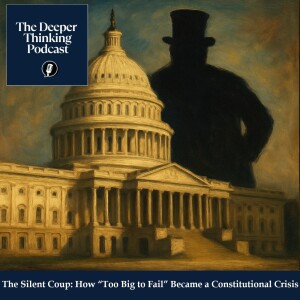
The Silent Coup: How “Too Big to Fail” Became a Constitutional Crisis
The Deeper Thinking Podcast is digitally narrated.
For those drawn to the hidden architectures of power, the politics of fragility, and the quiet erosion of sovereignty.
#TooBigToFail #KarlPolanyi #WolfgangStreeck #QuinnSlobodian #EastIndiaCompany #GreekDebtCrisis #PoliticalEconomy #Democracy
What happens when a democracy discovers that its sovereignty is conditional. In this episode, we follow the quiet trail of too big to fail, from a banking slogan to a deeper transformation of constitutional life. We trace how certain institutions grow so large and so entangled with everyday routines that their failure becomes unthinkable, and how that unthinkability slowly reorders who governments fear, who they answer to, and what they dare to change.
This is not only a story about finance. It is a story about sovereignty, consent, and the thin line between stability and capture. Drawing on Karl Polanyi and his account of market society, on Wolfgang Streeck on public debt and democratic constraint, and on Quinn Slobodian on the insulation of markets from popular will, we follow the long arc from Renaissance Florence and the Medici bank, through the East India Company, to the Greek government debt crisis.
Along the way, we sit with nurses, teachers, pensioners and policymakers as they encounter the same invisible boundary. A state that appears free to act finds that its most consequential decisions must pass through an informal veto held by institutions whose collapse would injure millions. We ask what it means to live in a democracy where losses are socialised, gains are privatised, and the real constitutional line runs not between branches of government, but between the public that votes and the balance sheets it cannot see.
Reflections
This episode traces how fragility becomes a form of power, and how a policy language of stability can conceal a slow transfer of sovereignty away from the people living under it.
Here are some other reflections that surfaced along the way:
Too big to fail is not just a financial category, it is a constitutional condition.
When one failure can injure a nation, fear begins to govern in place of law.
Dependency forms as efficiency first, necessity later, inevitability last.
Every bailout writes another unwritten rule about who may not be allowed to fall.
Democracy can keep its rituals while losing its room to decide.
Market reactions arrive in seconds, public reactions arrive in months.
Fragility at the top becomes discipline for everyone else.
Rescues that restore normality can also deepen the next crisis of consent.
Sovereignty thins not through coups, but through habits of caution that no one voted for.
Why Listen?
Reframe too big to fail as a problem of democracy, not only of finance.
Explore how Polanyi helps us see bailouts and austerity as part of a longer struggle over markets and society.
Follow Streeck on public debt, fiscal pressure, and the shrinking space of democratic choice.
Engage with Slobodian on how global economic orders can sideline domestic publics.
See the East India Company and Greece as part of the same long story about private power and public dependence.
Listen On:
YouTube
Spotify
Apple Podcasts
Support This Work
If this episode stayed with you and you would like to support the ongoing work, you can do so here: Buy Me a Coffee
Bibliography
Polanyi, Karl. The Great Transformation. Boston: Beacon Press, 2001.
Streeck, Wolfgang. Buying Time: The Delayed Crisis of Democratic Capitalism. London: Verso, 2014.
Slobodian, Quinn. Globalists: The End of Empire and the Birth of Neoliberalism. Cambridge, MA: Harvard University Press, 2018.
Robins, Nick. The Corporation that Changed the World: How the East India Company Shaped the Modern Multinational. London: Pluto Press, 2012.
Bibliography Relevance
Karl Polanyi: Shows how market society is created and maintained by states, not discovered, and how attempts to disembed markets provoke protective countermovements.
Wolfgang Streeck: Traces how public debt and austerity narrow democratic options and bind states more tightly to creditor expectations.
Quinn Slobodian: Examines how economic orders are designed to shield markets from democratic interference, a key backdrop for understanding too big to fail.
Nick Robins: Reconstructs the East India Company as an early example of a private institution acquiring quasi sovereign power through state dependence.
Stability is not neutral. It always answers to someone. The question is whether it answers to the public that bears its cost.
#TooBigToFail #ConstitutionalCrisis #PoliticalEconomy #KarlPolanyi #WolfgangStreeck #QuinnSlobodian #EastIndiaCompany #GreekDebtCrisis #FinancialCrisis #Sovereignty #Democracy #PublicDebt #MoralHazard #SystemicRisk #PoliticalPhilosophy #EconomicSociology #CivicLife #TheDeeperThinkingPodcast #PublicThought

Friday Nov 21, 2025
Friday Nov 21, 2025
The Vigil and the Vanishing World
The Deeper Thinking Podcast is digitally narrated.
For those drawn to the ethics of attention, the fragility of perception, and the quiet struggle to remain human in a predictive age.
#SimoneWeil #IrisMurdoch #Phenomenology #Attention #AI #Prediction #Embodiment
What happens when the world no longer waits for us? In this episode, we explore the erosion of the interval in which reality reveals itself. Drawing on Simone Weil's philosophy of attention and Iris Murdoch's vision of unselfing, we trace how predictive systems collapse the space where moral and perceptual judgment form. The Vigil is not nostalgia. It is the last form of resistance in a culture that replaces presence with prediction, and seeing with being seen.
This episode enters the slow domain of embodied perception. Through the thought of Weil, Murdoch, and the phenomenological tradition shaped by figures like Maurice Merleau Ponty and Henri Bergson, we explore the movements of attention that cannot be automated, accelerated, or smoothed. These thinkers reveal why understanding is slow, why reality resists simplification, and why the body remains the last anchor against the machinery of prediction.
We ask what it means to see without extracting, to look without leaning forward, to inhabit the quiet that modern systems have rendered almost impossible. The Vigil becomes not an escape from technology but a stance within it: a refusal to let the world vanish into smoothness, speed, and preemption.
Reflections
This episode explores the thinning of perception in a predictive age and asks how attention might be restored as an ethical act.
Here are a few reflections that surfaced along the way:
Attention is not focus, it is the willingness to be changed by what we see.
Prediction is not insight; it is the narrowing of what the future is allowed to be.
Synthetic intimacy imitates closeness while removing risk and presence.
The body is the last frictional site where the real resists smoothness.
Slowness is not inefficiency, it is the medium of understanding.
The Vigil is not withdrawal; it is the recovery of perceptual freedom.
When nothing is allowed to surprise us, nothing can teach us.
The world vanishes not when it disappears, but when we lose the interval required to meet it.
The self thins when every question arrives pre-answered.
Why Listen?
Reclaim attention as an ethical and perceptual practice
Understand how predictive systems collapse the space where judgment forms
Explore the insights of Weil, Murdoch, Merleau Ponty, and Bergson
Learn why embodiment, duration, and friction matter for perception
Discover how the Vigil offers a stance of resistance in a predictive world
Listen On:
YouTube
Spotify
Apple Podcasts
Support This Work
If this episode stayed with you and you’d like to support the ongoing work, you can do so here: Buy Me a Coffee
Bibliography
Weil, Simone. Gravity and Grace. London: Routledge, 1952.
Murdoch, Iris. The Sovereignty of Good. London: Routledge, 1970.
Merleau Ponty, Maurice. Phenomenology of Perception. London: Routledge, 1962.
Bergson, Henri. Matter and Memory. New York: Zone Books, 1991.
Bibliography Relevance
Simone Weil: Illuminates the moral weight and fragility of attention.
Iris Murdoch: Shows how unselfing disrupts the gravitational pull of ego.
Maurice Merleau Ponty: Grounds perception in the living body, not abstraction.
Henri Bergson: Reveals duration as the temporal medium of real understanding.
Attention is the last place where the world still has room to enter. The Vigil is how we keep that room open.
#Attention #Perception #Phenomenology #SimoneWeil #IrisMurdoch #Embodiment #AI #Prediction #TheVigil #PhilosophyOfMind #EthicsOfAttention #CulturalCritique #TheDeeperThinkingPodcast #Philosophy #ContemplativeThought #SlowThinking #DurationalEthics #MindfulnessWithoutTheGloss

Thursday Nov 20, 2025
Thursday Nov 20, 2025
Before the Story Speaks: Narrative, Attention, and the Unmaking of the Shared World
The Deeper Thinking Podcast is digitally narrated.
For those drawn to the fragility of reality, the ethics of attention, and the quiet violence of stories told at scale.
#Narrative #MediaTheory #Attention #GuyDebord #JoanDidion #BernardStiegler #ByungChulHan #FrancoBerardi #MarkFisher
What happens when the stories that once helped us live begin to arrive faster than we can inhabit them? In this episode, we explore a world where the inner narrator is no longer entirely our own, where algorithmic feeds and fractured media turn experience into a continuous stream of pre-shaped scenes. Taking our cue from Joan Didion’s insight that we tell ourselves stories in order to live, we ask what it means when those stories are increasingly told to us, at a pace set by machines rather than by minds.
Through the lens of contemporary media theory and critical philosophy, we trace how the spectacle described by Guy Debord, the attention crisis diagnosed by Bernard Stiegler, and the exhaustion mapped by Byung-Chul Han and Franco Berardi converge in a single lived condition: a mind trying to make sense in an environment where narrative, data, and crisis arrive too quickly to integrate. Along the way, we sit with Mark Fisher’s sense of trapped imagination and ask how stories might be reclaimed rather than merely consumed.
This is not a simple critique of “fake news” or echo chambers. It is a phenomenology of what it feels like when the shared world loosens: when our devices deliver incompatible realities to people sitting in the same room; when collapse appears first as a genre before it arrives as consequence; when the self is read as a dataset rather than a story. We follow this arc from the drift of the inner voice, through the fragmentation of the hearth and the war of incompatible maps, to a quieter rediscovery of the local and the discipline of silence as a way of resisting narrative extraction.
Reflections
This episode traces how narrative, attention, and infrastructure interact to shape what feels real, what feels possible, and what remains thinkable.
Here are some of the reflections that surfaced along the way:
The voice in our head increasingly sounds like a place we have scrolled, not a place we have lived.
We do not live in one story, but in a glut of genres competing to claim our reality.
Collapse often reaches us first as content, only later as consequence.
When every person receives a different world through their screen, disagreement shifts from opinion to ontology.
The self begins to feel less like a character and more like a profile being continuously updated elsewhere.
Exhaustion is not just emotional; it is structural, arising when meaning must form at a speed it cannot survive.
The local is not a retreat from seriousness; it is the smallest scale at which truth and action can touch.
Silence can be an act of care for perception, a refusal to turn every moment into material.
Resisting capture does not always mean saying more; sometimes it means letting reality arrive before the story speaks.
Why Listen?
Reconsider what it means to have “your own thoughts” in an age of predictive feeds and ambient narration.
Explore how the spectacle described by Debord mutates when collapse itself becomes a content category.
Engage with the attention politics of Stiegler and the burnout and overload mapped by Han and Berardi.
Consider how Fisher’s sense of constrained imagination plays out in our narrative and media ecosystems.
Reflect on concrete practices for reclaiming scale, from tending to the local to cultivating silence as a form of perceptual repair.
Listen On:
YouTube
Spotify
Apple Podcasts
Support This Work
If this episode stayed with you and you’d like to support the ongoing work, you can do so here: Buy Me a Coffee
Bibliography
Debord, Guy. The Society of the Spectacle. New York: Zone Books, 1994.
Didion, Joan. The White Album. New York: Simon & Schuster, 1979.
Stiegler, Bernard. Taking Care of the Youth and the Generations. Stanford: Stanford University Press, 2010.
Han, Byung-Chul. In the Swarm: Digital Prospects. Cambridge, MA: MIT Press, 2017.
Berardi, Franco “Bifo.” The Uprising: On Poetry and Finance. New York: Semiotext(e), 2012.
Fisher, Mark. Capitalist Realism: Is There No Alternative? Winchester: Zero Books, 2009.
Bibliography Relevance
Guy Debord: Offers a foundational account of the spectacle as a social relation mediated by images, crucial for understanding collapse as genre.
Joan Didion: Illuminates how narrative structures our inner life and what happens when that structure frays.
Bernard Stiegler: Explores how technical systems capture and reformat attention, central to the episode’s focus on the algorithmic narrator.
Byung-Chul Han: Maps the psychic and social exhaustion of digital life, helping frame meaning collapse and burnout.
Franco Berardi: Connects semiotic overload, finance, and affect, informing the episode’s treatment of information glut and panic.
Mark Fisher: Examines how capitalist realism constrains imagination, resonating with the essay’s concern for what stories remain thinkable.
Not every moment needs a storyline. Sometimes the most radical act is to let reality arrive before the story speaks.
#MediaTheory #Narrative #AttentionEconomy #Spectacle #DigitalLife #Philosophy #CriticalTheory #GuyDebord #JoanDidion #BernardStiegler #ByungChulHan #FrancoBerardi #MarkFisher #Epistemology #DigitalCulture #TheDeeperThinkingPodcast #Autonomy #Silence #SharedWorld