Saturday May 23, 2026
A Life Standing Beside Itself (Part 2) - The Deeper Thinking Podcast
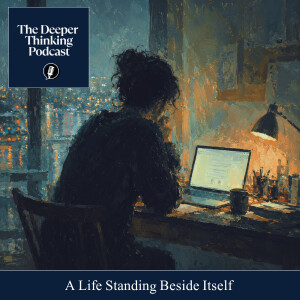
A Life Standing Beside Itself
Readiness Without Arrival and the Future Occupying the Present
For those drawn to the emotional pressure of modern life, the quiet violence of permanent readiness, and the strange ways the future begins occupying the present before anything has happened.
#Anticipation #Burnout #Phenomenology #MichelFoucault #ByungChulHan #HartmutRosa #MarkFisher #AttentionEconomy
What if exhaustion now begins before anything has happened? In this episode, we explore a condition of contemporary life in which the body starts preparing before thought arrives, the day begins before it has properly begun, and the future enters ordinary life as a form of quiet occupation. A phone brightens a room before the mind is fully awake. A message is rewritten before it is sent. A calendar is checked before the feet touch the floor. Nothing catastrophic has occurred, yet the body has already begun arranging itself around what might come next.
This is not simply a story about distraction, productivity, or phone addiction. It is a deeper inquiry into phenomenology, social time, and the nervous system under conditions of permanent readiness. Drawing on resonances with Michel Foucault, Byung-Chul Han, Hartmut Rosa, Mark Fisher, and the broader study of the attention economy, the episode asks how power increasingly works not only through command, but through anticipation, self-monitoring, emotional rehearsal, and the internal pressure to remain available.
The essay follows the small gestures through which contemporary life becomes organised around futures that have not yet arrived. A message softened before it risks being misunderstood. A document revised long after it is finished. A parent monitoring a child’s school portal out of care. A worker checking a roster because one missed update may narrow the week. A child learning to prepare a face for the camera before understanding what memory means. Across these scenes, readiness appears not only as anxiety, but as love, responsibility, survival, professionalism, and hope.
What emerges is not a simple refusal of preparation. The future really does matter. Planning can protect people. Anticipation can prevent harm. The difficulty begins when readiness stops serving life and becomes the medium through which life is lived. When rest becomes recovery strategy, silence becomes mindfulness, friendship becomes network maintenance, and a finished document can no longer feel finished because its consequences are still being rehearsed.
Reflections
This episode traces how anticipation enters the body, how readiness becomes identity, and how the present is quietly reorganised by futures still under construction.
Here are some reflections that surfaced along the way:
- Thought does not always initiate action. Sometimes thought arrives after the body has already begun preparing.
- The future does not arrive equally for everyone.
- For some, anticipation appears as opportunity. For others, it appears as survival.
- Readiness often feels like care, competence, intimacy, and moral seriousness.
- The same gesture can be love and injury.
- Modern power increasingly works through self-monitoring before explicit command.
- Language itself begins to flinch early when every sentence anticipates possible reaction.
- A finished task may not feel finished when its future interpretation remains active.
- Preparation does not always produce competence. Sometimes it produces a life standing beside itself.
- The problem is not anticipation itself, but readiness becoming the medium through which life is lived.
Why Listen?
- Explore how phenomenology can illuminate the ordinary bodily experience of modern anticipation
- Understand why contemporary exhaustion often begins before any visible crisis has occurred
- Examine how Foucault’s ideas about discipline and self-regulation resonate with internalised readiness
- Consider how Byung-Chul Han helps explain achievement, self-exploitation, and the pressure to remain available
- Reflect on how social acceleration, economic precarity, and digital systems reshape the experience of time
- Think through the emotional ambiguity of preparation as care, fear, hope, and exhaustion
Listen On:
Support This Work
If this episode stayed with you and you’d like to support the ongoing work, you can do so here: Buy Me a Coffee
Further Reading
- Foucault, Michel. Discipline and Punish: The Birth of the Prison. New York: Pantheon, 1977.
- Han, Byung-Chul. The Burnout Society. Stanford: Stanford University Press, 2015.
- Rosa, Hartmut. Social Acceleration: A New Theory of Modernity. New York: Columbia University Press, 2013.
- Fisher, Mark. Capitalist Realism: Is There No Alternative? Winchester: Zero Books, 2009.
- Berlant, Lauren. Cruel Optimism. Durham: Duke University Press, 2011.
Further Reading Relevance
- Michel Foucault: Helps frame how discipline moves from external command into internalised self-regulation.
- Byung-Chul Han: Illuminates how modern subjects exhaust themselves through performance, availability, and self-optimisation.
- Hartmut Rosa: Provides a theory of social acceleration and the shrinking capacity to inhabit time without pressure.
- Mark Fisher: Clarifies the emotional atmosphere of systems that feel unavoidable, even when they are visibly damaging.
- Lauren Berlant: Helps explain why people remain attached to futures, habits, and promises that also deplete them.
The future still arrives early most days, but not always in the forms we rehearsed.
The Deeper Thinking Podcast is digitally narrated.
#Philosophy #Phenomenology #Anticipation #Burnout #ModernLife #Readiness #AttentionEconomy #ByungChulHan #MichelFoucault #HartmutRosa #MarkFisher #LaurenBerlant #SocialAcceleration #SelfMonitoring #DigitalLife #Exhaustion #TheDeeperThinkingPodcast
No comments yet. Be the first to say something!