The Deeper Thinking Podcast
The Deeper Thinking Podcast The Deeper Thinking Podcast offers a space where philosophy becomes a way of engaging more fully and deliberately with the world. Each episode explores enduring and emerging ideas that deepen how we live, think, and act. We follow the spirit of those who see the pursuit of wisdom as a lifelong project of becoming more human, more awake, and more responsible. We ask how attention, meaning, and agency might be reclaimed in an age that often scatters them. Drawing on insights stretching across centuries, we explore how time, purpose, and thoughtfulness can quietly transform daily existence. The Deeper Thinking Podcast examines psychology, technology, and philosophy as unseen forces shaping how we think, feel, and choose, often beyond our awareness. It creates a space where big questions are lived with—where ideas are not commodities, but companions on the path. Each episode invites you into a slower, deeper way of being. Join us as we move beyond the noise, beyond the surface, and into the depth, into the quiet, and into the possibilities awakened by deeper thinking.










Episodes

Apr 28, 2025
Apr 28, 2025
9 min
The Slow Reweaving: On Trust, Presence, and the Future of Belonging
The Deeper Thinking Podcast
What if the most urgent repairs a society needs are not material or political, but relational? This episode listens to the quiet unraveling of civic life through the twin lenses of Robert D. Putnam’s analysis of social capital and Andy Haldane’s reflections on collective economic fragility. We trace how the erosion of trust, mutual regard, and the civic imagination signals not just institutional weakness—but a crisis of relation itself.
Presence cannot be legislated back into being. It must be risked—through small, unseen acts of recognition, vulnerability, and time. This episode is not a proposal. It is a meditation on how societies slowly reweave themselves through the fibre of attention, patience, and encounter. Drawing from Hannah Arendt, Simone Weil, and Sara Ahmed, we ask how belonging can be rebuilt without spectacle—through presence, not performance.
From civic decline to ethical intimacy, we follow the subtle architecture of shared life. What emerges is not a theory, but a plea: that we return to the daily, vulnerable work of relation as the foundation of freedom itself.
Why Listen?
Understand how the erosion of social trust imperils democracy and shared life
Explore the relational foundations beneath visible political and economic structures
Reflect on how belonging is rebuilt not through design, but through daily acts of presence
Engage with thinkers like Putnam, Haldane, Arendt, Weil, and Ahmed on freedom, relation, and civic repair
Listen On:
YouTube
Spotify
Apple Podcasts
Bibliography
Putnam, Robert D. Bowling Alone: The Collapse and Revival of American Community. Simon & Schuster, 2000.
Haldane, Andy. “Counting the Cost of Bowling Alone.” RSA Lecture, 2025.
Arendt, Hannah. The Human Condition. University of Chicago Press, 1998.
Ahmed, Sara. Living a Feminist Life. Duke University Press, 2017.
Weil, Simone. Gravity and Grace. Routledge, 2002.
Bibliography Relevance
Robert D. Putnam: Frames the decline of civic participation as the erosion of shared social capital
Andy Haldane: Explores the economic costs and implications of declining social trust
Hannah Arendt: Anchors the political stakes of presence, attention, and public space
Simone Weil: Brings ethical gravity to the act of attention and the moral weight of presence
Sara Ahmed: Highlights how belonging is shaped through lived, felt, and contested experiences
What if freedom begins not with rights, but with recognition?
#SocialTrust #CivicImagination #RelationalEthics #Putnam #Haldane #Arendt #Weil #Ahmed #Presence #TheDeeperThinkingPodcast #Philosophy #Belonging #Freedom #Democracy #MutualRegard
Apr 28, 2025
Apr 28, 2025
9 min
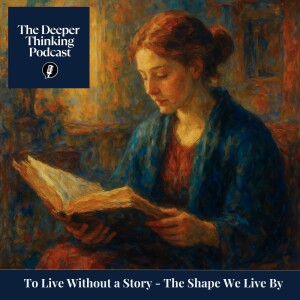
To Live Without a Story - The Shape We Live By
The Deeper Thinking Podcast
What if the stories we tell don’t just reflect the world—but shape how we live within it?
What if the stories we tell about ourselves don’t just reflect the world, but shape how we experience it? In this episode, we explore how narrative structures—from arcs to resolutions—don’t simply make sense of life, but create the conditions for how we understand time, meaning, and agency. We explore whether life follows a narrative, or whether we impose one retroactively to survive the chaos. From war memoirs to courtroom dramas, narrative functions as a deeply human framework—shaping not only our stories, but our very sense of self. This isn’t about storytelling for entertainment. It’s about the stories that make us human.
We draw on Paul Ricoeur and Alasdair MacIntyre, who remind us that stories are not mirrors, but scaffolding. But as narratives shape us, they also limit us. We ask whether the human mind can ever resist the pull to make sense of what might forever remain senseless. Are we able to dwell in uncertainty, or are we always narrating toward resolution?
Quiet references to Hannah Arendt, Martin Heidegger, and Simone Weil shape a deeper inquiry: does the narrative free us—or trap us? This is not an essay with answers. It’s an invitation to reflect on the shapes that hold us—and whether we are living inside a story we’ve chosen, or one we’ve inherited without question.
Reflections
Are our identities written through the stories we survive—or the ones we deny?
Can we resist the narrative impulse long enough to remain in ambiguity?
What is lost when chaos is overwritten with meaning too soon?
Do stories liberate us—or quietly script us?
How much of our freedom depends on the shape we live by?
Why Listen?
Consider how narrative shapes our experience of time, identity, and meaning
Explore the philosophical tension between coherence and chaos
Reflect on the function of storytelling in ethics, memory, and agency
Experience a contemplative approach that privileges inquiry over resolution
Listen On:
YouTube
Spotify
Apple Podcasts
Support This Work
If you'd like to support the ongoing work, you can visit buymeacoffee.com/thedeeperthinkingpodcast or leave a kind review on Apple Podcasts.
Bibliography
Arendt, Hannah. The Human Condition. 2nd ed. Introduction by Margaret Canovan. Chicago: University of Chicago Press, 1998.
Heidegger, Martin. Being and Time. Translated by John Macquarrie and Edward Robinson. New York: Harper & Row, 1962.
Weil, Simone. Gravity and Grace. Translated by Emma Craufurd. London: Routledge, 2002.
MacIntyre, Alasdair. After Virtue. 3rd ed. Notre Dame: University of Notre Dame Press, 2007.
Ricoeur, Paul. Time and Narrative, Volume 1. Translated by Kathleen McLaughlin and David Pellauer. Chicago: University of Chicago Press, 1984.
To live without a story is unbearable. To live by one unknowingly may be worse.
#NarrativePhilosophy #HumanCondition #Storytelling #Heidegger #Ricoeur #MacIntyre #SimoneWeil #HannahArendt #TheShapeWeLiveBy #TheDeeperThinkingPodcast
Apr 28, 2025
Apr 28, 2025
14 min
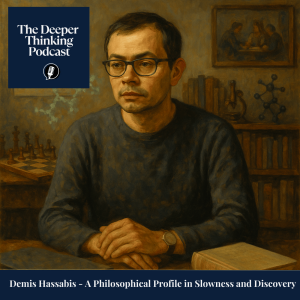
Demis Hassabis - The AI Pioneer.
The Deeper Thinking Podcast
What if the future of discovery demanded not just faster thinking, but slower seeing? In this episode, we explore the life and vision of Demis Hassabis—chess prodigy, neuroscientist, AI pioneer—and the deeper paradox he embodies: that true innovation may depend less on acceleration than on the careful cultivation of attention. From protein structures to mathematical proofs, from games of logic to the fragile architectures of meaning, Hassabis’s work asks us not simply what we can know, but whether we can remain human enough to hold what we uncover. This is not a celebration of technology. It is a meditation on what discovery requires: patience, discernment, and the refusal to collapse wonder into conquest.
Scientific progress, Hassabis reminds us, is not the smooth unveiling of new worlds. It is the slow art of inhabiting uncertainty—of learning to think differently long before we can act differently. As AI accelerates, it is the ancient human skills—attention, slowness, relational imagination—that will decide whether possibility becomes promise or peril. We trace how games trained his mind for complexity, how neuroscience taught him to trust emergence over control, and how philosophy now shadows the future he helped unleash. This isn’t an essay that offers solutions. It opens a space where solutions lose their urgency—and presence becomes the deeper aim.
With quiet references to Arendt, Heidegger, and Weil, this episode listens for the forms of wisdom that emerge only when discovery is slowed down. What happens when the machines we build move faster than our capacity to understand them? When meaning risks being outpaced by mastery? When the future demands a different kind of mind—one willing to linger, to doubt, and to dwell? This is not a race to the next breakthrough. It is a return to the older work: the slow making of minds still capable of wonder.
Why Listen?
Explore how AI is reshaping not only science but the ethics of discovery itself
Reflect on slowness, discernment, and the moral architecture of innovation
Engage with philosophical tensions around speed, presence, and meaning
Experience a relational, contemplative approach to technology and thought
Listen On:
YouTube
Spotify
Apple Podcasts
Bibliography
Arendt, Hannah. The Human Condition. 2nd ed. Introduction by Margaret Canovan. Chicago: University of Chicago Press, 1998.
Heidegger, Martin. Being and Time. Translated by John Macquarrie and Edward Robinson. New York: Harper & Row, 1962.
Weil, Simone. Gravity and Grace. Translated by Emma Craufurd. London: Routledge, 2002.
Sennett, Richard. The Craftsman. New Haven: Yale University Press, 2008.
Bergson, Henri. Creative Evolution. Translated by Arthur Mitchell. New York: Henry Holt, 1911.
Turkle, Sherry. Reclaiming Conversation. New York: Penguin Press, 2015.
Bibliography Relevance
Each work referenced here deepens the philosophical and ethical questions raised in this episode. They are not citations to decorate, but invitations to linger differently inside the tensions discovery now demands.
Hannah Arendt’s The Human Condition explores action, labor, and thought as fragile human practices that technological acceleration risks unmooring—a silent foundation beneath the essay’s call for slowness.
Martin Heidegger’s Being and Time frames existence not as something to master, but as something to dwell within—a philosophical current that quietly shapes the call for presence in discovery.
Simone Weil’s Gravity and Grace offers a meditation on attention and moral discernment as acts of resistance against force—echoing the essay’s concern for the ethics of attention in an era of speed.
Richard Sennett’s The Craftsman illuminates the relationship between patience, skill, and care in making—deepening the reflection on how discovery itself might be practiced differently.
Henri Bergson’s Creative Evolution reframes change as emergence rather than mere accumulation—supporting the essay’s vision of progress as something slower, stranger, and more relational than technological narratives often allow.
Sherry Turkle’s Reclaiming Conversation examines the erosion of deep presence in a connected world—offering a cultural echo to the essay’s philosophical call for reweaving attention and relationality in a technological era.
#DemisHassabis #ArtificialIntelligence #SlowThinking #EthicsOfAI #DeepMind #PresenceInProgress #HannahArendt #MartinHeidegger #ScientificDiscovery #DeeperThinkingPodcast
Apr 26, 2025
Apr 26, 2025
15 min
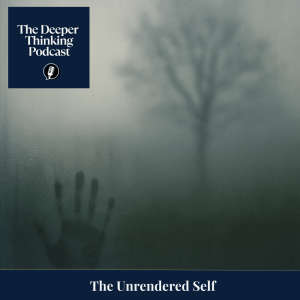
The Unrendered Self
The Deeper Thinking Podcast
What happens to the self when even absence becomes a kind of presence? In this episode, we examine the quiet erosion of identity under conditions of constant visibility. This is not about digital detox or offline escape—it’s about the deeper structural shift where reflection becomes performance, privacy becomes signal, and being becomes something that must be rendered to be real.
We explore how the self survives—or doesn’t—amid an economy of attention that cannot tolerate ambiguity. Drawing on Simone Weil’s ethics of attention, Gloria Anzaldúa’s defence of contradiction, and Roland Barthes’s concept of the neutral, the episode traces the contours of presence without performance. We also touch on Édouard Glissant’s right to opacity and Hannah Arendt’s space of appearance to imagine what it means to remain unrendered—felt but uncaptioned, real but unreadable.
This is not an elegy for privacy—it is a meditation on presence without proof. A quiet reclaiming of the unspoken, the unperformed, the unnamed self. The one who listens but does not post, who thinks but does not narrate, who exists in the opacity we are no longer taught to value.
Why Listen?
Reframe visibility and identity through the lens of attention, fatigue, and erosion
Engage with thinkers like Barthes, Glissant, Weil, and de Certeau without academic distance
Experience audio as a space of ambient intimacy and structural reflection
Consider what it means to exist without translating yourself
Listen On:
YouTube
Spotify
Apple Podcasts
Bibliography
Weil, Simone. Gravity and Grace. London: Routledge, 2002.
Glissant, Édouard. Poetics of Relation. Ann Arbor: University of Michigan Press, 1997.
Barthes, Roland. The Neutral. New York: Columbia University Press, 2005.
Arendt, Hannah. The Human Condition. Chicago: University of Chicago Press, 1998.
de Certeau, Michel. The Practice of Everyday Life. Berkeley: University of California Press, 1984.
Anzaldúa, Gloria. Borderlands/La Frontera: The New Mestiza. San Francisco: Aunt Lute Books, 1999.
Bibliography Relevance
Simone Weil: Offers a sacred attention that does not demand rendering, anchoring presence in stillness.
Édouard Glissant: Defends opacity as an ethical right, countering the demand to be always visible, always legible.
Roland Barthes: Introduces the neutral as a space of resistance to classification, performance, or capture.
Hannah Arendt: Invites reflection on how public identity emerges within a space of appearance, and what it means to disappear from it.
Michel de Certeau: Highlights the quiet subversions of everyday life—walking without mapping, speaking without broadcasting.
Gloria Anzaldúa: Centres contradiction and multiplicity as modes of authentic, unrendered being.
To be unrendered is not to vanish—but to resist conversion into content.
#AttentionEconomy #VisibilityFatigue #PhilosophyOfSelf #SimoneWeil #GloriaAnzaldúa #RolandBarthes #EdouardGlissant #HannahArendt #DeCerteau #TheDeeperThinkingPodcast #Presence #Opacity #ExistenceWithoutPerformance #AmbientIntimacy
Apr 26, 2025
Apr 26, 2025
19 min
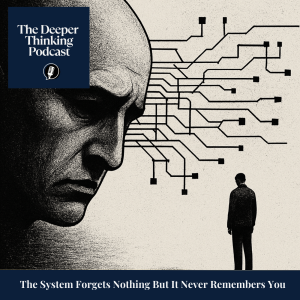
The System Forgets Nothing, But It Never Remembers You
The Deeper Thinking Podcast
A meditation on capitalism, memory, and the quiet refusal to be rendered knowable.
We live in a system that forgets nothing, but never remembers us. It tracks our movements, records our actions, and stores our data—yet the more it accumulates, the less it seems to know us. It does not recognize us as beings, but as fragments in an ever-expanding machine. In this world, alienation is not an affliction—it is the architecture.
This episode traces the silent contradiction at the heart of late capitalism—how it demands our presence while erasing our personhood. Drawing from the writings of Karl Marx, Fredric Jameson, Silvia Federici, and Bernard Stiegler, we examine how unpaid life, estranged labor, and digital extraction converge to produce not just economic inequality—but ontological displacement.
This is not a story of collapse. It is a search for interruption: moments that elude monetization, gestures that resist capture, spaces that soften rather than sort. In this episode, the act of remembering oneself—within and against the system—becomes a philosophical gesture of resistance.
Reflections
Some thoughts that surfaced in the margins:
The system doesn’t forget because it remembers—it forgets because it never knew you.
To be recognised as data is not to be remembered—it is to be rendered predictable.
Attention is political. So is memory. So is the act of feeling real in a world of proxies.
Not all gestures need to be productive. Some simply need to be felt.
Capitalism metabolises everything—except what we refuse to offer.
The smallest acts of presence might be the only unextractable currency we have left.
Why Listen?
Reframe capitalism not as an economic force—but as an ontological structure
Trace alienation as infrastructure, not just emotion
Engage with Marx, Jameson, Federici, and Stiegler on attention, memory, and unpaid life
Recognise the small, human gestures that resist extraction
Listen On:
YouTube
Spotify
Apple Podcasts
Support This Work
If you’d like to support the ongoing work, you can visit buymeacoffee.com/thedeeperthinkingpodcast or leave a review on Apple Podcasts. Thank you.
Bibliography
Marx, Karl. Economic and Philosophic Manuscripts of 1844. New York: International Publishers, 1964.
Jameson, Fredric. Postmodernism, or, The Cultural Logic of Late Capitalism. Durham: Duke University Press, 1991.
Federici, Silvia. Caliban and the Witch. New York: Autonomedia, 2004.
Stiegler, Bernard. Technics and Time, 1: The Fault of Epimetheus. Stanford: Stanford University Press, 1998.
Han, Byung-Chul. Psychopolitics. London: Verso, 2017.
Bibliography Relevance
Karl Marx: Explores alienation and the displacement of human essence under capitalism
Fredric Jameson: Frames late capitalism as a totalising cultural logic
Silvia Federici: Grounds the politics of unpaid labor in historical structures
Bernard Stiegler: Introduces technics as memory systems that displace human temporality
Byung-Chul Han: Uncovers the internalisation of control through self-optimization
To be remembered, we must first become illegible to the system that forgets nothing.
#OntologicalCapitalism #KarlMarx #FredricJameson #SilviaFederici #BernardStiegler #ByungChulHan #Memory #Alienation #Postmodernism #EstrangedLabor #CapitalismCritique #TheDeeperThinkingPodcast #SystemicForgetting
Apr 26, 2025
Apr 26, 2025
16 min
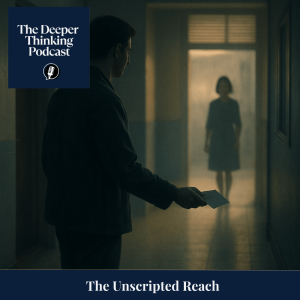
The Unscripted Reach
The Deeper Thinking Podcast
What happens when the act of reaching out becomes rarer than the connection itself? In this episode, we trace the slow disappearance of interpersonal initiation—not as a cultural lapse, but as a civilizational contradiction. Algorithms promise endless proximity, yet remove the necessity of contact. We ask what is lost when approach is replaced by performance, and what it means to risk presence in an age of optimization.
Through the lens of philosophy and lived gesture, we explore the disappearance of embodied mutuality—from Aristotle’s vision of human fulfillment in relation, to Simone Weil’s understanding of attention as generosity, and Emmanuel Levinas’s ethics of the face. We ask: how do we become, if never met? What happens to courage when friction is removed from the social field? In the absence of real-time approach, we find a loss not just of intimacy—but of ethical improvisation itself.
This is not an argument for nostalgia. It is a meditation on risk, refusal, and revelation—on the sacred awkwardness of showing up unrehearsed, and the relational art we may be forgetting how to perform.
Why Listen?
Reflect on intimacy as relational improvisation, not outcome
Understand how frictionless design impacts mutual becoming
Explore quiet allusions to Aristotle, Weil, Levinas, Badiou, and Byung-Chul Han
Reconsider the ethics of hesitation, awkwardness, and approach
Listen On:
YouTube
Spotify
Apple Podcasts
Bibliography
Agamben, Giorgio. The Coming Community. Trans. Michael Hardt. University of Minnesota Press, 1993.
Aristotle. The Politics. Trans. Benjamin Jowett. Dover Publications, 2000.
Badiou, Alain. In Praise of Love. Trans. Peter Bush. The New Press, 2012.
Baudrillard, Jean. Simulacra and Simulation. Trans. Sheila Faria Glaser. University of Michigan Press, 1994.
Buber, Martin. I and Thou. Trans. Ronald Gregor Smith. Scribner, 1970.
Byung-Chul Han. The Transparency Society. Trans. Erik Butler. Stanford University Press, 2015.
Foucault, Michel. Discipline and Punish. Trans. Alan Sheridan. Vintage Books, 1995.
Kierkegaard, Søren. The Present Age. Trans. Alexander Dru. Harper Torchbooks, 1962.
Levinas, Emmanuel. Totality and Infinity. Trans. Alphonso Lingis. Duquesne University Press, 1969.
Nietzsche, Friedrich. The Gay Science. Trans. Walter Kaufmann. Vintage Books, 1974.
Nietzsche, Friedrich. Thus Spoke Zarathustra. Trans. R.J. Hollingdale. Penguin Books, 2003.
Scarry, Elaine. The Body in Pain. Oxford University Press, 1985.
Stiegler, Bernard. Technics and Time, 1. Trans. Richard Beardsworth and George Collins. Stanford University Press, 1998.
Turkle, Sherry. Alone Together. Basic Books, 2011.
Weil, Simone. Gravity and Grace. Trans. Emma Craufurd. Routledge, 2002.
Weil, Simone. Waiting for God. Trans. Emma Craufurd. Harper Perennial Modern Classics, 2009.
Zuboff, Shoshana. The Age of Surveillance Capitalism. PublicAffairs, 2019.
When initiation disappears, contact becomes content. But what becomes of the human in the absence of risk?
#Presence #Attention #Hesitation #PhilosophyOfRelation #Buber #Weil #Levinas #Optimization #Improvisation #TheDeeperThinkingPodcast #UnscriptedReach #Friction #EthicsOfDialogue #DigitalIntimacy
```
Apr 25, 2025
Apr 25, 2025
16 min
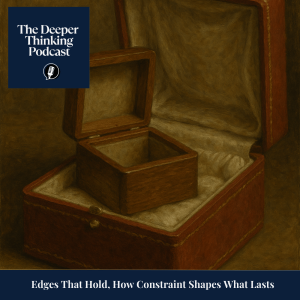
Edges That Hold: How Constraint Shapes What Lasts
The Deeper Thinking Podcast
What if the moments that stay with us didn’t arise from freedom, but from its absence? This episode explores how material, emotional, and structural constraint can become the shape of expression itself.
We trace this paradox through a child’s treehouse, the tape hiss in Daniel Johnston’s basement recordings, the quiet of Agnes Martin’s grids, and the undeveloped rolls left behind by Vivian Maier. These are not stories of overcoming adversity. They are devotions to the form that holds. Constraint here is not failure—it’s fidelity.
The conversation threads through Simone Weil on attention as moral act, Marshall McLuhan on form becoming message, Gaston Bachelard on poetic space, and Jean-Paul Sartre on situated freedom. From minimalist sound to photographic silence, from domestic labor to the unseen archive, this episode listens for the work that doesn’t transcend its frame—but honours it.
Why Listen?
Reframe constraint as creative condition, not limitation
Encounter artists whose work is inseparable from what they lacked
Explore the ethics of form, silence, and minimal presence
Engage thinkers from Martin to Maier, Johnston to Bachelard
Listen On:
YouTube
Spotify
Apple Podcasts
Bibliography
Bachelard, Gaston. The Poetics of Space. Boston: Beacon Press, 1994.
Maier, Vivian. Vivian Maier: Street Photographer. New York: powerHouse Books, 2011.
Martin, Agnes. Writings. Ostfildern: Hatje Cantz, 2005.
McLuhan, Marshall. Understanding Media: The Extensions of Man. Cambridge: MIT Press, 1994.
Sartre, Jean-Paul. Being and Nothingness. Translated by Hazel Barnes. New York: Washington Square Press, 1993.
Weil, Simone. Gravity and Grace. Translated by Emma Craufurd. London: Routledge, 2002.
Bibliography Relevance
Gaston Bachelard: Frames space as poetic rather than merely architectural—constraint as imaginative ground.
Simone Weil: Recasts attention as ethical form—constraint as devotion.
Marshall McLuhan: Asserts that medium is not neutral—constraint shapes content itself.
Jean-Paul Sartre: Links freedom not to choice but to situated responsibility—constraint as condition of agency.
Sometimes what lasts is not what breaks free—but what stays still, within its edges.
#Constraint #AgnesMartin #VivianMaier #DanielJohnston #Bachelard #SimoneWeil #McLuhan #Sartre #PoeticsOfSpace #CreativeLimitations #Minimalism #TheDeeperThinkingPodcast #EthicsOfForm #ArtAndSilence #PhilosophyOfConstraint
Apr 24, 2025
Apr 24, 2025
7 min
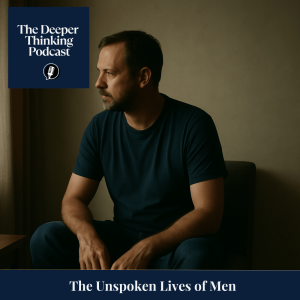
The Unspoken Lives of Men
The Deeper Thinking Podcast
What does it mean to witness a masculinity that doesn’t perform? And how do we make space for forms of strength that don’t announce themselves? Drawing from the relational ethics of bell hooks and the radical attentiveness of Simone Weil, this episode listens for what emerges when masculine identity is neither defended nor performed—but allowed to soften.
This is not a critique of men, nor a celebration of them—it is an invitation to witness what remains unspoken. From the disorientation that follows when the cultural scripts no longer fit, to the quiet dignity of those who choose presence over posture, we ask: what does liberation sound like when it doesn’t shout? How might silence itself be a form of love?
Engaging with the feminist thought of Sara Ahmed and Amia Srinivasan, and the border-thinking of Gloria Anzaldúa, the episode traces how disenfranchised masculinity is not the absence of power, but the quiet space where new ways of being begin to form. We pay attention to not-knowing—not as weakness, but as a kind of ethical presence.
For anyone questioning what it means to be a man in a world where performance is no longer enough, this episode is a meditation on restraint, vulnerability, and the strength that does not seek applause.
Why Listen?
What happens when the scripts for being a man no longer fit
Why not-knowing can be a new kind of presence
The emotional terrain of disenfranchised masculinity
How thinkers like hooks, Weil, Srinivasan, Ahmed, and Anzaldúa expand the conversation around love, masculinity, and care
Listen On:
YouTube
Spotify
Apple Podcasts
Bibliography
hooks, bell. The Will to Change: Men, Masculinity, and Love. New York: Washington Square Press, 2004.
Weil, Simone. Gravity and Grace. Translated by Emma Craufurd. London: Routledge, 2002.
Ahmed, Sara. Living a Feminist Life. Durham: Duke University Press, 2017.
Srinivasan, Amia. The Right to Sex: Feminism in the Twenty-First Century. New York: Farrar, Straus and Giroux, 2021.
Anzaldúa, Gloria. Borderlands/La Frontera: The New Mestiza. San Francisco: Aunt Lute Books, 1999.
Bibliography Relevance
bell hooks: Connects masculinity to love and liberation as intertwined forces.
Simone Weil: Reframes attention as a devotional act—core to witnessing.
Sara Ahmed: Tracks the affective politics of gendered life and refusal.
Amia Srinivasan: Pushes the boundaries of consent, power, and gendered norms.
Gloria Anzaldúa: Opens a space for hybrid identities and new modes of belonging beyond masculine borders.
What if the strongest thing a man could do—is not to act, but to stay?
#Masculinity #bellhooks #SimoneWeil #Feminism #Care #Attention #Gender #Anzaldúa #TheDeeperThinkingPodcast #Liberation #DisenfranchisedMasculinity #NotKnowing #Presence #Love
Apr 24, 2025
Apr 24, 2025
21 min
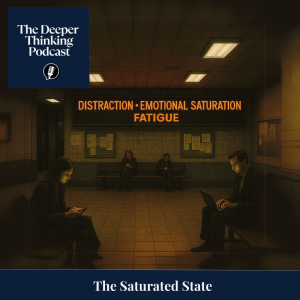
The Saturated State: Mood, Consent, and the Performance of Power
The Deeper Thinking Podcast
We are governed not by force alone, but by saturation—of noise, of image, of pace. This episode explores how distraction, emotional overload, and political fatigue are not accidents of the moment but tools of governance. It asks what happens when democracy becomes aesthetic, memory becomes unstable, and speech becomes calibration rather than expression.
Power today no longer declares. It performs. Drawing on the work of Byung-Chul Han, who examines the psychic toll of hyper-visibility, and Lauren Berlant, who identifies the slow erosion of public optimism, this episode explores how governance now operates atmospherically—through mood, through rhythm, and through exhaustion.
With Mark Fisher’s critique of capitalist realism and Simone Weil’s notion of attention as moral discipline, we ask what it means to hold shape when institutions collapse inward. What forms of refusal remain in a world saturated not by fear, but by feeling?
Why Listen?
Understand how emotion, repetition, and pace are used as instruments of governance
Engage with the concept of saturation as political atmosphere, not just media effect
Examine how aesthetic forms can erode civic agency and public optimism
Learn how thinkers like Han, Berlant, Fisher, and Weil reframe attention as resistance
Listen On:
YouTube
Spotify
Apple Podcasts
Bibliography
Berlant, Lauren. Cruel Optimism. Durham, NC: Duke University Press, 2011.
Fisher, Mark. Capitalist Realism: Is There No Alternative? Winchester, UK: Zero Books, 2009.
Han, Byung-Chul. The Burnout Society. Stanford, CA: Stanford University Press, 2015.
Weil, Simone. Gravity and Grace. Translated by Emma Crawford and Mario von der Ruhr. London: Routledge, 2002.
Bibliography Relevance
Lauren Berlant: Grounds the concept of “cruel optimism” as a lens for understanding emotional governance
Byung-Chul Han: Frames transparency and hyper-communication as coercive norms of contemporary life
Mark Fisher: Diagnoses the psychic effects of neoliberal realism as cultural saturation and inertia
Simone Weil: Offers attention as an ethical stance, enabling resistance through care and perception
To endure saturation is not to escape it, but to find new rhythms beneath it. Resistance, here, is a way of listening.
#GovernanceByMood #Berlant #ByungChulHan #CapitalistRealism #SimoneWeil #TheDeeperThinkingPodcast #AestheticPower #EmotionalOverload #Philosophy #AttentionAsResistance
Apr 24, 2025
Apr 24, 2025
18 min
Come Home to Yourself: Boundaries, Burnout, and the Rhythm of Return
The Deeper Thinking Podcast
What does it mean to return to yourself—not as a goal, but as a rhythm? This episode is a translation of an inner voice: the one that waits beneath survival, beyond performance, under the noise. It doesn’t instruct. It doesn’t explain. It listens. And when we listen back, something begins to soften.
Drawing on the emotional textures of slow growth, quiet resistance, and relational repair, we explore how healing isn’t a triumph but a return. We question clarity as a requirement, challenge motivation as a moral standard, and examine how joy, pain, and presence can coexist without apology.
With echoes of Brené Brown, Sara Ahmed, and Pádraig Ó Tuama, this episode isn’t here to tell you what to feel. It’s here to keep you company while you feel it. No fixing. No striving. Just a steady invitation back to the truth beneath it all.
Why Listen?
For a companionable, poetic audio essay that moves at the speed of breath
To explore how boundaries, belonging, and burnout intertwine with care
To learn how to live from softness without collapsing
To feel reminded—not instructed—of what’s already true in you
Listen On:
YouTube
Spotify
Apple Podcasts
Further Reading
Ahmed, Sara. Living a Feminist Life. Durham: Duke University Press, 2017.
Anzaldúa, Gloria. Borderlands/La Frontera: The New Mestiza. 4th ed. San Francisco: Aunt Lute Books, 2012.
Weil, Simone. Gravity and Grace. Translated by Emma Crawford and Mario von der Ruhr. London: Routledge, 2002.
Bibliography Relevance
Sara Ahmed: Explores the politics and ethics of emotion, embodiment, and care, anchoring the episode’s refusal of emotional instruction.
Gloria Anzaldúa: Offers a framework for inner multiplicity and border-being, underscoring the porousness of personal return.
Simone Weil: Centers attention as an act of love, framing presence and listening as sacred disciplines rather than performative acts.
Not all healing requires movement. Some asks you to stay—gently, faithfully—with yourself.
#Burnout #Boundaries #Healing #Softness #SaraAhmed #GloriaAnzaldúa #SimoneWeil #PhilosophyOfCare #Attention #EmotionalEthics #TheDeeperThinkingPodcast #Gentleness #Return #Companionship #Presence