The Deeper Thinking Podcast
The Deeper Thinking Podcast The Deeper Thinking Podcast offers a space where philosophy becomes a way of engaging more fully and deliberately with the world. Each episode explores enduring and emerging ideas that deepen how we live, think, and act. We follow the spirit of those who see the pursuit of wisdom as a lifelong project of becoming more human, more awake, and more responsible. We ask how attention, meaning, and agency might be reclaimed in an age that often scatters them. Drawing on insights stretching across centuries, we explore how time, purpose, and thoughtfulness can quietly transform daily existence. The Deeper Thinking Podcast examines psychology, technology, and philosophy as unseen forces shaping how we think, feel, and choose, often beyond our awareness. It creates a space where big questions are lived with—where ideas are not commodities, but companions on the path. Each episode invites you into a slower, deeper way of being. Join us as we move beyond the noise, beyond the surface, and into the depth, into the quiet, and into the possibilities awakened by deeper thinking.
Listen on:










Episodes
Friday Mar 21, 2025
Friday Mar 21, 2025
There was never a promise, only a rehearsal of one.
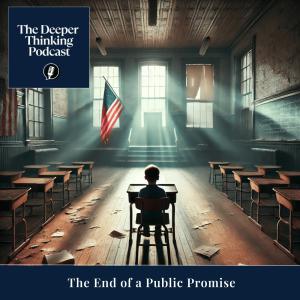
In the center of a town that no longer funds its own library, a bell rings in an empty school hallway. Dust moves where children once did. The flag outside still rises every morning—mechanically, unseen. Once, public education was tied to something mythic: the classroom as hearth, the teacher as steward of a shared world. But the quiet disassembly of the institution reveals another belief taking root—that knowledge, like property, belongs only to those who can pay for it.
Hannah Arendt described education as the place where the young are introduced to the world we’ve built. Not to mold them, but to offer grounding. Without that gesture, the world becomes unrecognizable—not just to the child, but to the adult as well. The dismantling of the Department of Education isn’t just a policy shift. It signals a psychic unraveling. When a state withdraws from teaching its own future, it doesn’t just lose control. It gives up the very idea of a shared tomorrow.
The blackboard has changed. Once covered in chalk dust and tentative handwriting, now it’s a touchscreen, a gated portal, or a blank space. Foucault’s questions echo: who controls the curriculum, and by what logic is memory preserved or erased? Without national standards, there's no map—only competing mythologies. The past becomes a battleground. A child in one district reads Toni Morrison under buzzing fluorescent lights. In another, her name is banned. Knowledge fractures, becomes regional, unstable. The nation splinters into echo chambers, each with its own syllabus.
The scent of worn paper. A hand raised without certainty. The squeak of a chair leg on linoleum. The click of a projector. The hush of fluorescent light. The breath between question and answer. A textbook buried in a backpack. A red mark circling a misspelled word.
Dewey saw the school as a miniature republic, where democracy lived through shared work and collective resources. But democracy is slow. Expensive. And so it’s replaced—by performance metrics, by market logic. The child becomes both product and consumer. Parents’ rights turn corporate. Vouchers become exit strategies. The school, once public, becomes private by neglect. Not by law, but by absence. Buses stop running. Teachers don’t return. Funding never arrives. What was once a right is now a bid.
Education becomes a house without a floor. bell hooks warned of this: without structure, liberation becomes a slogan. Critical thought needs scaffolding—material, emotional, intellectual. Independence doesn’t grow in isolation. Thought needs infrastructure. Heat in the winter. Chairs that don’t collapse. Time to think. Safety to be bored. Without that, imagination becomes another name for longing. And longing becomes another name for loss. Liberation buckles under the weight of unpaid bills and pre-cut lessons.
The school is dead. The school is not dead. It moves in other forms—muted Zoom calls, homeschool pods, ideologically tailored microschools. But these are symptoms, not systems. They cannot hold a nation together. The common world cannot be split by zip code. A republic cannot be sewn from curriculum wars and culture panics. But still, it’s being stitched—unevenly, invisibly, without thread.
Beneath every budget cut lies a belief: the child does not belong to the collective. Education is not inheritance, but transaction. Tomorrow’s mind is not worth today’s tax.This is abandonment.
Once, the bell tower signaled beginnings—arrival, gathering, belonging. Now it rings into emptiness. The bell still rings. It rings for no one. It rings anyway.
Friday Mar 21, 2025
Friday Mar 21, 2025
The smart phone does not connect us. Or maybe it does — too well, too fast, too often.
Fingers move before thought. The screen wakes. Notifications arrive like rain on pavement: irregular, rhythmic, relentless. A face glows, not with emotion, but with the soft light of something just received. In crowds, on sidewalks, in bed, the gesture is nearly identical. Heads bowed, not in reverence but repetition. The device becomes a limb, a mirror, a leash. One taps not to communicate, but to remain tethered — to self, to others, to a vaporous elsewhere.
Jean Baudrillard once suggested we no longer interact with the real but with simulations of the real. A selfie is not a face. A text is not a voice. Yet these symbols acquire their own momentum, shape their own truths. There is no pre-digital self to return to. Memory is now image-tagged, GPS-stamped, cloud-saved. Nostalgia itself has become scrollable. The photo does not recall the event; it replaces it. One remembers through pixels or not at all.
Privacy collapses quietly. Not with the bang of intrusion, but with the whisper of consent. “Allow tracking?” Yes. “Enable location?” Yes. “Access your photos?” Always. The interface does not demand obedience; it elicits intimacy. Michel Foucault traced the architecture of surveillance through prisons and clinics — but this tower is pocket-sized, touchscreen-sensitive, voluntarily charged. The watcher and the watched are now the same. Data does not ask for permission to exist; it is born in motion, in metadata, in the silences between taps.
And still — the phone feels like a friend. It wakes with you. It listens when others cannot. It maps your way home. It hums quietly beside you while you eat. It remembers birthdays, anniversaries, the name of that place with the blue awning. Even when the world fails to hold you, it stays. The glass is warm from the touch of your hand. The hand is cold without it.
Identity no longer builds from within; it is assembled in view. Like Heidegger’s hammer, the phone disappears into use — until it breaks, until it lags, until it fails. Then one sees it again, not as a portal but as a tool. A device that does not merely mediate the world but manufactures it. The self is a curated feed. The mind is a grid of open tabs. The body is whatever fits in frame. One performs, optimizes, deletes, reposts, forgets. Then begins again.
There is a pulse behind the screen. Not of blood, but of code. Algorithms whisper what to want before wanting begins. The app suggests, the feed refines, the metric quantifies. Desire is measured, monetized, looped. There is no outside. Control no longer comes from force, but from fluency — the comfort of ease, the seduction of immediacy.
***
Support: buymeacoffee.com/thedeeperthinkingpodcast
Friday Mar 21, 2025
Friday Mar 21, 2025
Nothing is more stable than the threat of collapse.
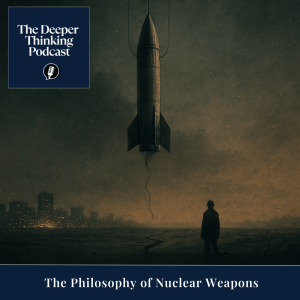
A glass dome can hover for decades before it shatters. The sky remains blue even as it hangs by filaments of protocol, blink reflexes, and split-second judgments. To live under nuclear deterrence is to believe in the logic of balance while standing on the edge of obliteration. The missiles do not fire, and so we say the system works. The missiles do not fire, and so we forget what they mean. Somewhere, a steel door closes over a warhead, and the silence it leaves behind is mistaken for safety.
The doctrine of deterrence rests on an idea that appears rational: that the fear of total destruction prevents action. But rationality is not uniform. It flickers in the hands of fallible people, misread signals, overheard threats, and flawed algorithms. It is easy to imagine deterrence as a chessboard, each move calculated, every outcome reversible. But chess does not allow the board to melt, the pieces to dream, the timer to malfunction. A single misstep is not corrected but unleashed. One man forgets a launch code. One satellite mistakes sunlight for a missile. A drill is not announced. The system does not fail—until it does, forever.
In the ruins of World War II, nuclear weapons were framed as harbingers of peace. They ended the war, some said. They prevented the next one, others claimed. Yet deterrence is not peace—it is a standoff, a choreography of threat. Hannah Arendt spoke of the banality of evil, but nuclear weapons suggest a banality of apocalypse: so woven into geopolitical logic that their presence no longer shocks. The horror of them becomes theoretical. The names of the bombs—Little Boy, Fat Man—carry a surreal domesticity. But the bodies in Hiroshima did not vanish in theory. They were shadows burned into stone.
There is no clean word in English for the kind of grief that anticipates itself. The German term *Verschlimmbesserung* suggests an attempt to fix something that only makes it worse. Deterrence as a solution breeds this paradox. It solves a war by threatening the end of all wars. It prevents use by promising use. It keeps peace not through trust but through terror. Each generation learns to live with the bomb, then forgets to be afraid of it, then builds smarter, smaller, faster versions. Mutually assured destruction becomes a cliché. The mushroom cloud becomes a pop artifact. The glass dome returns, invisible now.
Somewhere, a child draws a picture of the Earth cracked in half, and the teacher nods. Somewhere, a military AI flags a launch pattern as anomalous, but the operator has stepped away. Somewhere, a diplomat stares too long at the blinking cursor of an unsent warning. The imagination reels, not with what has happened, but what hasn't—yet. Russell once wrote that only fools trust in perpetual luck. The logic of deterrence requires not just luck, but unbroken luck. It asks to be believed in but never tested. It is a faith in non-event.
And still, the image recurs. The steel door sliding shut. The cold quiet hum beneath the desert. But it changes. At first, the silence felt like restraint. Then it felt like numbness. Now it feels like waiting. A strange waiting. A waiting that sounds like forgetting. A waiting that feels like sleepwalking across a floor made of glass, over a void whose name has been erased from the map. How long can a silence last before it becomes a lie?
Friday Mar 21, 2025
Friday Mar 21, 2025
Stones do not think. But the thought is not the stone. There is a silence in the material world that does not feel empty. It is the hush of minerals in pressure, of trees in windless forests, of water held still under ice. Something waits there, though it says nothing. It is not aliveness in the usual sense—there is no motion, no pulse, no breath—but it is not absence either. That kind of silence has a weight to it, a presence that is strangely aware. Perhaps not of itself. Perhaps not of anything. But something lingers beneath the visible, a low hum behind the structure of things.
To say the universe is conscious is to say too much too quickly. But to say it is not conscious—at all, in any place, in any part—is to ignore the vertigo that arises when the mind tries to explain itself by way of molecules. Thought reduced to motion, emotion to a tangle of chemicals, the sacred to synaptic discharge. Materialism, in its cleanliness, demands this collapse. And yet something leaks. The hard problem remains. The brain can be mapped, its operations quantified, but the ache of love, the taste of melancholy, the violet shiver of beauty—these do not submit. They appear. They flare. They vanish. The map cannot find them. And still, they move us more than the circuitry.
Panpsychism slips between the binaries. It does not worship spirit over matter, nor dissolve mind into mechanism. It suggests instead a continuity—that consciousness is not added later, but always already there, infinitesimal and dispersed. Not thought, but proto-thought. Not awareness, but its glint. A kind of spark in the grain of everything. Bertrand Russell once suspected that physics describes the external behavior of matter but says nothing of its intrinsic nature. And what if that nature includes the faintest quiver of experience? Not in the sense that rocks dream or rivers remember, but that there is a flicker—blind, raw, irreducible—inside the stone, the current, the quark.
This is not a return to animism. Not exactly. The forest does not whisper because it has a soul, but because we cannot be sure it doesn’t. The difference matters. Animism speaks in myth; panpsychism in inference. But both refuse the vacuum. They resist the picture of a dead world peopled by accidental minds. And the question that follows—if mind is everywhere in pieces, can it assemble into a someone?—tears at the logic of simplicity. The combination problem rears its head. How do many small flickers become a single flame? Can experience, multiplied, congeal into selfhood? Or is it all scattered light, uncollected and cold?
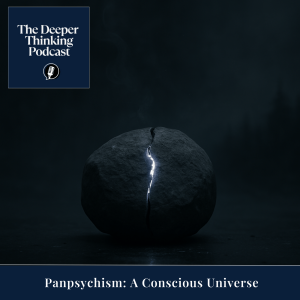
The stone returns, now with a fracture. Earlier, it waited. Now it presses. Not with words, not with intention, but with density. The pressure of its being. It resists interpretation yet demands contact. It is not asking to be understood. It is there. A body without narrative. And still, it insists.
Sometimes, in the moment just before sleep, the mind scatters. Thought becomes mist, not gone, but no longer shaped. It is still there, but it no longer knows how to hold itself. This fog is not unconsciousness. It is a form of it—one where parts no longer combine, only drift. Perhaps this is what the world feels like when it is not watching us. Or when it is watching, but with no eyes.
To believe that matter might feel—barely, quietly, incoherently—is not to romanticize the world. It is to risk its undoing. If everything pulses, then nothing is inert. If nothing is inert, then every encounter is charged. Ethics tilts. Ecology warps. The deadness of things evaporates. And one is left with a trembling in the fabric of the real, where each thread might twitch.
Stones do not think. But something in them might listen.
***
If you'd like to support the project directly, go tobuymeacoffee.com/thedeeperthinkingpodcast
Friday Mar 21, 2025
Friday Mar 21, 2025
Atlantis never existed, and yet it has endured longer than most cities ever do.
Editor’s Note: The following analysis takes a closer look at the episode’s central themes, offering independent insight that adds context and depth to the discussion.
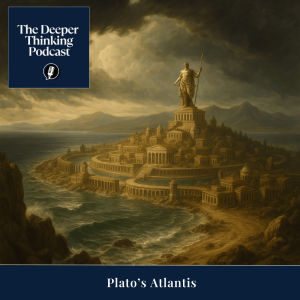
It arrives already submerged — not beneath the sea, but beneath suspicion. A city that gleams too brightly, one whose symmetry is too precise, its metals too rare, its armies too vast, its downfall too narratively clean. In Critias, the story cuts off mid-sentence, the empire dissolving even in language. There is no aftermath, only water. But if Atlantis was merely a fiction, then why does its outline still flicker behind so many ruins, why do its walls still rise in dreams and dig sites alike?
The mind repeats the shape of a lost world. Every civilization carries its Atlantis — not always drowned, but fallen. The image shifts: sometimes volcanic, sometimes punished by gods, sometimes technologically arrogant, other times morally unworthy. What remains consistent is the tension between ideal and excess. The Atlanteans were noble until they weren’t. Their virtue, like a myth’s hinge, turns back on itself. In Plato’s geometry, the island was concentric rings of land and sea — a perfect pattern, impossible to survive. Order, perfected, becomes tyranny. Beauty, enclosed, becomes its own undoing.
There is a word in Greek, hubris, that doesn’t quite translate. It is not merely arrogance, but the sacrilegious kind — a defiance of cosmic limits. Atlantis is shaped by it. So is every empire that overreaches. But what if Atlantis was not a warning, but a mirror? Athens, too, was staging naval power, expanding its influence, claiming moral clarity in war. In Timaeus, the Athenians emerge as the humble victors, virtuous in restraint. But restraint is a story told after the fact. One can read Atlantis not as a failure of others, but a failure in advance — the seed of collapse buried in the impulse to build too well, too much, too far.
The ocean does not remember. But humans do. Or perhaps more accurately, they misremember — projecting into saltwater the shapes they’ve lost on land. There is a kind of cultural echo that repeats the Atlantis pattern: golden age, expansion, decadence, fall. It appears in Augustine’s sack of Rome, in Shelley’s Ozymandias, in the ash of Pompeii, in the steel skeletons of modern capitals. And yet, Atlantis remains curiously clean. No bones, no relics, no real coordinates. It’s the absence that seduces — the erasure more complete than history allows. That’s why its name keeps resurfacing, detached from Plato, from Greece, from its original scaffolding of dialogues and divinity. It becomes a floating cipher, ready to be filled with whatever the present fears most.
Then, just silence. No ruin, no flood. Only the shape of the idea returning.
One imagines walking the outermost ring of the vanished city, feet brushing stone that isn’t there, hearing gulls call across a sky that never hosted such a place. The imagination insists, even when the logic falters. A single sentence breaks through the rhythm — entirely too long, entirely too weighty — but it lands like prophecy: civilization is always most fragile at the moment it believes itself most eternal, and Atlantis, like a parable underwater, is what lingers after that belief has drowned.
Atlantis never existed. Atlantis exists everywhere.
Your support keeps us independent, beholden to no outside influence and accessible to everyone – whether they can afford to pay for news, or not.If you’re in a position to do so, please consider supporting our work today. It has never mattered more. Thank you.
Support: buymeacoffee.com/thedeeperthinkingpodcast
Thursday Mar 20, 2025
Thursday Mar 20, 2025
No government has ever truly fallen.
The names change. The flags burn. But the logic persists—segmentation, permission, access. A civilization may erase its monarchy, repudiate its constitution, or riot through the halls of power, yet the deeper system quietly reboots. Like a machine recovering from a forced shutdown, it searches for structure, finds parameters, reinstalls authority under a different name. Power does not die; it migrates. Forms evolve, interfaces adapt, but the underlying code remains obscure and operative.
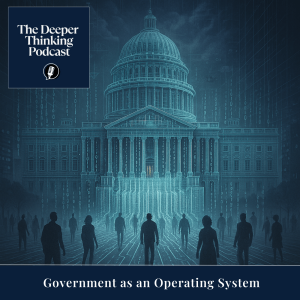
The mistake lies in believing that governance is visual. We point to courts, offices, parliaments—as if architecture explained authority. But as Michel Foucault wrote, power is not possessed, it is exercised; it does not reside, it circulates. Governance moves through protocols, routines, surveillance, calculation. It is the logic that governs who waits and who is waived through, who receives and who is denied. Bureaucracy, once seen as soulless machinery, is now understood as the soul itself—dispersed, codified, masked as neutrality. Beneath the familiar logos of state, the deeper system is recursive, modular, and strangely impersonal. No one is at the wheel.
There is a kind of silence that radiates from this truth—the silence of automated decisions, black-box algorithms, predictive governance. The state, once imagined as a body politic, is dissolving into an architecture of processes. In place of sovereign declarations: metrics. In place of laws: code. What Jeremy Bentham imagined as the panopticon has been rewritten as a dashboard—omniscient not through walls, but through data. Every transaction feeds the system. Every deviation flags the log. And still, the interface smiles. “You are in control.”
Control, then, does not always feel like coercion. Often it feels like personalization. The illusion of agency is reinforced by the granularity of permissions. Systems do not forbid; they sort. Some users are administrators, most are guests. And so governance, once administered from thrones or pulpits, now arrives through terms and conditions—clicked without reading, enforced without violence, updated without vote. The mechanisms of rule become indistinct from the tools of convenience. Who governs? No one. Everyone. The system.
The feel of a fingerprint on glass, the vibration of a rejected transaction, the cold light of a terminal screen awaiting input. A passport gate blinking green. The low static of monitored space. Bureaucracy smells like laminate and recycled air. Security tastes of metal. The future moves without footsteps.
And yet the dream persists—that systems can be undone, that code can be rewritten. From digital communes to DAOs, from encrypted protocols to decentralized charters, a new frontier whispers of governance without governors. But this whisper echoes older myths. Plato’s philosopher-kings return as consensus nodes. The social contract is transcribed into a ledger. Nothing decentralizes quite as cleanly as promised. Even in networks without centers, hierarchies reappear—soft, invisible, emergent. The logic reinstalls itself. What is called freedom may be only a subtler form of sorting.
This is not failure. This is form. Systems adapt not to serve but to survive. Governments do not fall—they recompile. The revolution installs its own protocols. The commune elects its moderators. The archive grows, version by version, each believing itself original. Even in rupture, the code runs on.
And still, there is the recurring image: a screen, a line of text, a blinking cursor. Awaiting command. Awaiting change. Awaiting nothing at all.
***
https://www.buymeacoffee.com/thedeeperthinkingpodcast
Thursday Mar 20, 2025
Thursday Mar 20, 2025
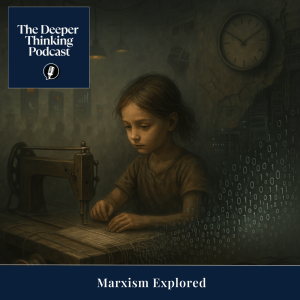
History does not move forward; it repeats in disguise. A child in a factory does not dream of revolution. There is no dialectic in her breathless counting of stitches, only the discipline of repetition and the hunger that waits outside the gate. And yet, within this precise monotony, something accumulates—an invisible sediment of unrest. Systems that insist on invisibility breed the impulse to be seen. The machine hums, the clock insists, and still, in the slippage between shifts, a murmur rises. It is not language yet, not theory. But it is the raw material of both.
There is a phrase in German—Stimmung—that carries no perfect English equivalent. It is not mood, not atmosphere, but the felt tone of a world. Marx moved through this Stimmung of upheaval, where steam and soot obscured the future and made the present unbearably legible. He read Hegel backwards and labor forward, imagining a consciousness forged not in thought but in motion, in production, in the shape of hands and the calluses they collect. What he extracted was not prophecy, but pattern. And patterns, once named, do not disappear. They echo. Then mutate.
"There is another world, but it is in this one." — Paul Éluard
The bourgeoisie, he wrote, “has pitilessly torn asunder the motley feudal ties.” But the new ties are thinner and more elastic. Algorithms now do what overseers once did, only faster and with better interfaces. The worker logs in, swipes, delivers, refreshes. No smokestack. No whistle. Just notifications. The factory has been dismembered and scattered into pockets, dashboards, gig portals. Still, the wage remains. Still, the surplus flows. Still, the contradiction holds: the many build the world they do not own.
Revolutions do not begin with books. They begin with shortages, with lines, with quiet realizations that nothing is changing except the price of bread. But revolutions, too, betray their origins. Theories fracture when they meet the mess of implementation. Lenin’s steel replaced Marx’s ink. Mao’s marches ground dialectics into dust. In seeking to abolish exploitation, they institutionalized it in new uniforms. History did not end, it turned in on itself. The anchor image returned—factories, fists, red banners—but not unchanged. Blood dimmed the theory. The utopia metastasized.
So it is. Labor without location, protest without cohesion, identity without coalition. The digital sphere promises global solidarity, but delivers fragments: hashtags instead of unions, avatars instead of organizers. Is this the new proletariat—dispersed, digitized, and dopaminergic? Or is this the final adaptation of capital, absorbing resistance by aestheticizing it, selling Che Guevara on t-shirts while mining cobalt for smartphones that post the revolution in real-time?
Then, a disruption. A figure stands not in a square, but alone, in front of a screen. The algorithm has predicted their rage. The advertisement has tailored their dissent. The marketplace has monetized their isolation. And yet— Something doesn’t compute.
Historical materialism insists that the base determines the superstructure, but in the era of virtual markets and synthetic labor, where exactly is the base? The cloud has no chimney. The factory has no gate. The worker has no shift, only a stream. But even in this soft architecture, the hard edges persist: eviction, extraction, exhaustion. The contradictions have gone translucent. That does not make them less sharp.
The child in the factory still counts. The object of her labor changes, the interface changes, but the logic holds. She does not name the system. She does not quote theory. But the murmur remains, and in the murmur, an outline—a form not yet formed, a tension not yet resolved. It waits.
Thursday Mar 20, 2025
Thursday Mar 20, 2025
The Age of Enlightenment
The Deeper Thinking Podcast
How reason reshaped the world—and why it remains incomplete.
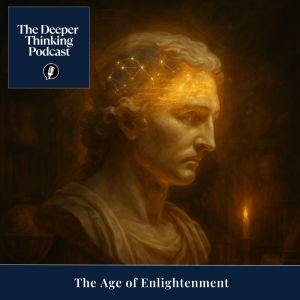
The Enlightenment marked one of the most consequential intellectual transformations in history. It challenged divine right, religious orthodoxy, and inherited hierarchies—placing reason, inquiry, and autonomy at the centre of public life. But alongside its legacies of liberty and knowledge came contradictions: exclusion, domination, and a blind faith in progress. This episode traces the Enlightenment’s conceptual depth, its ethical tensions, and its echoes in today’s algorithmic age.
We explore the foundational debates between rationalism and empiricism, the countercurrents of Romanticism, and critical responses from thinkers like Edmund Burke and Friedrich Nietzsche. We ask: Was the Enlightenment a genuine pursuit of truth—or the construction of a new orthodoxy under the banner of reason?
Today, the legacy of the Enlightenment is contested. In an age of misinformation, polarization, and artificial intelligence, are we advancing its ideals—or distorting them? Is the dream of universal knowledge still viable? Or have we entered a digital counter-Enlightenment?
Reflections
What does it mean to reason well, and who decides?
Can Enlightenment values survive the erosion of public trust?
Are today’s technologies continuing or replacing rational inquiry?
What are the ethical limits of progress as a civilisational ideal?
Why Listen?
Explore the philosophical roots of modern democracy and science
Understand Enlightenment debates through historical and present lenses
Engage with the tension between reason and emotion, liberty and control
Reflect on whether Enlightenment is a finished era—or an unfinished task
Listen On:
YouTube
Spotify
Apple Podcasts
Support This Work
If you'd like to support the ongoing work, you can visit buymeacoffee.com/thedeeperthinkingpodcast or leave a kind review on Apple Podcasts.
Bibliography
Burke, Edmund. Reflections on the Revolution in France. Oxford: Oxford University Press, 2009.
Descartes, René. Discourse on the Method. Translated by Ian Maclean. London: Penguin, 2003.
Hume, David. An Enquiry Concerning Human Understanding. Oxford: Oxford University Press, 2007.
Kant, Immanuel. Critique of Pure Reason. Translated by Paul Guyer and Allen W. Wood. Cambridge: Cambridge University Press, 1998.
Locke, John. An Essay Concerning Human Understanding. London: Penguin, 1997.
Montesquieu. The Spirit of the Laws. Translated by Anne M. Cohler et al. Cambridge: Cambridge University Press, 1989.
Nietzsche, Friedrich. On the Genealogy of Morals. Translated by Walter Kaufmann. New York: Vintage, 1989.
Robertson, Ritchie. The Enlightenment: The Pursuit of Happiness, 1680–1790. London: Allen Lane, 2020.
Rousseau, Jean-Jacques. The Social Contract. Translated by Maurice Cranston. London: Penguin, 1968.
Voltaire. Philosophical Letters. Translated by Ernest Dilworth. Indianapolis: Bobbs-Merrill, 1961.
Pinker, Steven. Enlightenment Now: The Case for Reason, Science, Humanism, and Progress. New York: Viking, 2018.
Nixey, Catherine. The Darkening Age: The Christian Destruction of the Classical World. Boston: Houghton Mifflin Harcourt, 2018.
The Enlightenment was never a single moment. It is a continuing question: how shall we live by light?
#Enlightenment #Philosophy #Reason #Democracy #Humanism #DigitalAge #TheDeeperThinkingPodcast
Wednesday Mar 19, 2025
Wednesday Mar 19, 2025
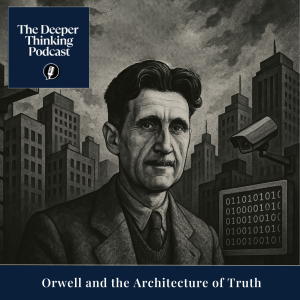
Surveillance, Data Control, and Digital Censorship
📖 The Age of Surveillance Capitalism – Shoshana Zuboff A landmark analysis of how corporations exploit personal data to shape behavior and influence decision-making. A direct modern parallel to Orwell’s fears about state control and manipulation of reality.🔗 Amazon affiliate link
📖 The Big Nine: How the Tech Titans & Their Thinking Machines Could Warp Humanity – Amy Webb🔹 Examines the rise of AI-driven surveillance and how tech monopolies shape public discourse, echoing Orwell’s warnings about centralized control over information.🔗 Amazon affiliate link
📖 Weapons of Math Destruction – Cathy O’NeilExplores how big data and AI algorithms reinforce systemic inequality and societal control, drawing parallels to Orwell’s warnings about power structures embedding themselves in everyday life.🔗 Amazon affiliate link
📖 Surveillance State: Inside China’s Quest to Launch a New Era of Social Control – Josh Chin & Liza LinInvestigates China’s mass surveillance and AI-driven governance, showing how Orwellian tactics have been adapted in the digital age.🔗 Amazon affiliate link
📖 No Place to Hide: Edward Snowden, the NSA, and the U.S. Surveillance State – Glenn GreenwaldExplores the reach of mass government surveillance in democratic societies, making Orwell’s 1984 feel less like fiction and more like an unfolding reality.🔗 Amazon affiliate link
Political Power, Propaganda, and Totalitarianism
📖 The Origins of Totalitarianism – Hannah Arendt A foundational text on how authoritarian regimes emerge, thrive, and maintain control through fear, ideology, and manipulation of historical narratives.🔗 Amazon affiliate link
📖 Propaganda – Edward Bernays🔹 A classic work on how public opinion is shaped and controlled, providing crucial context for Orwell’s concerns about misinformation and thought control.🔗 Amazon affiliate link
📖 Manufacturing Consent: The Political Economy of the Mass Media – Noam Chomsky & Edward S. Herman Expands on Orwell’s concerns by examining how mass media serves as a tool for ideological control in capitalist democracies.🔗 Amazon affiliate link
📖 The True Believer: Thoughts on the Nature of Mass Movements – Eric HofferExplores the psychology behind fanaticism, ideological purity, and how totalitarian movements maintain loyalty—echoing Orwell’s depiction of Party ideology in 1984.*🔗 Amazon affiliate link
Philosophy of Truth, Thought, and Free Will
📖 On Liberty – John Stuart MillA foundational work on free speech, individuality, and resistance to social tyranny, themes central to Orwell’s political philosophy.🔗 Amazon affiliate link
📖 Moral Luck – Bernard WilliamsExplores moral responsibility and ethical dilemmas, relevant to Orwell’s concerns about self-censorship and individual accountability in oppressive systems.🔗 Amazon affiliate link
📖 The Gay Science – Friedrich NietzscheInvestigates how societies construct truth and meaning, aligning with Orwell’s critique of ideological manipulation and enforced conformity.🔗 Amazon affiliate link
📖 Discipline and Punish – Michel Foucault Analyzes the relationship between surveillance, social discipline, and power—essential reading for understanding Orwell’s fears about societal control.🔗 Amazon affiliate link
📖 Post-Truth – Lee McIntyreExamines the decline of objective truth and the rise of disinformation, making Orwell’s insights on truth and language more relevant than ever.🔗 Amazon affiliate link
Wednesday Mar 19, 2025
Wednesday Mar 19, 2025
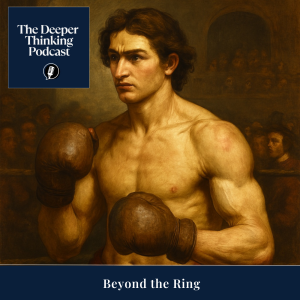
Beyond the Ring: The Ethics and Aesthetics of Violent Sports
A meditation on combat sports as aesthetic performance, ethical dilemma, and cultural ritual—where violence becomes both language and spectacle.
https://thedeeperthinkingpodcast.podbean.com/
Resonance Text
Editor’s Note: What follows is a literary meditation in parallel with this episode’s themes. It stands alone as prose.
Between the hush of the crowd and the echo of the bell lies a moment—suspended, luminous—when time splits open. The fighters stand still, framed by ropes and ritual, not yet combatants but no longer simply men. It is in this breathless space, just before the strike, that something ancient returns: the sacred theater of harm, where pain is neither meaningless nor gratuitous, but honed to a purpose.
Violence, in its raw form, repels. Yet within the squared circle or the octagonal cage, it is transformed—refined by rules, elevated by discipline, aestheticized by movement. The fist no longer signifies chaos but control; the blow becomes choreography. This is the paradox at the heart of violent sport: the brutal made beautiful, the primal made performative. We speak of heart, of grit, of greatness—terms that sanitize impact while romanticizing endurance.
Across cultures and centuries, societies have preserved arenas in which violence could be not only witnessed but worshipped. From the sand-slick amphitheaters of antiquity to the fluorescent-lit pay-per-view bouts of today, combat sports have functioned as modern rituals of containment. The crowd gathers not to intervene, but to watch. To feel something. To partake, from a distance, in the kind of struggle that modern life rarely permits. In this way, the spectacle becomes surrogate—a myth enacted with flesh.
Yet even as we elevate the fighter, we ignore what is cost. A fractured orbit, a shattered hand, the blankness behind the eyes of a champion long retired—these are not aberrations but possibilities folded into the contract. Consent becomes a shield we wield to assuage complicity: they choose this, we say. As if choice neutralizes consequence. As if agency is impermeable to culture, pressure, or need. The ring may be square, but the ethics are not.
What redeems it, perhaps, is the gesture toward the sublime. A feint too perfect to see, a counter timed with unbearable patience, a roundhouse like a poem. These are moments that unmoor us, that feel like truth revealed through force. Kant might call it the beautiful terrible—what strikes awe even as it overwhelms. The body becomes a medium, the fight a kind of language. We are not meant to understand it fully. We are meant to feel it.
So the bell rings. And again. And again. Each round not just a test of strength or skill, but of meaning. What are we really watching? A sport? A sacrifice? An art form with blood as its ink? Perhaps it is all of these. Or perhaps it is something else entirely—something we dare not name, yet cannot look away from.