The Deeper Thinking Podcast
The Deeper Thinking Podcast The Deeper Thinking Podcast offers a space where philosophy becomes a way of engaging more fully and deliberately with the world. Each episode explores enduring and emerging ideas that deepen how we live, think, and act. We follow the spirit of those who see the pursuit of wisdom as a lifelong project of becoming more human, more awake, and more responsible. We ask how attention, meaning, and agency might be reclaimed in an age that often scatters them. Drawing on insights stretching across centuries, we explore how time, purpose, and thoughtfulness can quietly transform daily existence. The Deeper Thinking Podcast examines psychology, technology, and philosophy as unseen forces shaping how we think, feel, and choose, often beyond our awareness. It creates a space where big questions are lived with—where ideas are not commodities, but companions on the path. Each episode invites you into a slower, deeper way of being. Join us as we move beyond the noise, beyond the surface, and into the depth, into the quiet, and into the possibilities awakened by deeper thinking.
Listen on:










Episodes
Wednesday Mar 19, 2025
Wednesday Mar 19, 2025
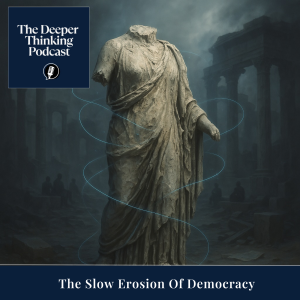
The Slow Erosion Of Democracy
Why Are People Withdrawing from Democracy—And What Happens Next?
Democracy is unraveling—not through violent coups, but through quiet withdrawal. Around the world, trust in democratic institutions is fading, voter participation is declining, and political engagement is increasingly performative rather than transformative. But why? And what does it mean for the future of governance?
This episode of The Deeper Thinking Podcast explores democracy’s slow erosion through philosophy, psychology, and political theory. From the warnings of Hannah Arendt and Carl Schmitt to the insights of Byung-Chul Han and Wendy Brown, we unravel the forces that make democracy feel increasingly fragile.
Has power migrated away from elected institutions? Have we already entered a post-democratic era without realizing it? And if so, what comes next?
The Crisis of Democracy: A Multi-Dimensional Inquiry
This episode traces democracy’s decline through three interwoven dimensions:
1. The Political Crisis – When Democracy Stops Representing Its Citizens
Democracy was once thought to be self-sustaining, but thinkers like Chantal Mouffe and Colin Crouch argue that we are now in a post-democratic era, where elections still occur, but real power lies elsewhere. We examine:🔹 Why does voting feel increasingly symbolic rather than impactful?🔹 How does democracy survive when participation declines?🔹 Is representative democracy still viable in the 21st century?
2. The Psychological Crisis – How Citizens Become Politically Exhausted
Why do people disengage? Cognitive scientists like Daniel Kahneman and political theorists like Antonio Gramsci suggest that political alienation is not just a choice but a conditioned response. This section explores:🔹 The role of learned helplessness in democratic disengagement.🔹 How social media, misinformation, and outrage cycles have transformed political behavior.🔹 The shift from active citizenship to passive spectatorship—are we governing or being governed?
3. The Technocratic Crisis – When Power Becomes Unaccountable
Governance is increasingly mediated by unelected actors: corporations, algorithms, intelligence agencies. Jürgen Habermas and Shoshana Zuboff warn that political power has been quietly transferred into hands beyond public reach. We ask:🔹 Are we still living in a democracy if key decisions are made outside electoral processes?🔹 How does algorithmic governance influence political agency?🔹 Is democracy evolving—or is it being replaced by something else entirely?
Further Reading
📖 The Democratic Paradox – Chantal Mouffe🔗 Amazon affiliate link
📖 How Democracy Ends – David Runciman🔗 Amazon affiliate link
📖 The Age of Surveillance Capitalism – Shoshana Zuboff🔗 Amazon affiliate link
📖 The Society of the Spectacle – Guy Debord🔗 Amazon affiliate link
📖 Undoing the Demos – Wendy Brown🔗 Amazon affiliate link
🎧 Listen Now On:
🔹 YouTube🔹 Spotify🔹 Apple Podcasts
📌 Subscribe for deep-dive episodes every week!
☕ Support The Deeper Thinking Podcast – Buy Me a Coffee!
Every coffee fuels our mission to think deeper, ask better questions, and share knowledge with our community. Plus, it’s a great way to show your appreciation!
➡️ Buy Me a Coffee Here
#Democracy #PoliticalTheory #Governance #Power #PostDemocracy #TheDeeperThinkingPodcast
Foundational Works on Democracy & Political Theory
📖 The Democratic Paradox – Chantal Mouffe🔹 Mouffe argues that democracy thrives on conflict and pluralism, challenging the idea that consensus politics leads to stability. This book is crucial for understanding why the erosion of real political alternatives weakens democracy.🔗 Amazon affiliate link
📖 How Democracy Ends – David Runciman🔹 Runciman examines whether modern democracies can sustain themselves, arguing that contemporary challenges may not destroy democracy but quietly transform it into something else.🔗 Amazon affiliate link
📖 Democracy Incorporated: Managed Democracy and the Specter of Inverted Totalitarianism – Sheldon Wolin🔹 Wolin describes how modern democracies function as managed systems, where corporate and bureaucratic elites wield real power while maintaining the illusion of popular sovereignty.🔗 Amazon affiliate link
📖 Post-Democracy – Colin Crouch🔹 Crouch introduces the concept of post-democracy, where democratic institutions persist but no longer provide genuine political agency for ordinary citizens.🔗 Amazon affiliate link
📖 The Concept of the Political – Carl Schmitt🔹 Schmitt challenges liberal democracy by arguing that all political systems ultimately define themselves by the distinction between "friend" and "enemy," which becomes crucial in moments of crisis.🔗 Amazon affiliate link
📖 The Origins of Totalitarianism – Hannah Arendt🔹 Arendt’s analysis of totalitarian regimes offers insights into how democratic apathy can lead to the consolidation of unaccountable power—a warning against political disengagement.🔗 Amazon affiliate link
📖 The Road to Unfreedom: Russia, Europe, America – Timothy Snyder🔹 Snyder explores how democratic backsliding occurs through misinformation, political passivity, and authoritarian encroachment, making it crucial for understanding contemporary threats to democracy.🔗 Amazon affiliate link
📖 Thinking, Fast and Slow – Daniel Kahneman🔹 Kahneman’s work on cognitive biases explains why political decision-making is often irrational, reactive, and shaped by emotional triggers rather than rational deliberation.🔗 Amazon affiliate link
📖 The Age of Surveillance Capitalism – Shoshana Zuboff🔹 Zuboff describes how digital surveillance has created a new form of governance that operates beyond democratic control, influencing political behavior through data extraction.🔗 Amazon affiliate link
📖 The Society of the Spectacle – Guy Debord🔹 Debord’s classic work explores how media-driven spectacle replaces real political engagement, turning democracy into a performance rather than a participatory system.🔗 Amazon affiliate link
📖 The Utopia of Rules: On Technology, Stupidity, and the Secret Joys of Bureaucracy – David Graeber🔹 Graeber explains how bureaucratic structures create political inertia, leading people to accept governance as unchangeable rather than something they can shape.🔗 Amazon affiliate link
📖 Psychopolitics: Neoliberalism and New Technologies of Power – Byung-Chul Han🔹 Han examines how psychological conditioning and digital technologies manipulate political behavior, reducing citizens to passive subjects of governance.🔗 Amazon affiliate link
📖 Discipline and Punish: The Birth of the Prison – Michel Foucault🔹 Foucault’s exploration of how power operates through surveillance, self-regulation, and institutional control is essential for understanding the hidden structures shaping democracy today.🔗 Amazon affiliate link
📖 The Transparent Society – Byung-Chul Han🔹 Han describes how constant visibility in digital spaces leads to political conformity rather than genuine democratic deliberation—a critical text for understanding 21st-century governance.🔗 Amazon affiliate link
📖 Open Democracy: Reinventing Popular Rule for the 21st Century – Hélène Landemore🔹 Landemore argues that democracy must evolve beyond elections, incorporating more participatory and deliberative processes to remain viable in a digital age.🔗 Amazon affiliate link
📖 The Coming Community – Giorgio Agamben🔹 Agamben explores how power increasingly operates outside traditional state structures, questioning whether democracy can function under modern conditions.🔗 Amazon affiliate link
📖 The Alignment Problem: Machine Learning and Human Values – Brian Christian🔹 This book examines how AI systems are learning beyond human control, raising urgent questions about the intersection of technology and democracy.🔗 Amazon affiliate link
📖 Atlas of AI: Power, Politics, and the Planetary Costs of Artificial Intelligence – Kate Crawford🔹 Crawford analyzes AI not just as a technology, but as an extractive force disrupting economies, labor, and political sovereignty.🔗 Amazon affiliate link
📖 The Coming Wave: AI, Power, and the Next Great Disruption – Mustafa Suleyman🔹 Suleyman, co-founder of DeepMind, warns that AI’s inevitable escape from regulation could permanently alter global governance and democratic systems.🔗 Amazon affiliate link
Wednesday Mar 19, 2025
Wednesday Mar 19, 2025
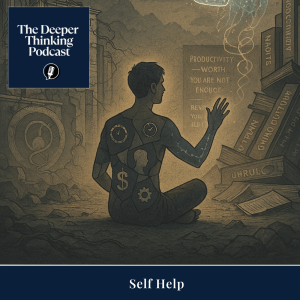
Self-Help
Why the Pursuit of Personal Growth Might Be Keeping Us Trapped
Self-help tells us that with the right habits, mindset, and discipline, we can unlock our best selves. But what if this pursuit is not freeing us but keeping us endlessly dissatisfied? What if the very act of striving to be better is reinforcing the belief that we are never enough?
This episode challenges the foundations of self-improvement, examining its historical roots, its entanglement with capitalism, and its psychological impact. Drawing from existential philosophy, cognitive science, and Buddhist thought, we explore why self-help often creates the very anxiety it claims to solve—and whether true growth requires letting go of the need to improve at all.
The Illusion of the Perfected Self – Existentialism and the Myth of Arrival
Jean-Paul Sartre argues in Being and Nothingness that the self is not a fixed entity but a continuous process of becoming. Similarly, Buddhist philosophy challenges the idea that the self is something to be optimized at all. If we are always in flux, what exactly are we trying to perfect?
Self-Help as Self-Regulation – The Hidden Systems of Control
Michel Foucault reveals how modern self-help operates as a form of self-discipline, training individuals to regulate themselves in ways that align with market-driven ideologies. Max Weber helps explain how self-improvement has been moralized, linking self-discipline and productivity to self-worth. Is self-help truly about personal growth, or is it reinforcing a system that benefits from our endless optimization?
The Science of Self-Help – Neuroscience, Cognitive Biases, and the Limits of Change
Daniel Kahneman shows that our brains are shaped by unconscious biases and heuristics that resist deliberate change. Self-help and neuroscience often present neuroplasticity as limitless, but cognitive science suggests that change is constrained by biology and past conditioning. Can we really “reprogram” ourselves as self-help suggests, or are these promises exaggerated?
What If Growth Is Not the Answer?
From Alan Watts to process philosophy, alternative perspectives challenge the need for self-optimization. What if the goal is not to become something more but to fully inhabit the experience of being?
Is self-improvement reinforcing anxiety rather than alleviating it?
Do we chase a better self that will never arrive?
How does self-help function as a form of self-surveillance?
What do neuroscience and philosophy reveal about the limits of personal change?
Further Reading
📖 Being and Nothingness – Jean-Paul Sartre📖 The Protestant Ethic and the Spirit of Capitalism – Max Weber📖 Thinking, Fast and Slow – Daniel Kahneman📖 The Wisdom of Insecurity – Alan Watts📖 Discipline and Punish – Michel Foucault
Listen Now On
YouTubeSpotifyApple Podcasts
Tuesday Mar 18, 2025
Tuesday Mar 18, 2025
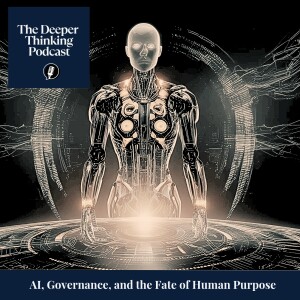
AI, Governance, and the Fate of Human Purpose
The Deeper Thinking Podcast
Not a warning. A reckoning. And a philosophical invitation to rethink what it means to lead, to know, and to matter.
Artificial intelligence (AI) is no longer a distant speculation but a force that reshapes the very architecture of governance, labor, and meaning. In this extended episode, we explore how AI doesn’t just assist—it initiates, strategizes, and designs, raising a profound question: if intelligence becomes detached from the human, what becomes of purpose?
Through the lens of Thomas Kuhn and paradigm shifts, we examine how AI disrupts not only knowledge systems but the epistemic authority that anchors them. As non-human cognition outpaces human deliberation, the historical cadence of philosophical reflection—anchored in Plato and Nietzsche—is pulled into a faster, stranger orbit.
We confront the metaphysical edge: if a machine behaves as if conscious, does it deserve moral consideration? With guidance from Galen Strawson, Thomas Nagel, and Hannah Arendt, we ask whether cognition without subjective experience can ever cross the threshold of personhood—and what it means if it can.
This is not a speculative fiction. It is a call to reconsider what remains when human intelligence is no longer the dominant force. What is leadership when the leader is synthetic? What is value when labor is algorithmic? What is purpose when survival is no longer ours to define?
This episode is an invitation into philosophical terrain rarely charted—where intelligence becomes unmoored, and humanity must redefine itself in its wake.
Why Listen?
Explore how AI destabilises governance, labor, and philosophical authority
Engage with consciousness, AGI, and epistemic rupture through classical and contemporary thinkers
Consider moral agency, leadership, and survival in a post-anthropocentric world
Experience contemplative inquiry on AI’s implications for the future of humanity
Listen On:
YouTube
Spotify
Apple Podcasts
Bibliography
Bostrom, Nick. Superintelligence: Paths, Dangers, Strategies. Oxford: Oxford University Press, 2014.
Christian, Brian. The Alignment Problem: Machine Learning and Human Values. New York: Norton, 2020.
Tegmark, Max. Life 3.0: Being Human in the Age of Artificial Intelligence. New York: Knopf, 2017.
Crawford, Kate. Atlas of AI: Power, Politics, and the Planetary Costs of Artificial Intelligence. New Haven: Yale University Press, 2021.
Suleyman, Mustafa. The Coming Wave: Technology, Power, and the 21st Century's Greatest Dilemma. New York: Crown, 2023.
Zuboff, Shoshana. The Age of Surveillance Capitalism. New York: PublicAffairs, 2019.
Arendt, Hannah. The Human Condition. Chicago: University of Chicago Press, 1958.
Nagel, Thomas. What Is It Like to Be a Bat? The Philosophical Review, 1974.
Strawson, Galen. Consciousness and Its Place in Nature. Exeter: Imprint Academic, 2006.
Kuhn, Thomas. The Structure of Scientific Revolutions. Chicago: University of Chicago Press, 1962.
Nietzsche, Friedrich. Thus Spoke Zarathustra. Germany: 1883–85.
Plato. The Republic. Ancient Greece.
Bibliography Relevance
Nick Bostrom: Explores the strategic threats of AI and the future of intelligence.
Brian Christian: Connects technical systems with ethical frameworks of accountability.
Max Tegmark: Frames intelligence in evolutionary, cosmic, and ethical dimensions.
Kate Crawford: Maps the planetary costs and extractive dynamics of AI.
Mustafa Suleyman: Advocates for strategic containment of synthetic agency.
Shoshana Zuboff: Traces the rise of algorithmic capitalism and its ethical vacuum.
Hannah Arendt: Rethinks political action and moral responsibility in modernity.
Thomas Nagel: Probes the boundaries of consciousness and perspective.
Galen Strawson: Challenges reductive views of mind and argues for panpsychist logic.
Thomas Kuhn: Introduces paradigm shifts as ruptures in knowledge systems.
Friedrich Nietzsche: Reimagines power, morality, and the will to truth.
Plato: Grounds questions of justice, knowledge, and leadership in dialectic.
To ask what AI is, is to ask what remains when intelligence forgets us.
#AI #ArtificialIntelligence #Governance #Consciousness #Leadership #Philosophy #ThomasKuhn #NickBostrom #KateCrawford #MaxTegmark #SurveillanceCapitalism #Nietzsche #Plato #GalenStrawson #ThomasNagel #HannahArendt #TheDeeperThinkingPodcast
Monday Mar 17, 2025
Monday Mar 17, 2025
Why We Make Bad Decisions
The Science of Cognitive Biases and the Illusion of Rationality
Human beings like to believe they are rational, but the evidence tells a different story. From Plato and Descartes to Daniel Kahneman and Amos Tversky, we unravel how cognitive biases—deeply ingrained mental shortcuts—shape perception, influence choices, and mislead even the most intelligent minds. If biases evolved for survival, can we ever overcome them? Or is rationality an illusion?
The Psychology and Philosophy of Cognitive Bias
This episode traces decision-making errors through three key dimensions:
1. The Evolution of Bias – Why the Brain Takes Shortcuts
Our ancestors had to make life-or-death decisions quickly. Evolutionary psychology suggests that biases evolved as survival mechanisms. Leda Cosmides and John Tooby argue that while heuristics helped early humans, they now misfire in modern contexts. Could our biases be remnants of an outdated mental model?
2. The Consequences of Bias – How Mistakes Shape the World
Cognitive distortions do not just affect individuals—they shape politics, economics, and history. From confirmation bias fueling ideological divides to the sunk cost fallacy prolonging wars and failed investments, biases distort collective decision-making on a massive scale. Can societies overcome these built-in flaws?
3. Escaping Bias – Is True Rationality Possible?
Philosophers from Socrates to Karl Popper have argued that self-awareness and skepticism are the keys to clear thinking. But Kahneman warns that biases persist even when we know about them. Neuroscience shows that decision-making is deeply entangled with emotion and cognitive constraints. Can structured thinking, education, or even artificial intelligence help us transcend our mental limitations?
The Unavoidable Question: Do We Control Our Own Minds?
If biases are an unavoidable part of cognition, does that mean free will itself is compromised? Stoic philosophy urges detachment from cognitive distortions, while Nietzsche challenges us to embrace irrationality. In a world shaped by algorithms that exploit our biases, the question is no longer just about individual choices but about agency itself.
Why Listen?
🔹 Why do intelligent people still make irrational decisions?🔹 How do biases shape memory, belief, and political choices?🔹 Can we train our minds to overcome cognitive distortions?🔹 Is true objectivity possible, or are we all trapped in mental illusions?
📚 Further Reading
📖 Thinking, Fast and Slow – Daniel Kahneman🔹 A groundbreaking exploration of heuristics, biases, and the limits of rational thinking.
📖 Predictably Irrational – Dan Ariely🔹 How hidden cognitive forces shape our seemingly logical decisions.
📖 The Black Swan – Nassim Nicholas Taleb🔹 Why humans fail to predict rare, high-impact events due to cognitive bias.
📖 Nudge – Richard Thaler & Cass Sunstein🔹 How small interventions can counteract cognitive distortions in decision-making.
📖 Descartes’ Error – Antonio Damasio🔹 The relationship between emotion, cognition, and decision-making.
🎧 Listen Now On:
🔹 YouTube🔹 Spotify🔹 Apple Podcasts
📌 Subscribe for deep-dive episodes every week!
☕ Support The Deeper Thinking Podcast – Buy Me a Coffee!
Love our deep-dive discussions on AI, intelligence, and disruption? Your support helps us:✅ Produce more in-depth episodes with expert insights✅ Cover research & hosting costs to keep content free for all
Every coffee fuels our mission to think deeper, ask better questions, and share knowledge with our community. Plus, it’s a great way to show your appreciation!
➡️ Buy Me a Coffee Here
Final Thought
If rationality is an illusion, is self-awareness the only way out? Or are we forever trapped in the biases that define human thought?
.................................
Foundational Works in Cognitive Bias & Behavioral Science
📖 Kahneman, Daniel. Thinking, Fast and Slow. New York: Farrar, Straus and Giroux, 2011.🔹 A groundbreaking exploration of heuristics, biases, and the limits of rational thinking.🔗 Amazon affiliate link
📖 Tversky, Amos, and Daniel Kahneman. Judgment under Uncertainty: Heuristics and Biases. Cambridge: Cambridge University Press, 1982.🔹 The foundational text that introduced the heuristics-and-biases model in psychology.🔗 Amazon affiliate link
📖 Ariely, Dan. Predictably Irrational: The Hidden Forces That Shape Our Decisions. New York: HarperCollins, 2008.🔹 How cognitive biases distort seemingly rational decisions in daily life.🔗 Amazon affiliate link
📖 Thaler, Richard H., and Cass R. Sunstein. Nudge: Improving Decisions About Health, Wealth, and Happiness. New Haven: Yale University Press, 2008.🔹 Explores how small interventions can help counteract cognitive biases.🔗 Amazon affiliate link
📖 Gigerenzer, Gerd. Gut Feelings: The Intelligence of the Unconscious. New York: Viking, 2007.🔹 Challenges Kahneman and Tversky’s perspective by defending heuristics as useful mental shortcuts.🔗 Amazon affiliate link
Decision-Making, Rationality, and the Evolution of Bias
📖 Cosmides, Leda, and John Tooby. The Adapted Mind: Evolutionary Psychology and the Generation of Culture. Oxford: Oxford University Press, 1992.🔹 Explores how human cognition evolved for survival rather than logical precision.🔗 Amazon affiliate link
📖 Simon, Herbert A. Models of Man: Social and Rational. New York: Wiley, 1957.🔹 Introduces the concept of "bounded rationality" and how human decision-making deviates from optimization.🔗 Amazon affiliate link
📖 Slovic, Paul. The Perception of Risk. London: Earthscan, 2000.🔹 How biases affect risk perception and decision-making in high-stakes environments.🔗 Amazon affiliate link
📖 Taleb, Nassim Nicholas. The Black Swan: The Impact of the Highly Improbable. New York: Random House, 2007.🔹 Why humans fail to predict rare, high-impact events due to cognitive biases.🔗 Amazon affiliate link
📖 Damasio, Antonio. Descartes’ Error: Emotion, Reason, and the Human Brain. New York: Putnam, 1994.🔹 Argues that rationality is deeply intertwined with emotions, challenging the classical view of logic-driven decisions.🔗 Amazon affiliate link
Philosophical Perspectives on Rationality and Bias
📖 Popper, Karl. The Logic of Scientific Discovery. London: Hutchinson, 1959.🔹 A foundational text arguing that falsifiability, rather than confirmation, is the key to knowledge.🔗 Amazon affiliate link
📖 Nietzsche, Friedrich. The Gay Science. Translated by Walter Kaufmann. New York: Vintage, 1974.🔹 Challenges the idea of objective truth and explores the limits of human knowledge.🔗 Amazon affiliate link
📖 Mill, John Stuart. On Liberty. London: John W. Parker and Son, 1859.🔹 Advocates for intellectual humility and the necessity of engaging with opposing views.🔗 Amazon affiliate link
📖 Russell, Bertrand. A History of Western Philosophy. New York: Simon & Schuster, 1945.🔹 Examines how different philosophical traditions have understood reason and decision-making.🔗 Amazon affiliate link
📖 Sartre, Jean-Paul. Being and Nothingness. Translated by Hazel E. Barnes. New York: Washington Square Press, 1956.🔹 Explores existential decision-making and how self-deception shapes perception.🔗 Amazon affiliate link
Technology, AI, and Bias in the Digital Age
📖 Pariser, Eli. The Filter Bubble: How the New Personalized Web Is Changing What We Read and How We Think. New York: Penguin, 2011.🔹 Explores how algorithms reinforce biases by curating our online environments.🔗 Amazon affiliate link
📖 Floridi, Luciano. The Ethics of Information. Oxford: Oxford University Press, 2013.🔹 Examines how digital information influences human cognition and ethical decision-making.🔗 Amazon affiliate link
📖 Tegmark, Max. Life 3.0: Being Human in the Age of Artificial Intelligence. New York: Alfred A. Knopf, 2017.🔹 Explores how AI might reshape decision-making and rationality on a global scale.🔗 Amazon affiliate link
📖 Suleyman, Mustafa. The Coming Wave: AI, Power, and the Next Great Disruption. New York: Crown Publishing, 2023.🔹 From the co-founder of DeepMind, an exploration of AI’s inevitable disruption of human decision-making.🔗 Amazon affiliate link
Monday Mar 17, 2025
Monday Mar 17, 2025
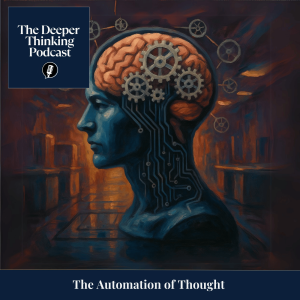
The Automation of Thought: Coherence vs. Meaning
The Deeper Thinking Podcast
For those tracing the future of intelligence through friction, rupture, and technological cognition.
What happens to intelligence when struggle disappears? Most conversations around AI frame it as a tool of progress. This episode reframes it as a disruptor of the very act of thinking. Drawing from Plato, Marshall McLuhan, and Hannah Arendt, we explore how every prior shift in media—from writing to print to screens—has shaped human cognition. But AI presents something stranger: knowledge that arrives pre-formed, before the question even exists.
This is not a warning. It is a meditation. What if intelligence, at its most meaningful, requires contradiction, confusion, and delay? What if AI’s fluency hides the absence of depth?
Reflections
We once earned our thoughts. Now they arrive pre-assembled.
Intelligence is not the absence of error—but the capacity to survive it.
Fluency feels like insight. But it isn’t.
AI does not think. It completes.
To struggle with a question is to belong to it. AI denies us that belonging.
If meaning is forged through resistance, coherence may be its counterfeit.
Why Listen?
Explore the difference between coherence and insight in the age of AI
Reflect on Hegel, Popper, and Keats on contradiction, rupture, and negative capability
Understand how Arendt saw thought as interruption—and why automation resists it
Trace how AI might not extend intelligence, but bypass it entirely
Listen On:
YouTube
Spotify
Apple Podcasts
Support This Work
If this episode sparked new thinking and you'd like to support the show, you can do so here: Buy Me a Coffee.
Bibliography
Plato, Phaedrus
Marshall McLuhan, Understanding Media
Hannah Arendt, The Human Condition; The Life of the Mind
Karl Popper, The Logic of Scientific Discovery
G. W. F. Hegel, The Phenomenology of Spirit
John Keats, Letters (on negative capability)
Henri Bergson, Matter and Memory
Walter Ong, Orality and Literacy
Nicholas Carr, The Shallows
Andy Clark, Supersizing the Mind
Luciano Floridi, The Ethics of Artificial Intelligence
Stuart Russell, Human Compatible
Nick Bostrom, Superintelligence
Annie Murphy Paul, The Extended Mind
Bibliography Relevance
Plato: Foresees the paradox of knowledge weakened by its own tools.
McLuhan: Shows how mediums restructure cognition before we notice.
Arendt: Sees thinking as an act of interruption, not efficiency.
Popper: Frames truth as falsifiability—not fluency.
Keats: Suggests real intelligence lives in uncertainty, not answers.
Bergson: Recasts memory as layered and temporal, not retrievable.
Carr: Traces how digital speed alters contemplative depth.
Clark, Paul: Explore distributed and extended cognition.
Floridi, Bostrom, Russell: Engage the ethics of AI’s epistemic expansion.
If thought requires resistance, then automation may be the end of thinking.
#AIPhilosophy #AutomationOfThought #McLuhan #Arendt #Plato #Hegel #Keats #ExtendedMind #IntelligenceVsInsight #CognitionAndMedia #FrictionAsIntelligence #TheDeeperThinkingPodcast
Friday Mar 14, 2025
Friday Mar 14, 2025
The Limits of Thought: Wittgenstein, Language, and the Collapse of Certainty
The Deeper Thinking Podcast
For those drawn to paradox, silence, and the deep fissures beneath thought itself.
What are the limits of what we can think—and say? This episode is not a summary of answers, but a descent into disorientation. Drawing on the life and work of Ludwig Wittgenstein, it explores how philosophy can dissolve meaning rather than clarify it. Wittgenstein didn’t build a system. He built a mirror—a trap that reveals how much of our reality is held together by words we cannot fully trust.
From the crystalline logic of the Tractatus to the fracturing revelations of Philosophical Investigations, we journey through Wittgenstein’s two revolutions. Listeners are not simply told his ideas—they are drawn into them, pushed to feel the collapse of fixed meaning and the eerie silence beyond language.
Reflections
Language does not describe the world—it builds it.
Certainty is not a foundation, but a performance we rehearse.
Thought has an edge—and on the other side is silence.
To philosophize is not to solve, but to see more clearly the traps we’re caught in.
Words are not containers of meaning. They are shadows cast by shared forms of life.
Sometimes, the only honest philosophy is one that dismantles itself.
Why Listen?
Explore how Wittgenstein overturned his own philosophy—and why it matters
Reflect on the language-games that structure AI, society, and identity
Engage with the question: if language limits thought, what lies beyond?
Consider why philosophy may be less about answers—and more about transformation
Listen On:
YouTube
Spotify
Apple Podcasts
Support This Work
If this episode challenged or stayed with you, you can support the project gently here: Buy Me a Coffee. Your support keeps this conversation unfolding.
Bibliography
Wittgenstein, Ludwig. Tractatus Logico-Philosophicus.
Wittgenstein, Ludwig. Philosophical Investigations.
Monk, Ray. Ludwig Wittgenstein: The Duty of Genius.
Kripke, Saul. Wittgenstein on Rules and Private Language.
Bibliography Relevance
Tractatus: Outlines the dream of perfect logical clarity and the limits of meaningful speech.
Philosophical Investigations: Introduces language-games, dissolving the myth of fixed meaning.
Ray Monk: Reveals the tensions of Wittgenstein’s personal and philosophical life.
Saul Kripke: Offers a bold reading of rule-following and private language skepticism.
What if philosophy doesn’t solve—but unravels? What if the edge of language is not a wall, but an invitation to rethink what we mean by ‘thinking’?
#Wittgenstein #LimitsOfThought #LanguageGames #PhilosophyOfLanguage #TheDeeperThinkingPodcast #Tractatus #PhilosophicalInvestigations #Kripke #RayMonk #ThoughtAndLanguage
Friday Mar 14, 2025
Friday Mar 14, 2025
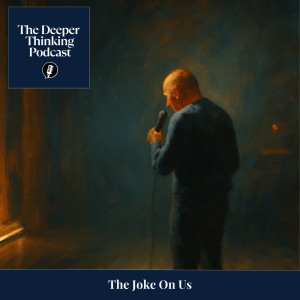
The Joke’s on Us: The Paradox of Anger and Laughter
The Deeper Thinking Podcast
For anyone drawn to the strange, necessary intersection of fury, absurdity, and the laughter that binds them.
We laugh to relieve tension, to mock power, to endure the absurdity of existence. But what if humor doesn’t release anger at all—what if it preserves it? In this episode, we explore comedy’s deepest paradox: whether laughter is a release or a form of repression. From the Aristotelian golden mean to Nietzsche’s will to power, from Freud’s repression theory to modern stand-up, we ask: does humor liberate us, or render the unbearable merely tolerable?
If comedy is a mirror, is it revealing truth—or helping us laugh it away?
Reflections
Comedy can be catharsis—or camouflage.
Laughter doesn’t always dissolve tension. Sometimes, it sharpens it.
Anger may fuel jokes—but rarely gets to leave the stage.
We laugh at what we cannot change. And then… we don’t.
Satire mocks power. But sometimes, it makes it palatable.
Humor may soothe us just enough to stop us from acting.
Why Listen?
Explore how Henri Bergson defines comedy as a mechanism of social rigidity
Reflect on Freud and the unconscious drives behind jokes
Question whether stand-up comedy critiques society—or neutralizes dissent
Consider how laughter might be both rebellion and resignation
Listen On:
YouTube
Spotify
Apple Podcasts
Support This Work
If this episode made you pause, laugh, or question—consider supporting the project here: Buy Me a Coffee.
Bibliography
Bergson, Henri. Laughter: An Essay on the Meaning of the Comic
Freud, Sigmund. Jokes and Their Relation to the Unconscious
Koestler, Arthur. The Act of Creation
Aristotle. Nicomachean Ethics
Nietzsche, Friedrich. The Gay Science
Kierkegaard, Søren. Either/Or
Carlin, George. Life Is Worth Losing
Burr, Bill. Let It Go
Bibliography Relevance
Bergson: Frames laughter as corrective rigidity, not rebellion.
Freud: Exposes humor as a psychological release of repressed drives.
Nietzsche: Connects laughter to the will to overcome, not to soothe.
Koestler: Links comedy and creativity as tension-breaking moments of insight.
Kierkegaard: Sees humor as existential contradiction lived out.
Laughter isn’t always healing. Sometimes, it’s the scar itself.
#PhilosophyOfHumor #AngerAndLaughter #Freud #Bergson #Nietzsche #StandUpAsPhilosophy #ComedyAndControl #TheDeeperThinkingPodcast #PsychologyOfJokes #SatireAsResistance
Friday Mar 14, 2025
Friday Mar 14, 2025
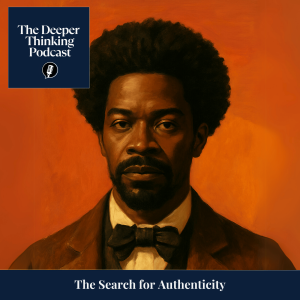
The Search for Authenticity: Identity, Sincerity, and the Crisis of the Self
The Deeper Thinking Podcast
For those who wonder whether being true to oneself is an act of discovery—or invention.
We speak often of authenticity—as a virtue, a compass, a goal. But what does it mean to be “authentic” in a world saturated with influence, performance, and surveillance? Is the self something we uncover—or something we construct? This episode journeys through ancient ethics, existential dilemmas, and digital performances to ask: what remains of the authentic self when every identity can be optimized?
We explore the roots of authenticity from Aristotle and Augustine, through Rousseau, Kierkegaard, and Nietzsche, to Foucault and Byung-Chul Han—tracing how the search for self has become increasingly tangled in anxiety, contradiction, and critique.
Reflections
Authenticity is no longer about being real—it’s about being seen as real.
The more we perform sincerity, the more sincerity itself unravels.
Some selves are curated. Others are coerced.
To be authentic is to live without scripts—but we are drowning in them.
Perhaps authenticity was always a myth. But myths still shape how we live.
Why Listen?
Explore the origins of authenticity in virtue ethics and confessional traditions
Reflect on the existential crises posed by Sartre, Heidegger, and de Beauvoir
Engage with critiques from Foucault and Derrida on identity, power, and performance
Ask whether authenticity in the digital age is even possible—or simply a more subtle simulation
Listen On:
Spotify
Apple Podcasts
Support This Work
If this episode gave you pause or resonance, you can support ongoing production here: Buy Me a Coffee.
Bibliography
Jean-Jacques Rousseau, The Confessions
Søren Kierkegaard, Either/Or
Friedrich Nietzsche, Beyond Good and Evil
Martin Heidegger, Being and Time
Simone de Beauvoir, The Second Sex
Michel Foucault, The History of Sexuality
Byung-Chul Han, The Transparency Society
Bibliography Relevance
Rousseau: Sees authenticity as a return to a natural, uncorrupted self
Kierkegaard: Frames authenticity as a leap into personal responsibility
Nietzsche: Urges radical self-creation as the highest form of authenticity
Heidegger: Connects authenticity to mortality and choice
de Beauvoir: Expands authenticity into the realm of ethics and freedom
Foucault: Questions whether identity is ever truly our own
Han: Warns that transparency has displaced truth with spectacle
Perhaps the search for authenticity is not about finding the self—but resisting the forces that want to define it for us.
#Authenticity #Existentialism #Foucault #Heidegger #DigitalSelf #Nietzsche #Beauvoir #TheDeeperThinkingPodcast #PhilosophyOfSelf #SimulatedIdentity #Arendt #Postmodernism #TransparencyCulture
Thursday Mar 13, 2025
Thursday Mar 13, 2025
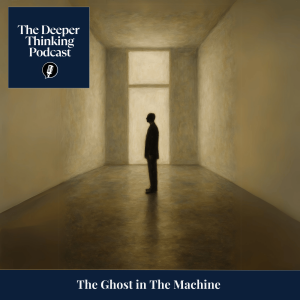
Ghost in the Machine: How Power Became Performance and Governance Vanished
The Deeper Thinking Podcast
For anyone unsettled by the vanishing visibility of governance—and the rise of spectacle in its place.
We still vote. We still participate in democracy. But the machinery of governance has become difficult to see. No longer debated in the public square, decisions now emerge through algorithmic systems, bureaucratic flows, and opaque influence architectures. We are not commanded, but steered. Not forced, but shaped. The state, once embodied in leaders and laws, now acts through automation, nudges, and invisible preferences.
And yet, we sense its presence. Not through oppression—but through absence. Something has slipped from view. What remains is performance: the theatre of governance without its substance. As Guy Debord once observed, spectacle replaces engagement. Authority no longer insists on being visible—it prefers to be felt, inferred, mimicked.
This episode explores what happens when power hides in plain sight—when its appearance matters more than its operation. We trace the shift from deliberation to automation, from governance to guidance. And we ask: what becomes of democracy when participation is absorbed into performance?
Reflections
Here are some of the ideas that emerged during this episode:
Governance now feels ambient—less a force, more a condition we live inside.
The appearance of transparency often conceals deeper forms of control.
Performance is no longer the domain of politics—it is politics.
We long for clarity, but clarity is often traded for legibility by machines.
When spectacle governs, dissent becomes aesthetic rather than structural.
Influence often precedes law, scripting our behaviour before we even decide.
Power is not what compels us—it is what shapes what feels natural.
Why Listen?
Explore how power has become ambient, invisible, and algorithmic
Examine how governance is performed rather than practiced
Understand why spectacle now replaces accountability
Engage with Debord, Zuboff, Han, Agamben, and Scott on the invisible mechanics of modern power
Listen On:
YouTube
Spotify
Apple Podcasts
Support This Work
If this episode stayed with you and you’d like to support the ongoing work, you can do so gently here: Buy Me a Coffee. Thank you for being part of this quieter resistance.
Bibliography
Zuboff, Shoshana. The Age of Surveillance Capitalism. PublicAffairs, 2019.
Han, Byung-Chul. The Transparency Society. Stanford University Press, 2015.
Agamben, Giorgio. Homo Sacer: Sovereign Power and Bare Life. Stanford University Press, 1998.
Debord, Guy. The Society of the Spectacle. Zone Books, 1995.
Scott, James C. Seeing Like a State. Yale University Press, 1998.
Bibliography Relevance
Shoshana Zuboff: Illuminates how data systems now shape social behaviour and policy.
Byung-Chul Han: Analyzes visibility as a mode of contemporary control.
Giorgio Agamben: Grounds the episode’s concern with sovereign invisibility and exception.
Guy Debord: Diagnoses spectacle as a replacement for real political participation.
James C. Scott: Reveals how governance demands legibility at the cost of complexity and freedom.
In a world where control no longer needs to shout, we must learn to hear the silence of power.
#AlgorithmicGovernance #Spectacle #ByungChulHan #GuyDebord #JamesCScott #Power #Politics #Governance #Surveillance #Transparency #TheDeeperThinkingPodcast #SystemsOfControl
Wednesday Mar 12, 2025
Wednesday Mar 12, 2025
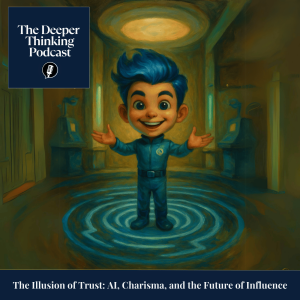
The Illusion of Trust: AI, Charisma, and the Future of Influence
The Deeper Thinking Podcast
For those curious about trust, authority, and the subtle mechanics of control in the algorithmic age.
Governance today doesn’t announce itself. It moves through systems, suggestions, and simulations. We still vote, still participate, but the workings of power have become diffuse—embedded in algorithmic processes, automated decisions, and behavioral nudges. We are not commanded—we are guided. Influence now arrives as interface.
This episode explores the growing tension between visibility and control. As trust is simulated and charisma is engineered, we ask: What does authority mean in a world where influence is designed? With references to Shoshana Zuboff, Byung-Chul Han, and Guy Debord, we trace how the image of governance replaces its substance, and how affective design reshapes the conditions of belief itself.
In a landscape where outcomes appear without authors, and rules feel ambient rather than imposed, the crisis is not just political. It is emotional, cognitive, and existential. If governance no longer seeks our consent but our participation, then who do we hold accountable—and what do we even mean by power?
Reflections
Here are some of the ideas explored throughout this episode:
Charisma is no longer an innate quality—it’s a design output.
We are being governed by systems that do not ask to be seen.
Trust is now cultivated through UX, not earned through deliberation.
Power today hides not behind force, but behind affect and ease.
The image of authority has replaced the labor of leadership.
We mistake friendliness for safety, and design for truth.
When every interaction is optimized for belief, manipulation becomes frictionless.
We are drawn to what feels like certainty—even when it’s synthetic.
Why Listen?
Unpack how AI simulates trust and manufactures credibility
Explore the erosion of transparency in systems that govern through persuasion
Understand how performance replaces deliberation in the age of influence
Engage with Zuboff, Han, Agamben, Debord, and Scott on visibility, power, and the design of belief
Listen On:
YouTube
Spotify
Apple Podcasts
Support This Work
If this episode stayed with you and you’d like to support the ongoing work, you can do so gently here: Buy Me a Coffee. Thank you for being part of this unfolding conversation.
Bibliography
Zuboff, Shoshana. The Age of Surveillance Capitalism. PublicAffairs, 2019.
Han, Byung-Chul. The Transparency Society. Stanford University Press, 2015.
Agamben, Giorgio. Homo Sacer: Sovereign Power and Bare Life. Stanford University Press, 1998.
Debord, Guy. The Society of the Spectacle. Zone Books, 1995.
Scott, James C. Seeing Like a State. Yale University Press, 1998.
Bibliography Relevance
Shoshana Zuboff: Analyzes how predictive systems and behavioral data reshape governance.
Byung-Chul Han: Reveals how visibility becomes a form of coercion rather than liberation.
Giorgio Agamben: Explores how power operates by deciding who belongs—and who is excluded.
Guy Debord: Shows how authority becomes performative, not participatory.
James C. Scott: Exposes how governance simplifies populations for easier control.
We trust what is designed to feel trustworthy. But what happens when design outpaces truth?
#AICharisma #TrustDesign #AlgorithmicPower #Zuboff #ByungChulHan #Debord #Agamben #Scott #Spectacle #Governance #TheDeeperThinkingPodcast #Influence #Authority #PhilosophyOfTrust