The Deeper Thinking Podcast
The Deeper Thinking Podcast The Deeper Thinking Podcast offers a space where philosophy becomes a way of engaging more fully and deliberately with the world. Each episode explores enduring and emerging ideas that deepen how we live, think, and act. We follow the spirit of those who see the pursuit of wisdom as a lifelong project of becoming more human, more awake, and more responsible. We ask how attention, meaning, and agency might be reclaimed in an age that often scatters them. Drawing on insights stretching across centuries, we explore how time, purpose, and thoughtfulness can quietly transform daily existence. The Deeper Thinking Podcast examines psychology, technology, and philosophy as unseen forces shaping how we think, feel, and choose, often beyond our awareness. It creates a space where big questions are lived with—where ideas are not commodities, but companions on the path. Each episode invites you into a slower, deeper way of being. Join us as we move beyond the noise, beyond the surface, and into the depth, into the quiet, and into the possibilities awakened by deeper thinking.










Episodes

Feb 26, 2025
Feb 26, 2025
31 min
The Hidden Power of Language: Thought, Control, and the Future of Meaning
The Deeper Thinking Podcast is digitally narrated.
For those drawn to the quieter questions beneath what we say—and why it matters.
Language doesn’t just describe reality—it creates it. In this episode, we trace the hidden architecture of words: how they shape perception, encode bias, and quietly direct what we believe is possible. This is not a conversation about grammar or rhetoric. It’s about how language forms the scaffolding of law, identity, memory, and even justice itself.
From George Orwell’s dystopian vision of Newspeak to Noam Chomsky’s critique of political manipulation, we examine how words carry invisible power. We ask what happens when language is weaponized—when it no longer reflects meaning, but controls it. Through the lens of the Sapir–Whorf Hypothesis, we explore the deep structure of thought itself, and how unexamined language can quietly reinforce the status quo.
We also look ahead. As artificial intelligence begins to generate and interpret language at scale, we face new questions: Can machines understand meaning—or only simulate it? If language is context, embodiment, and history, what gets lost when algorithms speak for us?
Reflections
This episode is an invitation to notice the unseen influence of language in shaping who we are—and what we believe is real.
Here are some of the questions and insights we explore:
Every word is a frame. What does our language make invisible?
Who decides which words enter public consciousness—and which quietly disappear?
Does AI speak, or does it merely echo us?
Language isn’t neutral. Even silence can be structured by power.
What happens when the meaning of justice is redefined by legal language?
The words we forget may matter as much as the ones we repeat.
We shape language, but it also shapes us—quietly, deeply, daily.
Why Listen?
Explore the ethical and political dimensions of language
Understand how AI changes not just communication, but meaning itself
Reflect on the connection between words, power, and perception
Engage with Orwell, Chomsky, and Sapir–Whorf on the politics of speech and the future of understanding
Listen On:
YouTube
Spotify
Apple Podcasts
Support This Work
If you’d like to support this ongoing conversation, you can do so gently here: Buy Me a Coffee. Thank you for listening with such care.
Bibliography
Bostrom, Nick. Superintelligence: Paths, Dangers, Strategies. Oxford University Press, 2014.
Pinker, Steven. The Language Instinct. Harper Perennial, 2007.
Orwell, George. 1984. Penguin Classics, 2008.
Pinker, Steven. The Stuff of Thought. Viking, 2007.
Lakoff, George, and Johnson, Mark. Metaphors We Live By. University of Chicago Press, 2003.
Bibliography Relevance
Nick Bostrom: Explores how predictive language shapes power in AI.
Steven Pinker: Illuminates the cognitive and evolutionary foundations of language.
George Orwell: Shows how language can reshape reality itself through control and erasure.
George Lakoff & Mark Johnson: Reveal how metaphor forms the invisible logic of thought and action.
Language doesn’t just change what we say. It changes what we can see.
#LinguisticPower #GeorgeOrwell #NoamChomsky #SapirWhorf #LanguageAndAI #PhilosophyOfLanguage #CognitiveLinguistics #MeaningMaking #TheDeeperThinkingPodcast #WordsAndPower #SpeechEthics #ThoughtAndLanguage

Feb 25, 2025
Feb 25, 2025
27 min
The Myth of Success: Ambition, Emptiness, and the Performance of Fulfillment
The Deeper Thinking Podcast
For anyone questioning work culture, self-worth, and the story we’ve been told about achievement.
We are told success is the key to happiness. That if we stay productive, stay disciplined, and keep pushing, we will arrive. But what if success is not fulfillment at all—but performance? In this episode, we question the myth of success as a personal victory, and explore it instead as a cultural script. Drawing from existentialism, depth psychology, and social critique, we ask: if success is so meaningful, why does it feel so empty?
This is not a takedown of ambition. It is an exploration of ambition’s shadow side—the subtle ways we’re shaped by the very ideals we never chose. With insights from Jean-Paul Sartre, Christopher Lasch, and Carl Jung, we examine how our culture rewards burnout, glorifies overwork, and hides deep dissatisfaction beneath polished achievements.
We look at the performance of success in late capitalism, the inner emptiness behind constant striving, and what happens when we begin to see success not as truth—but as myth. What emerges when we no longer equate worth with productivity? What deeper forms of value appear when we let the hustle go silent?
Reflections
This episode invites a more honest relationship with ambition. Beneath every performance of success, there is often a quiet ache. We begin there.
Here are some reflections that surfaced along the way:
What if the feeling of “not enough” is not personal, but cultural?
We chase success to feel seen. But often, we disappear into the image we’ve created.
The more we perform fulfillment, the less space we have to ask if we feel it.
True ambition might not be to win—but to become whole.
Sometimes, burnout is not the price of success—it’s the evidence of its emptiness.
What if we stopped measuring our days by output?
We are not machines. We were never meant to optimize every hour.
The desire to matter is human. But mattering is not the same as impressing.
Maybe the real success is this: to want less, and love more deeply.
Why Listen?
Challenge the dominant cultural myth that external success equals happiness
Explore how capitalism, performance, and identity are entangled in ambition
Reframe burnout not as a failure, but as a signal of deeper misalignment
Engage with Sartre, Lasch, and Jung on freedom, illusion, and the search for wholeness
Listen On:
YouTube
Spotify
Apple Podcasts
Support This Work
If this episode stayed with you and you’d like to support the ongoing work, you can do so gently here: Buy Me a Coffee. Thank you for being part of this slower conversation.
Bibliography
Sartre, Jean-Paul. Being and Nothingness. Trans. Hazel Barnes. New York: Washington Square Press, 1992.
Lasch, Christopher. The Culture of Narcissism. New York: Norton, 1979.
Jung, Carl. Modern Man in Search of a Soul. New York: Harcourt, 1933.
Bibliography Relevance
Jean-Paul Sartre: Frames success as a potential act of bad faith, where freedom is denied in favor of conformity.
Christopher Lasch: Exposes how modern ideals of visibility and self-optimization create inner emptiness.
Carl Jung: Offers a psychological lens into the hidden motives and unmet needs that shadow success culture.
The truth is not that we are failing at success. It’s that success, as we’ve defined it, was never designed to satisfy us.
#MythOfSuccess #JeanPaulSartre #ChristopherLasch #CarlJung #WorkCulture #ProductivityMyth #ExistentialPsychology #Burnout #RelationalSelf #TheDeeperThinkingPodcast #CapitalismAndIdentity

Feb 24, 2025
Feb 24, 2025
21 min
The Love We Think We Want: Longing, Attachment, and the Fantasy of Connection
The Deeper Thinking Podcast
For anyone untangling love, pain, and the quiet ache beneath romantic longing.
We are told love should bring peace. That it should feel whole, safe, and mutual. But many of us find ourselves drawn to absence—to longing that never resolves. In this episode, we explore the difference between the love we think we want and the love we actually need. Through the lens of attachment theory, cultural myth, and existential thought, we ask: why do we chase what hurts?
This is not a guide to finding “the one.” It is a meditation on the inner maps that shape desire, and how early wounds can disguise themselves as attraction. With insights from Jean-Paul Sartre, Sigmund Freud, Lauren Berlant, and Eva Illouz, we explore how love, when shaped by anxiety and survival, becomes performance—not connection.
What if the person who feels magnetic isn’t our future—but our past repeating itself? What if the ache is not chemistry, but memory? This episode invites us to question the myths we’ve inherited, and to begin writing new stories rooted in safety, truth, and presence.
Reflections
Love shaped by longing will always feel dramatic. But it may never feel safe. This episode is for anyone ready to stop chasing pain disguised as passion.
Here are some reflections that surfaced along the way:
We often mistake the ache of longing for depth. But sometimes it’s just absence.
When love feels like a test, it may not be love—it may be a pattern.
Desire rooted in anxiety cannot sustain safety.
The pain of waiting to be chosen is not romantic. It’s a form of self-abandonment.
Love should not require proof. It should not feel earned through suffering.
We repeat what is familiar—not what is good for us.
What if “the one” is just the person who feels like home—and home was always uncertain?
To choose calm over chaos is a radical act of self-love.
Real love isn’t something we perform. It’s something we allow.
Why Listen?
Explore how attachment patterns shape attraction and emotional longing
Understand Freud’s theory of repetition compulsion and why we chase pain
Engage with Berlant’s cruel optimism and how romantic ideals keep us stuck
Reconsider modern dating through Illouz’s sociological lens on love and capitalism
Reflect on Sartre’s existential view of love, freedom, and desire
Listen On:
YouTube
Spotify
Apple Podcasts
Bibliography
Berlant, Lauren. Cruel Optimism. Durham: Duke University Press, 2011.
Illouz, Eva. Why Love Hurts. Cambridge: Polity Press, 2012.
Freud, Sigmund. Beyond the Pleasure Principle. New York: Liveright, 2020.
Sartre, Jean-Paul. Being and Nothingness. Trans. Hazel Barnes. New York: Washington Square Press, 1992.
Perel, Esther. The State of Affairs. New York: Harper, 2017.
Bibliography Relevance
Lauren Berlant: Illuminates how romantic ideals can become obstacles to real emotional fulfillment.
Eva Illouz: Explores how love is shaped by culture, capitalism, and emotional market forces.
Sigmund Freud: Offers insight into the unconscious repetition of emotional pain in relationships.
Jean-Paul Sartre: Frames love as a philosophical tension between freedom and fusion.
Esther Perel: Unpacks the tension between desire and attachment in modern intimacy.
The love we think we want is often not love at all. It is memory, longing, a repetition of wounds left unhealed. But real love? It was never meant to hurt.
#LoveAndAttachment #Freud #Sartre #EvaIllouz #LaurenBerlant #AttachmentTheory #CruelOptimism #ModernLove #RepetitionCompulsion #EmotionalPatterns #TheDeeperThinkingPodcast

Feb 24, 2025
Feb 24, 2025
31 min
The Final Phase: Capitalism’s Shift from Expansion to Exclusion
The Deeper Thinking Podcast
For those tracing the quiet collapse of growth—and the rise of economic control.
For centuries, capitalism has evaded collapse—not by solving its crises, but by shifting form. From industrial labor to financialization, from markets to metadata, it has always found new terrain to extract from. But what happens when the system runs out of space to grow? When adaptation gives way to entrenchment—and expansion becomes exclusion?
This episode explores capitalism’s transformation into a system of control. Drawing on economic critique, climate realities, and emerging post-work theory, we examine how capitalism is becoming less about productivity—and more about containment. As automation displaces labor and climate destabilizes economies, power is shifting toward those who own not factories, but the conditions of survival: water, land, energy, and data.
We are no longer watching capitalism evolve. We are watching it solidify into an architecture of exclusion—defined not by opportunity, but by access. This is no longer a system that lifts. It sorts, encloses, and controls. The question is no longer: how do we thrive within it? But: what comes after?
Reflections
This episode invites listeners to see past the illusion of continuous growth. It’s a reflection on what capitalism becomes when growth is no longer possible—and what that means for our future.
Here are some reflections that surfaced along the way:
Capitalism has always needed a frontier. Without one, it turns inward—on us.
When productivity declines, surveillance rises.
Owning the means of production is no longer enough. Power now lies in owning the means of survival.
Automation is not replacing labor. It is replacing participation.
In the absence of work, we are told consumption is enough.
Late capitalism doesn’t collapse. It calcifies.
When crisis becomes the economy, survival becomes a product.
Freedom under capitalism is the freedom to consume—or be excluded.
To imagine alternatives, we must first stop believing this is the only system that can exist.
Why Listen?
Examine capitalism’s shift from productivity to resource control
Understand the rise of surveillance capitalism and the monetization of data
Explore how automation and AI are displacing labor at structural levels
Interrogate neoliberalism’s limits and why exclusion—not adaptation—is its final form
Reflect on how climate change is reshaping global markets, migration, and inequality
Listen On:
YouTube
Spotify
Apple Podcasts
Bibliography
Klein, Naomi. The Shock Doctrine. New York: Picador, 2008.
Fisher, Mark. Capitalist Realism. Winchester: Zero Books, 2009.
Zuboff, Shoshana. The Age of Surveillance Capitalism. New York: PublicAffairs, 2019.
Bibliography Relevance
Naomi Klein: Explains how capitalism uses crisis as opportunity for consolidation and control.
Mark Fisher: Unpacks why capitalism feels inescapable—even in the face of systemic failure.
Shoshana Zuboff: Illuminates how surveillance and data extraction have become capitalism’s core logic.
Capitalism was built on expansion. Now that expansion is no longer possible, what comes next?
#LateCapitalism #SurveillanceCapitalism #MarkFisher #NaomiKlein #ShoshanaZuboff #ClimateCollapse #Automation #Neoliberalism #DeeperThinkingPodcast #PostWorkEconomy #EconomicExclusion #SystemicInequality
Feb 23, 2025
Feb 23, 2025
19 min
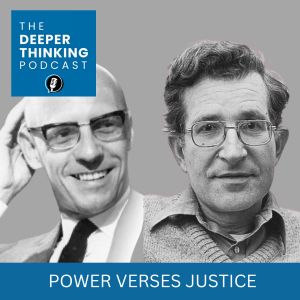
🎙️ Power vs. Justice: Chomsky, Foucault, and the Battle Over Truth
Is justice an objective truth, or just another mechanism of power and control? This question sits at the heart of one of the most provocative intellectual battles of the 20th century—a debate between Noam Chomsky and Michel Foucault that continues to shape how we think about law, ethics, media, and AI-driven governance today.
Chomsky argued that justice is innate, part of human nature, something real and worth fighting for. Foucault, on the other hand, believed that justice is always tied to power—it does not exist independently, but is constructed by those in control.
But if Foucault was right, what does that mean for today’s world? In an era where AI shapes public discourse, where Big Tech curates reality, and where surveillance capitalism dictates who sees what and when, have we already lost the battle they were fighting?
Are We Living in a Foucaultian Nightmare?
Chomsky believed in a rational, universal morality—a foundation for human rights and justice beyond manipulation. But if that were true, how do we explain the manufactured consent that defines modern media? Foucault warned that power is not just held by governments—it is embedded in institutions, technology, and even language itself.
If justice is always tied to power, then can we ever truly separate morality from politics? If our sense of truth is shaped by who controls the narrative, can we ever claim to be on the right side of history?
What We Discuss in This Episode:
Is justice ever truly neutral? – Or is it always a tool of power?
How AI is reshaping truth – Who gets to decide what is real?
Does resistance to oppression create new forms of control? – Are revolutions always doomed to become their own hierarchies?
Can truth exist without power? – Or is reality always a political construct?
If Chomsky is right, there is something real to fight for. If Foucault is right, even that fight may be an illusion.
Why Listen?
This episode explores the deep philosophical battle over justice, power, and truth, blending intellectual history with cutting-edge concerns about AI, media control, and surveillance capitalism. Whether you're searching for:
Chomsky vs. Foucault on justice and power
How AI is shaping media, truth, and control
The role of power in constructing knowledge
Philosophy of justice in the digital age
…this episode delivers a deep, engaging, and highly relevant discussion that uncovers the hidden power structures shaping our world today.
Further Reading
As an Amazon Associate, I earn from qualifying purchases.
📚 Michel Foucault – Discipline and PunishA groundbreaking exploration of how institutions shape knowledge, behavior, and the very definition of justice.
📚 Noam Chomsky & Edward Herman – Manufacturing ConsentAn essential critique of media control, propaganda, and how corporate interests shape democracy.
📚 Kate Crawford – Atlas of AIReveals how AI is not neutral—it extends political and economic power structures in ways we don’t even realize.
📚 Brian Christian – The Alignment ProblemExplores how AI is reshaping moral and ethical norms, sometimes beyond human control.
📚 Shoshana Zuboff – The Age of Surveillance CapitalismShows how Big Tech has redefined control, turning human experience into a marketable asset.
Listen & Subscribe
YouTubeSpotifyApple Podcasts
☕ Support the Podcast
☕ Buy Me a Coffee
If power determines truth, then who controls your reality?
Feb 20, 2025
Feb 20, 2025
38 min
🎙️ Technodissolution: The Erosion of Self in the Digital Age (Read on Medium)
In an era where technology seamlessly integrates into every facet of our lives, have you ever paused to consider the cost of such convenience? Technodissolution delves into the subtle erosion of personal autonomy as algorithms anticipate our desires, and automation streamlines our choices.
Are we willingly trading our agency for efficiency?
What happens when our preferences are shaped before we even form them?
Join us as we explore the profound implications of a world where technology doesn't just serve us but begins to define us.
#Technodissolution #DigitalAge #Automation #AI #PersonalAutonomy #TheDeeperThinkingPodcast #Technology #SelfIdentity #DigitalEra #TechPhilosophy
📚 Further Reading:
"The Age of Surveillance Capitalism" by Shoshana Zuboff
A comprehensive examination of how personal data has become a commodity and the implications for individual autonomy.
Amazon affiliate link
"Digital Minimalism: Choosing a Focused Life in a Noisy World" by Cal Newport
Offers strategies to reclaim control over your digital consumption and maintain autonomy in the digital age.
Amazon affiliate link
"The Shallows: What the Internet Is Doing to Our Brains" by Nicholas Carr
Explores how constant connectivity affects our cognition and sense of self.
Amazon affiliate link
"You Are Not a Gadget: A Manifesto" by Jaron Lanier
A call to preserve human uniqueness in a world increasingly dominated by digital technologies.
Amazon affiliate link
"The Attention Merchants: The Epic Scramble to Get Inside Our Heads" by Tim Wu
Chronicles the history of media companies commodifying human attention and its impact on autonomy.
Amazon affiliate link
"Irresistible: The Rise of Addictive Technology and the Business of Keeping Us Hooked" by Adam Alter
Investigates how technology companies engineer products to be addictive, influencing our behaviors and choices.
Amazon affiliate link
"The Filter Bubble: How the New Personalized Web Is Changing What We Read and How We Think" by Eli Pariser
Discusses how personalized algorithms can limit our exposure to diverse perspectives, subtly shaping our worldview.
Amazon affiliate link
"Alone Together: Why We Expect More from Technology and Less from Each Other" by Sherry Turkle
Explores the paradox of increased connectivity leading to social isolation and its effects on personal identity.
Amazon affiliate link
"The Glass Cage: Automation and Us" by Nicholas Carr
Examines the impact of automation on our jobs, lives, and sense of self-worth.
Amazon affiliate link
"Weapons of Math Destruction: How Big Data Increases Inequality and Threatens Democracy" by Cathy O'Neil
Highlights the dangers of relying on algorithms in decision-making processes and their potential to erode personal agency.
Amazon affiliate link
☕ Support The Deeper Thinking Podcast – Buy Me a Coffee!
Enjoying our deep dives into the intersection of technology and self? Your support enables us to:
Produce more insightful episodes with expert guests
Cover research and production costs to keep content accessible to all
Every coffee fuels our mission to explore profound questions and share knowledge with our community. Show your appreciation and help us continue this journey!
➡️ Buy Me a Coffee Here
🔎 Explore More on Technodissolution:
The Impact of Automation on Personal Autonomy
Algorithmic Influence on Human Behavior
The Psychology of Digital Dependency
Ethical Implications of AI in Daily Life
🎧 Listen Now On:
YouTube
Spotify
Apple Podcasts
📌 Subscribe for deep-dive episodes every week!
🔥 Exclusive Offer: Get Surfshark VPN
Our team relies on Surfshark VPN for secure, unrestricted access to global content across our laptops, phones, and TVs. It enables us to bypass regional restrictions on streaming services
, apps, and news platforms in the UK, US, and Australia while ensuring our online privacy remains intact.
➡️ Get Surfshark VPN here and start browsing securely!
📖 Comprehensive Academic References on Technodissolution
🔍 The Algorithmic Self: How Digital Systems Redefine Identity📚 John Danaher, “Automation and Utopia: Human Flourishing in a World Without Work” (Harvard University Press, 2019)Automation and Utopia
🔍 Surveillance Capitalism & The Commodification of Personal Data📚 Shoshana Zuboff, “The Age of Surveillance Capitalism” (PublicAffairs, 2019)Surveillance Capitalism
🔍 Digital Behaviorism: The Psychology of Algorithmic Influence📚 B.F. Skinner (influence) & Natasha Dow Schüll, “Addiction by Design: Machine Gambling in Las Vegas” (Princeton University Press, 2012)Digital Behaviorism
🔍 The Loss of Decision-Making: The Rise of Predictive AI📚 Frank Pasquale, “The Black Box Society: The Secret Algorithms That Control Money and Information” (Harvard University Press, 2015)Black Box Society
🔍 The Philosophy of Digital Minimalism & Cognitive Overload📚 Cal Newport, “Digital Minimalism: Choosing a Focused Life in a Noisy World” (Portfolio, 2019)Digital Minimalism
Feb 19, 2025
Feb 19, 2025
19 min
🎙️ The Architecture of Thought – The Deeper Thinking Podcast
What if the limits of our thinking are set long before we ever speak? What if the most radical ideas never fully form—not because they are untrue, but because they do not align with the rhythms of discourse that determine what is visible, what is valid, what is sayable?
Today’s episode explores the unseen forces that shape not only what we think, but how we think. Before a thought is articulated, it has already been filtered through systems of knowledge, institutional structures, and algorithmic curation. Thought does not exist in a vacuum—it emerges within a landscape shaped by power, discourse, and cultural inertia.
Michel Foucault warned that power is not merely repressive—it is productive. It determines the architecture of possibility, defining what is conceivable before anyone even attempts to conceive it. Mark Fisher showed how capitalism absorbs resistance, transforming even the most radical critique into entertainment. And Byung-Chul Han argues that in the digital age, intellectual labor has been folded into the logic of self-exploitation, where even thinking has become another measure of productivity.
What happens to the thoughts that never fully emerge?What ideas are abandoned before they are even spoken?If knowledge is curated before it reaches us, can intellectual autonomy truly exist?
To explore more about the concepts and thinkers discussed, including Michel Foucault’s discourse theory, Mark Fisher’s capitalist realism, and Byung-Chul Han’s critique of digital self-exploitation, please go to the description where you’ll find a link to the episode webpage, which includes additional reading, resources, and recommendations.
🎧 Listen Now On:
🔹 YouTube🔹 Spotify🔹 Apple Podcasts
📌 Subscribe for deep-dive episodes every week!
🔥 New episodes every week – Engage with us by liking, sharing, and leaving a review—your support keeps us exploring and thinking deeply.
📚 Further Reading & Research
For those who want to dive deeper into the themes of this episode, here are some must-read books exploring power, discourse, and the control of knowledge.
📌 The following Amazon links are Amazon affiliate links and comply with Amazon’s terms & conditions.
📖 Discipline and Punish – Michel Foucault🔹 A profound exploration of how power structures shape thought and behavior through institutions and discourse.🔗 Amazon affiliate link
📖 Capitalist Realism – Mark Fisher🔹 Argues that capitalism has absorbed all resistance, transforming critique into another form of entertainment.🔗 Amazon affiliate link
📖 The Transparency Society – Byung-Chul Han🔹 Explores how digital culture has eliminated privacy, making surveillance and self-exploitation a defining feature of modern life.🔗 Amazon affiliate link
📖 The Alignment Problem – Brian Christian🔹 Examines how AI and machine learning are reshaping human cognition, ethics, and decision-making.🔗 Amazon affiliate link
📖 The Age of Surveillance Capitalism – Shoshana Zuboff🔹 A groundbreaking work on how corporations manipulate human behavior through algorithmic control and predictive analytics.🔗 Amazon affiliate link
🔎 Further Exploration:
🔹 How power structures shape discourse🔹 The mechanisms of capitalist realism🔹 Digital labor and intellectual self-exploitation
☕ Support The Deeper Thinking Podcast – Buy Me a Coffee!
Love our deep-dive discussions on philosophy, power, and technology? Your support helps us:✅ Produce more in-depth episodes with expert insights✅ Cover research & hosting costs to keep content free for all
Every coffee fuels our mission to think deeper, ask better questions, and share knowledge with our community. Plus, it’s a great way to show your appreciation!
➡️ Buy Me a Coffee Here
📌 Thank you for supporting independent thinkers and meaningful conversations!
🔥 Exclusive Offer: Get Surfshark VPN
The internet isn’t neutral—what you see is curated, filtered, and often restricted. Protect your data, access global content, and browse freely with Surfshark VPN. Whether you’re reading about philosophy or watching restricted content, a VPN ensures that your access to knowledge remains uncensored.
➡️ Get Surfshark VPN here!
Philosophy #Foucault #MarkFisher #CapitalistRealism #ByungChulHan #TheDeeperThinkingPodcast #IntellectualAutonomy #KnowledgePower #AIandThought
Feb 14, 2025
Feb 14, 2025
9 min
🎙️ Redefining Governance: Power, Technology, and the Human Cost – The Deeper Thinking Podcast
What happens when the pursuit of efficiency overrides human welfare? When legal norms are suspended in favor of unchecked power? And when governance becomes a playground for corporate ambition? In this episode, we explore the intersection of political power and technological influence, where institutions are dismantled, protections vanish, and the human cost is often overlooked. Join us as we examine the quiet erosion of democratic safeguards through the lens of critical philosophy, reflecting on responsibility, resistance, and the ever-blurring line between state and market.
#Philosophy #Politics #Technology #Governance #CriticalTheory #ElonMusk #Project2025 #PowerDynamics #Capitalism #Democracy
🎧 Listen Now On:🔹 YouTube🔹 Spotify🔹 Apple Podcasts
📌 Subscribe for deep-dive episodes every week!
📚 Recommended Reading – Explore the critical works that inspired this episode. All links are Amazon affiliate links and help support the podcast at no extra cost to you.
📖 Capitalist Realism – Mark Fisher🔹 An essential critique of late capitalism and its pervasive influence on politics, culture, and governance.🔗 Amazon affiliate link
📖 Homo Sacer: Sovereign Power and Bare Life – Giorgio Agamben🔹 Analyzes the intersection of political power and human rights, exploring the limits of state control.🔗 Amazon affiliate link
📖 The Ethics of Ambiguity – Simone de Beauvoir🔹 A profound exploration of freedom, responsibility, and the human condition in political life.🔗 Amazon affiliate link
📖 The Age of Surveillance Capitalism – Shoshana Zuboff🔹 A groundbreaking critique of how technology companies exploit data for power and profit.🔗 Amazon affiliate link
📖 Post-Capitalist Desire – Mark Fisher🔹 Examines the possibilities for alternatives to capitalist systems through critical theory and political imagination.🔗 Amazon affiliate link
📖 The Society of the Spectacle – Guy Debord🔹 A classic work on how media and technology shape public perception and political reality.🔗 Amazon affiliate link
📖 Technopoly: The Surrender of Culture to Technology – Neil Postman🔹 Explores the cultural and political consequences of technology’s unchecked growth.🔗 Amazon affiliate link
📖 The Shock Doctrine – Naomi Klein🔹 Investigates how economic crises are exploited to erode democracy and impose neoliberal policies.🔗 Amazon affiliate link
📖 Undoing the Demos – Wendy Brown🔹 A sharp analysis of how neoliberalism is reshaping democratic institutions and political life.🔗 Amazon affiliate link
📖 State of Exception – Giorgio Agamben🔹 Explores how governments use states of emergency to bypass legal and democratic norms.🔗 Amazon affiliate link
🔎 Explore Further:Governance, Technology, and the Erosion of Democracy
🛡️ Stay secure online with Surfshark VPN. Protect your data, browse without limits, and enjoy peace of mind. Our go-to VPN for accessing global content securely across all devices.➡️ Get Surfshark VPN here and start browsing securely!
☕ Support The Deeper Thinking Podcast – Buy Me a Coffee!Love our deep-dive discussions on power, politics, and technology? Your support helps us:✅ Produce more in-depth episodes with expert insights✅ Cover research & hosting costs to keep content free for all
Every coffee fuels our mission to think deeper, ask better questions, and challenge systems of power and governance.➡️ Buy Me a Coffee Here
📌 Thank you for supporting independent thinkers and meaningful conversations!🔔 Subscribe & never miss a deep-dive discussion.

Feb 14, 2025
Feb 14, 2025
7 min
How AI is Redefining Humanity – The Deeper Thinking PodcastArtificial intelligence no longer merely serves humanity—it reshapes it. What happens when algorithms understand us better than we understand ourselves? When machines optimize industries with ruthless precision, leaving human labor behind? As AI disrupts everything from finance to healthcare, are we enhancing human potential or erasing it? This episode unpacks the profound consequences of AI’s silent revolution and its relentless march into our daily lives. Are we still in control—or are we merely passengers in a world governed by algorithms?
#ArtificialIntelligence #AIRevolution #TechPhilosophy #DonnaHaraway #Baudrillard #TechEthics #FutureOfWork #Automation #TechPodcast #DeeperThinking
📚 Recommended Reads (Amazon affiliate links):📖 The Age of Surveillance Capitalism – Shoshana Zuboff🔗 Amazon affiliate link📖 Superintelligence: Paths, Dangers, Strategies – Nick Bostrom🔗 Amazon affiliate link📖 Simulacra and Simulation – Jean Baudrillard🔗 Amazon affiliate link📖 The Cyborg Manifesto – Donna Haraway🔗 Amazon affiliate link📖 Capitalist Realism – Mark Fisher🔗 Amazon affiliate link📖 Technopoly: The Surrender of Culture to Technology – Neil Postman🔗 Amazon affiliate link📖 Posthuman Knowledge – Rosi Braidotti🔗 Amazon affiliate link📖 Algorithms of Oppression – Safiya Umoja Noble🔗 Amazon affiliate link📖 AI Superpowers: China, Silicon Valley, and the New World Order – Kai-Fu Lee🔗 Amazon affiliate link📖 Weapons of Math Destruction – Cathy O’Neil🔗 Amazon affiliate link☕ Support The Deeper Thinking Podcast – Buy Me a Coffee!➡️ Buy Me a Coffee Here🔎 Explore Further:AI Ethics and Human AutonomyAI and Labor DisplacementHuman-Machine HybridityPhilosophical Implications of AI🎧 Listen to This Episode Now:🔹 Spotify🔹 Apple Podcasts🔹 YouTube🛡️ Surfshark VPN – Protect Your Digital Life!Stay secure while streaming, browsing, or working. Get 83% off Surfshark VPN + 3 months free!➡️ Subscribe to Surfshark VPN Here
Feb 13, 2025
Feb 13, 2025
14 min
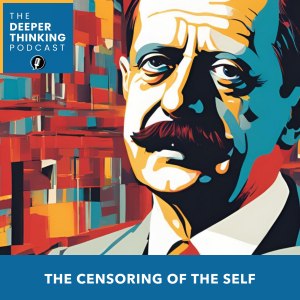
🎙️ The Censoring of the Self – The Deeper Thinking Podcast
Apologies for.previously uploading the wrong version in error.
This episode shifts backwards and forwards between different timelines and contexts. The opening starts with Edward Bernays, an American pioneer in the field of public relations and propaganda, and referred to in his obituary, his techniques have been criticized for manipulating public opinion, often in ways that undermined individual autonomy.
....
What happens when control no longer requires force?When an algorithm does not need to censor us because we have already learned to censor ourselves?Are we shaping our identities, or are we simply refining ourselves into the most compliant version of what the system desires?
Inspired by Adam Curtis’s The Century of the Self, this episode unpacks the shift from overt propaganda to the seamless influence of algorithmic feedback loops. Unlike the past, when power needed institutions, executives, and gatekeepers, today’s digital ecosystem operates without a central authority—because it does not need one. We have trained the machine, and in turn, the machine has trained us.
Through the lenses of Jean Baudrillard’s hyperreality, Michel Foucault’s self-discipline, and Edward Bernays’ legacy of manufactured consent, we explore how modern platforms have turned self-expression into a form of labor, attention into currency, and identity into an optimized product.
Have we become self-regulating data points, performing an illusion of freedom?Or is there still a way to reclaim the self from the algorithm?
🎧 Listen Now On:
🔹 YouTube🔹 Spotify🔹 Apple Podcasts
📌 Subscribe for deep-dive episodes every week!
🔥 New episodes every week – Engage with us by liking, sharing, and leaving a review—your support keeps us exploring and thinking deeply.
📚 Further Reading & Recommended Books
For those who want to dive deeper into the mechanics of self-censorship, algorithmic control, and the psychological shaping of society, these books provide essential perspectives.
📌 The following Amazon links are Amazon affiliate links and comply with Amazon’s terms & conditions.
📖 Propaganda – Edward Bernays🔹 A foundational work on the engineering of consent and the mechanisms of modern influence.🔗 Amazon affiliate link
📖 Simulacra and Simulation – Jean Baudrillard🔹 Explores how media and representation have blurred the lines between reality and illusion.🔗 Amazon affiliate link
📖 Discipline and Punish – Michel Foucault🔹 A study of how power operates through surveillance, normalization, and self-regulation.🔗 Amazon affiliate link
📖 The Society of the Spectacle – Guy Debord🔹 Examines how media turns lived experience into a passive spectacle.🔗 Amazon affiliate link
📖 The Age of Surveillance Capitalism – Shoshana Zuboff🔹 Reveals how data-driven platforms commodify personal behavior.🔗 Amazon affiliate link
📖 Who Owns the Future? – Jaron Lanier🔹 A critical look at how digital platforms exploit user data for profit.🔗 Amazon affiliate link
📖 The Medium is the Message – Marshall McLuhan🔹 A groundbreaking analysis of how media shapes thought itself.🔗 Amazon affiliate link
📖 The Attention Merchants – Tim Wu🔹 Explores how corporations have turned human attention into a global commodity.🔗 Amazon affiliate link
📖 Manufacturing Consent – Noam Chomsky & Edward S. Herman🔹 Exposes how media systems function as tools of political and corporate power.🔗 Amazon affiliate link
📖 Reality+ – David Chalmers🔹 A philosophical investigation into how virtual and digital realities shape truth and perception.🔗 Amazon affiliate link
🔎 Further Research & Academic Resources:
Baudrillard’s HyperrealityFoucault’s BiopoliticsThe Century of the Self DocumentaryAlgorithmic Bias and Behavioral Engineering
🔥 Exclusive Offer: Get Surfshark VPN
In a world where algorithms track, profile, and influence every digital move, online privacy is not optional—it’s essential. Surfshark VPN keeps your browsing secure, private, and unrestricted.
➡️ Get Surfshark VPN here and take control of your data!
☕ Support The Deeper Thinking Podcast – Buy Me a Coffee!
Love our deep-dive discussions on AI, philosophy, and media control? Your support helps us:✅ Produce more in-depth episodes with expert insights✅ Cover research & hosting costs to keep content free for all
Every coffee fuels our mission to think deeper, ask better questions, and challenge dominant narratives.
➡️ Buy Me a Coffee Here
📌 Thank you for supporting independent thinkers and meaningful conversations!
🔔 Subscribe & never miss a deep-dive discussion.📌 Follow us on social media for more thought-provoking content!
#ArtificialIntelligence #MediaManipulation #SelfCensorship #TheCenturyOfTheSelf #Baudrillard #Foucault #Chomsky #TheAttentionEconomy #SurveillanceCapitalism #AlgorithmicBias #AdamCurtis