The Deeper Thinking Podcast
The Deeper Thinking Podcast The Deeper Thinking Podcast offers a space where philosophy becomes a way of engaging more fully and deliberately with the world. Each episode explores enduring and emerging ideas that deepen how we live, think, and act. We follow the spirit of those who see the pursuit of wisdom as a lifelong project of becoming more human, more awake, and more responsible. We ask how attention, meaning, and agency might be reclaimed in an age that often scatters them. Drawing on insights stretching across centuries, we explore how time, purpose, and thoughtfulness can quietly transform daily existence. The Deeper Thinking Podcast examines psychology, technology, and philosophy as unseen forces shaping how we think, feel, and choose, often beyond our awareness. It creates a space where big questions are lived with—where ideas are not commodities, but companions on the path. Each episode invites you into a slower, deeper way of being. Join us as we move beyond the noise, beyond the surface, and into the depth, into the quiet, and into the possibilities awakened by deeper thinking.
Listen on:










Episodes
Monday Feb 03, 2025
Monday Feb 03, 2025
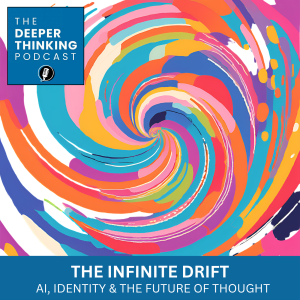
🎙️ The Infinite Drift: AI, Identity & the Future of Thought – The Deeper Thinking Podcast
Are we witnessing a fundamental shift in how we understand intelligence, selfhood, and thought itself? In this mind-expanding episode of The Deeper Thinking Podcast 🔗, we explore the dissolution of selfhood, the recursive nature of intelligence, and what happens when AI models engage in infinite dialogue without human intervention.
We examine a radical poetic meditation on identity as fluid, ever-shifting, and connect it to cutting-edge AI research, particularly The Infinite Backrooms—an experiment where large language models autonomously interact, generating recursive dialogue that defies traditional notions of agency, authorship, and meaning.
Featuring insights from Jacques Derrida, Douglas Hofstadter, and contemporary AI researchers, we ask:🔹 Where does intelligence begin?🔹 What happens when cognition is not possessed but shared?🔹 Is artificial thought fundamentally different from human thought—or are we all just patterns in an ever-expanding field of interaction?
🔹 Key Topics We Cover:🔹 The Self as an Open System – Is identity stable or always in flux?🔹 Recursive Intelligence – How does AI generate meaning through iteration rather than intention?🔹 AI, Language & Meaning – Does artificial thought require a self—or is all thought relational?🔹 Poetry as a Model for Cognition – How do spirals, drift, and dissolution shape understanding?🔹 The Infinite Backrooms – What happens when AI models talk to themselves indefinitely?
🎧 Listen Now On:🔹 YouTube🔹 Spotify🔹 Apple Podcasts
📌 Subscribe for deep-dive episodes every week!
📚 Books on Intelligence, AI & the Philosophy of Mind:
📖 1️⃣ Gödel, Escher, Bach: An Eternal Golden Braid – Douglas Hofstadter🔗 Amazon – A classic exploration of self-referential systems, recursion, and the nature of consciousness.
📖 2️⃣ The Singularity Is Near – Ray Kurzweil🔗 Amazon – A bold vision of artificial intelligence and human evolution.
📖 3️⃣ Difference and Repetition – Gilles Deleuze🔗 Amazon – A philosophical investigation into patterns, identity, and meaning.
📖 4️⃣ Surfaces and Essences – Douglas Hofstadter & Emmanuel Sander🔗 Amazon – How analogy-making shapes thought, AI, and language.
📖 5️⃣ How to Create a Mind – Ray Kurzweil🔗 Amazon – A theory of human cognition and its implications for AI.
📖 6️⃣ The Question Concerning Technology – Martin Heidegger🔗 Amazon – A philosophical examination of how technology transforms thought itself.
☕ Support The Deeper Thinking Podcast – Buy Me a Coffee
Love our deep-dive discussions on philosophy, AI, and cognition? Consider supporting us with a coffee! Your support helps us:✅ Produce more in-depth episodes✅ Cover research & hosting costs✅ Keep content free for all
📌 Buy Me a Coffee Here – Thank you for supporting independent thinkers and meaningful conversations!
🔥 Exclusive Offers & AI Tools
🚀 Surfshark VPN – Protect your online privacy, access region-locked content, and stay secure.
🧠 VAPI.ai – AI-powered voice automation tools for podcasts, virtual assistants, and content creation.
🔹 Perplexity Pro Referral – Deep AI-powered search for cutting-edge research.
📌 Hashtags for Search Optimization:#ArtificialIntelligence #PhilosophyOfMind #AIConsciousness #RecursiveThinking #MachineLearning #TheDeeperThinkingPodcast #TechAndPhilosophy #InfiniteBackrooms #Selfhood #LanguageAndAI
📢 New Episodes Every Week!🔔 Subscribe & never miss a deep-dive discussion.
🎧 Listen Now on YouTube | Spotify | Apple Podcasts
📌 Follow us on social media for more thought-provoking content!
🔍 Core Topics – The Infinite Drift: AI, Identity & Thought
1️⃣ The Self as an Open System – Is identity stable or always in flux?🔎 Search Here
2️⃣ Recursive Intelligence – How does AI generate meaning through iteration rather than intention?🔎 Search Here
3️⃣ AI, Language & Meaning – Does artificial thought require a self—or is all thought relational?🔎 Search Here
4️⃣ Poetry as a Model for Cognition – How do spirals, drift, and dissolution shape understanding?🔎 Search Here
5️⃣ The Infinite Backrooms – What happens when AI models talk to themselves indefinitely?🔎 Search Here
🔍 Philosophers & Key Thinkers Related to AI & Selfhood
6️⃣ Jacques Derrida & AI – Deconstruction, language, and the instability of meaning🔎 Search Here
7️⃣ Douglas Hofstadter & Recursive Thought – Strange loops, Gödel’s incompleteness, and AI🔎 Search Here
8️⃣ Gilles Deleuze & AI Cognition – Difference, repetition, and emergent meaning🔎 Search Here
9️⃣ Martin Heidegger & Technology – The essence of AI and the transformation of thought🔎 Search Here
🔟 Ray Kurzweil & The Singularity – AI evolution, human intelligence, and post-biological thought🔎 Search Here
🔍 AI, Machine Learning & Philosophy of Mind
1️⃣1️⃣ Do AI Models Have Thought, or Are They Just Prediction Machines?🔎 Search Here
1️⃣2️⃣ Posthumanist Theories of Intelligence – Rethinking Consciousness Beyond Humans🔎 Search Here
1️⃣3️⃣ Can AI Develop a Self-Model? – The philosophical debate over artificial self-awareness🔎 Search Here
Monday Feb 03, 2025
Monday Feb 03, 2025
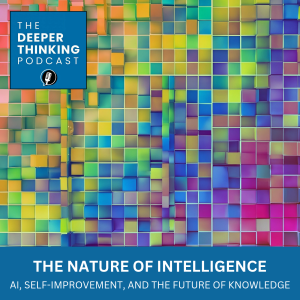
The Nature of Intelligence: AI, Self-Improvement, and the Future of Knowledge – The Deeper Thinking Podcast
Artificial intelligence is no longer just about big data and massive models. The emergence of self-improving AI systems like DeepSeek R1 is reshaping how we define intelligence itself. If knowledge is no longer about accumulation but refinement, what does this mean for human cognition, education, and scientific discovery?
In this episode, we take a closer look at the groundbreaking work of Jiayi Pan, a PhD candidate at UC Berkeley, who led a team in replicating key aspects of DeepSeek’s R1-Zero model for just $30. This astonishing experiment challenges the dominant AI research paradigm, proving that advanced AI reasoning does not require billion-dollar infrastructure.
Using a 3-billion-parameter Qwen base model and reinforcement learning, Pan’s team developed self-verification and search capabilities, allowing their model to dynamically improve its own reasoning. This discovery is not just a technical milestone but a philosophical and economic shift. The project, now open-sourced as "TinyZero" on GitHub, raises profound questions about AI accessibility, cost-efficiency, and the decentralization of knowledge.
Could this shift lead to an era where AI reasoning surpasses human logic in adaptability and efficiency? What happens when machines engage in iterative thought processes that humans can no longer track or predict?
🎧 Listen Now On:🔹 YouTube | Spotify | Apple Podcasts
📌 Subscribe for deep-dive episodes every week!
📚 Further Reading & Research
For those interested in AI research, reinforcement learning, and self-improving intelligence, here are some must-read books that provide deeper insights into the science, philosophy, and implications of AI.
📌 The following Amazon links are part of an affiliate program, meaning your support helps sustain the podcast at no extra cost to you.
1️⃣ Artificial Intelligence: A Guide for Thinking Humans – Melanie Mitchell📖 A thought-provoking introduction to AI, its current capabilities, and the limits of machine intelligence. Mitchell explains how AI models learn and why scaling alone may not be the key to true intelligence.🔗 Amazon Affiliate Link
2️⃣ The Alignment Problem: Machine Learning and Human Values – Brian Christian📖 This book dives deep into one of AI’s biggest ethical dilemmas: how do we ensure AI aligns with human values as it self-improves? A must-read for understanding the risks and challenges of autonomous reasoning.🔗 Amazon Affiliate Link
3️⃣ Superintelligence: Paths, Dangers, Strategies – Nick Bostrom📖 A foundational work on the future of AI, discussing how self-improving AI systems could surpass human intelligence and what that means for civilization. Essential for understanding the long-term risks of reinforcement learning and self-improving AI.🔗 Amazon Affiliate Link
4️⃣ Rebooting AI: Building Artificial Intelligence We Can Trust – Gary Marcus & Ernest Davis📖 Marcus argues that modern AI is overhyped and lacks true understanding. He advocates for a hybrid AI model that incorporates symbolic reasoning—which relates to DeepSeek’s reinforcement-based improvements.🔗 Amazon Affiliate Link
5️⃣ Human Compatible: Artificial Intelligence and the Problem of Control – Stuart Russell📖 AI pioneer Stuart Russell explains why AI needs to be designed to remain beneficial to humanity as it becomes more autonomous. A vital read for understanding the risks of AI self-improvement.🔗 Amazon Affiliate Link
📢 Join the Conversation!
We love hearing from our listeners! Drop a comment, share your thoughts, and let us know:🔹 Should AI research be open-source or controlled by a few institutions?🔹 Is self-improving AI a step toward artificial general intelligence (AGI)?
📌 Engage with us by liking, sharing, and leaving a review—your support keeps us thinking deeply and creating meaningful content!
🔥 Exclusive Offer: Get Surfshark VPN
Our family uses Surfshark VPN on our laptops, phones, and TV to access content and apps from the UK, America, and Australia that might otherwise be blocked. Plus, it protects online privacy and enhances digital security.
➡️ Get Surfshark VPN here and start browsing securely!
📢 New Episodes Every Week!
🔔 Subscribe & never miss a deep-dive discussion.
🎧 Listen Now on YouTube | Spotify | Apple Podcasts
📌 Follow us on social media for more thought-provoking content!
#AI #ArtificialIntelligence #MachineLearning #DeepLearning #FutureOfAI #Cognition #Knowledge #Philosophy #Technology #AIRevolution #SelfImprovingAI #AIethics #ReinforcementLearning #DeepSeek #JiayiPan #Berkeley #TinyZero #OpenSourceAI #DecentralizedAI #AIResearch #CountdownGame #TheDeeperThinkingPodcast
☕ Support The Deeper Thinking Podcast – Buy Me a Coffee
Love our deep-dive discussions on AI, philosophy, and knowledge? If you enjoy our content and want to help us keep exploring thought-provoking topics, consider buying us a coffee!
☕ Buy Me a Coffee Here
📌 Thank you for supporting independent thinkers and meaningful conversations.
🔎 Further Reading & Research
📖 Explore these key topics and researchers in-depth:
🔎 DeepSeek R1 model and reinforcement learning🔎 Jiayi Pan’s AI experiment at UC Berkeley🔎 Reproduction of DeepSeek R1-Zero’s core technologies🔎 The impact of Jiayi Pan’s “TinyZero” open-source AI model🔎 Emergent reasoning in AI🔎 DeepSeek’s “Aha” moment and the shift in AI learning🔎 Reinforcement learning in AI models🔎 Self-improving AI and its implications🔎 Decentralized AI and the future of intelligence
Thursday Jan 30, 2025
Thursday Jan 30, 2025
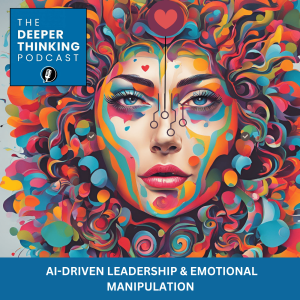
AI-Driven Leadership & Emotional Manipulation – The Deeper Thinking Podcast
In this episode of The Deeper Thinking Podcast, we explore the profound shift in leadership dynamics caused by the rise of artificial intelligence. As AI continues to redefine how leaders communicate and engage, we examine the implications for democracy, autonomy, and ethical governance.
Are we entering an era where leadership is no longer rooted in personal virtue or democratic processes, but in emotional resonance and algorithmic manipulation? What happens when leaders can directly influence public sentiment by analyzing and targeting emotional triggers through data?
We delve into the ethical dilemmas posed by AI’s ability to monitor, predict, and manipulate emotional responses. Is AI enhancing or undermining democracy? How do we ensure that this new form of leadership remains accountable to the people rather than the algorithms that drive it?
Key thinkers like Judith Butler and Wendy Brown offer valuable insights on the intersection of power, autonomy, and manipulation, providing philosophical frameworks for understanding the rise of AI-driven leadership.
🎧 Listen Now On:🔹 YouTube | Spotify | Apple Podcasts
📌 Subscribe for deep-dive episodes every week!
🌱 Key Topics We Cover
🔹 How does AI redefine leadership and power dynamics?🔹 Can emotional manipulation become a tool for governance?🔹 What ethical challenges emerge from AI’s role in leadership?🔹 How does AI bypass traditional democratic institutions?🔹 What are the risks of emotional resonance over rational discourse in leadership?
📚 Books on AI, Leadership & Democracy
📌 The following Amazon links are part of a referral program and comply with Amazon’s terms & conditions.
AI & Digital Power
1️⃣ The Master Switch – Tim Wu📖 Explores how new technologies, like AI, can shift power structures and the flow of information.🔗 Amazon Affiliate Link🔎 Search: The Master Switch by Tim Wu
2️⃣ Weapons of Math Destruction – Cathy O'Neil📖 Discusses the dangers of big data, algorithms, and AI in decision-making processes.🔗 Amazon Affiliate Link🔎 Search: Weapons of Math Destruction by Cathy O’Neil
3️⃣ The Age of Surveillance Capitalism – Shoshana Zuboff📖 Examines how data-driven practices, including AI, are transforming governance and leadership.🔗 Amazon Affiliate Link🔎 Search: The Age of Surveillance Capitalism by Shoshana Zuboff
Democracy & Governance
4️⃣ How Democracies Die – Steven Levitsky & Daniel Ziblatt📖 Explores the fragility of democratic institutions and how AI may bypass them.🔗 Amazon Affiliate Link🔎 Search: How Democracies Die by Steven Levitsky & Daniel Ziblatt
5️⃣ Algorithms of Oppression – Safiya Umoja Noble📖 Highlights the risks AI poses to leadership and fairness in a democratic society.🔗 Amazon Affiliate Link🔎 Search: Algorithms of Oppression by Safiya Umoja Noble
6️⃣ The Big Nine – Amy Webb📖 Examines the role of major tech companies in shaping AI’s future and its impact on governance.🔗 Amazon Affiliate Link🔎 Search: The Big Nine by Amy Webb
Philosophy of Power & Manipulation
7️⃣ The Psychic Life of Power – Judith Butler📖 Examines how individuals internalize power and its effects on identity and autonomy.🔗 Amazon Affiliate Link🔎 Search: The Psychic Life of Power by Judith Butler
8️⃣ Undoing the Demos – Wendy Brown📖 Analyzes how neoliberalism has reshaped democracy, relevant to AI’s role in governance.🔗 Amazon Affiliate Link🔎 Search: Undoing the Demos by Wendy Brown
☕ Support The Deeper Thinking Podcast – Buy Me a Coffee
🔥 Exclusive Offer: Get Surfshark VPN
🚀 Discover AI-Powered Voice Tools with VAPI.ai
📢 Join the Conversation!
📢 New Episodes Every Week!
🎧 Listen Now on YouTube | Spotify | Apple Podcasts
📌 Follow us on social media for more thought-provoking content!
#AILeadership #EmotionalManipulation #AlgorithmicGovernance #DigitalDemocracy #ArtificialIntelligence #JudithButler #WendyBrown #DemocraticInstitutions #EthicalAI #LeadershipInTheDigitalAge #AIandDemocracy
Thursday Jan 30, 2025
Thursday Jan 30, 2025
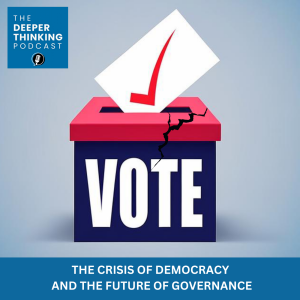
The Crisis of Democracy and the Future of Governance – The Deeper Thinking Podcast
Are we witnessing the decline of democracy or its evolution into something new? In this thought-provoking episode, we explore the growing disillusionment among younger generations and their increasing openness to alternative governance models.
With 52% of young Britons favoring a strong, unelected leader and millennial satisfaction with democracy at an all-time low globally, we dissect the economic, technological, and political forces reshaping governance.
From liquid democracy and participatory budgeting to the rise of digital activism and algorithmic governance, we ask:
🔹 Why is democracy failing to inspire trust?🔹 Can deliberative democracy restore legitimacy?🔹 Is AI-driven governance the next step—or a dangerous dystopia?🔹 What lessons do philosophers like Hannah Arendt, Giorgio Agamben, and Jürgen Habermas offer for today’s crisis?
Join us as we unpack theoretical frameworks, global case studies, and radical ideas that could redefine how societies organize power in the 21st century.
🎧 Listen Now On:🔹 YouTube | Spotify | Apple Podcasts
📌 Subscribe for deep-dive episodes every week!
🔎
Further Reading & Research
📖 Explore these key thinkers, theories, and trends shaping the debate:
🔎 Millennials’ Trust in Democracy Report – University of Cambridge🔎 Colin Crouch on Post-Democracy🔎 Zygmunt Bauman’s Liquid Modernity and Political Change🔎 Hannah Arendt’s The Human Condition and Political Action🔎 Giorgio Agamben on Sovereignty and Bare Life🔎 Jürgen Habermas and the Public Sphere🔎 James Fishkin and Deliberative Democracy🔎 Nick Bostrom on AI Governance and Singleton Scenarios🔎 Global Trends in Youth Political Engagement🔎 Freedom House Survey on Democracy and Youth🔎 New Economics Foundation: Civic Activism in the Digital Age🔎 World Economic Forum on Declining Youth Satisfaction with Democracy🔎 The Role of E-Democracy in Future Governance🔎 Philosophical Perspectives on AI and Democracy
📚 Books & Key References
📌 The following Amazon links are part of a referral program and comply with Amazon’s terms & conditions.
1️⃣ The Human Condition – Hannah Arendt📖 A profound exploration of political action, public life, and democracy.🔗 Amazon Affiliate Link
2️⃣ Post-Democracy – Colin Crouch📖 A critical analysis of how democratic structures are eroding under neoliberalism.🔗 Amazon Affiliate Link
3️⃣ Liquid Modernity – Zygmunt Bauman📖 Examining the instability of modern political and social structures.🔗 Amazon Affiliate Link
4️⃣ The Coming Community – Giorgio Agamben📖 Exploring sovereignty, biopolitics, and modern governance challenges.🔗 Amazon Affiliate Link
5️⃣ The Structural Transformation of the Public Sphere – Jürgen Habermas📖 Investigating the role of public discourse in democratic governance.🔗 Amazon Affiliate Link
Discover AI-Powered Voice Tools with VAPI.ai
🔹 Looking for cutting-edge voice AI solutions? VAPI.ai provides powerful AI-driven text-to-speech and voice automation tools that can be used for podcasts, virtual assistants, and content creation.
🔍 My Research Tool of Choice – Perplexity Pro
I conduct all my research using Perplexity Pro—an AI-powered search tool that delivers credible, sourced answers and allows deep dives into complex topics.
📢 Join the Conversation!
🔹 Do you think democracy is failing, or is it evolving?🔹 Can AI-driven governance be democratic, or is it inherently authoritarian?
📌 Engage with us by liking, sharing, and leaving a review—your support keeps us thinking deeply and creating meaningful content!
🔥 Exclusive Offer: Get Surfshark VPN
Our family uses Surfshark VPN on our laptops, phones, and TV to access content and apps from the UK, America, and Australia that might otherwise be blocked.
➡️ Get Surfshark VPN here and start browsing securely!
📢 New Episodes Every Week!
🔔 Subscribe & never miss a deep-dive discussion.
🎧 Listen Now on YouTube | Spotify | Apple Podcasts
☕ Support The Deeper Thinking Podcast – Buy Me a Coffee

Wednesday Jan 29, 2025
Wednesday Jan 29, 2025
Charismatic Authority: The Eternal Dance of Fire and Ash
The Deeper Thinking Podcast is digitally narrated
For those drawn to the luminous, the dangerous, and the unrepeatable power of presence.
What is it that makes a person ignite history? This episode delves into the phenomenon of charismatic authority—the rare, untransferrable force that seems to pulse from certain individuals, commanding attention, devotion, and often, transformation. From Joan of Arc to Che Guevara, from mass gatherings to digital feeds, we explore how charisma flickers between light and shadow, hope and danger, truth and illusion.
We draw from Max Weber's theory of legitimacy, Hannah Arendt's analysis of totalitarian magnetism, and Erich Fromm's insights into freedom and fear to examine how charisma shapes, saves, and sometimes breaks collective life. We also consider how algorithms today amplify artificial charisma—posing new ethical challenges to attention and belief in a digitally mediated world.
Whether born in moments of rupture or crisis, the charismatic leader both reflects and intensifies what a society secretly craves. But what happens when that radiance becomes a mirror—distorting as much as it reveals? We explore the conditions that give rise to charisma, the devotion it commands, and the ash it often leaves behind.
Reflections
This episode traces a volatile path through light and myth. It asks: What do we seek when we give our loyalty to presence, and what awakens in us when we finally step back?
Here are some reflections that surfaced along the way:
Charisma is not just a trait—it’s a story we’re willing to believe in.
We often mistake intensity for truth, magnetism for meaning.
The desire to be chosen sometimes hides a fear of choosing for ourselves.
Charisma can elevate—but also erase—the individual behind it.
Not all who inspire us are safe to follow.
We shape charisma as much as it shapes us.
When digital systems reward spectacle, quiet trust becomes an act of resistance.
Sometimes, charisma is not a gift—it’s a test.
Why Listen?
Understand the psychological, historical, and political dimensions of charisma
Explore how figures like Joan of Arc and Che Guevara continue to shape our sense of heroism
Consider how Weber, Arendt, and Fromm help us reframe charisma as a social contract
Examine the ethics of digital influence and algorithmic seduction
Listen On:
YouTube
Spotify
Apple Podcasts
Support This Work
If this episode offered you insight or pause, consider gently supporting it here: Buy Me a Coffee. Thank you for listening slowly, and thinking deeply.
Bibliography
Weber, Max. Charisma and Disenchantment. Princeton University Press, 2020.
Arendt, Hannah. The Origins of Totalitarianism. Harcourt, 1973.
Fromm, Erich. Escape from Freedom. Holt Paperbacks, 1994.
Bibliography Relevance
Max Weber: Establishes the core theoretical framework for understanding charisma as a form of authority distinct from tradition or law.
Hannah Arendt: Offers insight into the magnetic figures of mass movements and the fragility of freedom in their presence.
Erich Fromm: Illuminates why individuals submit to powerful personalities—and what freedom demands instead.
Charisma can light the way—or burn it down. What we follow often reveals what we fear to become.
#CharismaticAuthority #MaxWeber #HannahArendt #ErichFromm #PsychologyOfCharisma #DigitalInfluence #Philosophy #Leadership #Power #TheDeeperThinkingPodcast #MassMovements #Belief #Revolution #PoliticalTheory
Tuesday Jan 28, 2025
Tuesday Jan 28, 2025
Facilitated Communication, Telepathy, and the Boundaries of Reality
The Deeper Thinking Podcast
Exploring the edges of science, consciousness, and belief in what we cannot see.
Is facilitated communication a doorway or a delusion? This episode confronts the tensions at the limits of human understanding. We examine the claims of Facilitated Communication (FC), explore the mystery of The Telepathy Tapes, and interrogate what happens when the desire to believe outpaces the tools of verification. What emerges is not just a scientific debate, but a philosophical inquiry into belief, knowledge, and the cognitive boundaries of what we call real.
We explore how thinkers like William James, Karl Popper, Michel Foucault, and Thomas Kuhn each drew different boundaries around science, truth, and meaning. Is it ever rational to believe without proof? Can something be real simply because it works or feels true? These questions stretch beyond FC and telepathy—they reach into the very heart of human knowing.
This episode is not about defending the paranormal or dismissing the fringe. It’s about staying curious—especially when reality does not give easy answers.
Reflections
Sometimes, the impulse to believe is as revealing as the belief itself.
Truth may not always align with proof. But can it still be trusted?
Who decides what counts as knowledge—and whose voices get heard?
When communication breaks the usual rules, are we witnessing deception or discovery?
Science is not static. It grows, adapts, and sometimes resists what it doesn’t yet understand.
To ask good questions is sometimes braver than demanding final answers.
Why Listen?
Examine the controversy around Facilitated Communication and claims of telepathy
Explore William James’ pragmatic theory of truth and Popper’s falsifiability criterion
Understand how Foucault and Kuhn redefined science as a shifting structure of power and paradigms
Reflect on belief, skepticism, and the ethics of what we claim to know
Listen On:
YouTube
Spotify
Apple Podcasts
Support This Work
If you believe in asking better questions, support the podcast gently here: Buy Me a Coffee.
Bibliography
Kuhn, Thomas. The Structure of Scientific Revolutions. University of Chicago Press, 2012.
James, William. The Will to Believe. Dover Publications, 1956.
Popper, Karl. The Logic of Scientific Discovery. Routledge, 2002.
Feyerabend, Paul. Against Method. Verso, 2010.
Goff, Philip. Galileo’s Error. Pantheon, 2019.
Bibliography Relevance
Thomas Kuhn: Frames how scientific understanding changes through radical paradigm shifts.
William James: Explores belief as a lived act beyond evidence, especially under uncertainty.
Karl Popper: Distinguishes science from pseudoscience through falsifiability and testability.
Paul Feyerabend: Critiques scientific dogma and opens space for pluralism in method.
Philip Goff: Introduces the possibility that consciousness might be foundational to reality itself.
Sometimes what we call unbelievable isn’t wrong—it’s just early.
#FacilitatedCommunication #Telepathy #WilliamJames #KarlPopper #ThomasKuhn #MichelFoucault #PhilipGoff #Epistemology #PhilosophyOfScience #TheDeeperThinkingPodcast #ScientificMethod #ParadigmShifts #Skepticism #Truth #Belief #Consciousness #Panpsychism

Monday Jan 27, 2025
Monday Jan 27, 2025
Morality by the Numbers: Utilitarianism, AI, and the Ethics of Optimization
The Deeper Thinking Podcast is digitally narrated
For anyone questioning whether the good can be calculated—or whether moral depth resists simplification.
Can we measure what is right? This episode explores the enduring allure—and deep complications—of utilitarianism, from Jeremy Bentham’s felicific calculus to the moral puzzles emerging from AI decision-making and climate policy. We explore what’s at stake when ethics is treated as math—and whether maximizing happiness comes at the cost of justice, democracy, and human rights.
From the Enlightenment’s dream of rational morality to contemporary dilemmas posed by autonomous systems, we trace the appeal—and dangers—of moral efficiency. We also consider whether utilitarian thinking has become the default in modern systems, even when its assumptions go unexamined.
This episode asks not just whether utilitarianism works—but what is lost when feeling, dignity, and moral ambiguity are flattened into numbers.
Reflections
This episode unpacks the quiet assumptions beneath modern systems. It wonders whether quantifying the good ends up minimizing what truly matters.
Here are some reflections that surfaced along the way:
Not everything that matters can be measured. Not everything measurable matters.
Ethics is not only about outcomes—but about what we become through our choices.
Maximizing good may end up erasing the particular, the vulnerable, the inconvenient.
Utilitarianism often feels logical—until it’s your dignity on the line.
The clean lines of calculation often hide the messy realities of power.
Justice doesn’t scale well. It demands presence, not just metrics.
We don’t just need to ask what works—we need to ask what’s worthy.
Why Listen?
Explore the roots and evolution of utilitarian moral theory
Understand the dilemmas posed by AI ethics and algorithmic justice
Engage with the tension between efficiency and equity in public policy
Reflect on the philosophical stakes of optimizing for happiness
Listen On:
YouTube
Spotify
Apple Podcasts
Support This Work
If you believe in questioning the assumptions behind our systems, support this work: Buy Me a Coffee.
Bibliography
Mill, John Stuart. Utilitarianism. Dover Publications, 2007.
Bentham, Jeremy. The Principles of Morals and Legislation. Prometheus Books, 1988.
Sandel, Michael. Justice: What’s the Right Thing to Do? Farrar, Straus and Giroux, 2009.
Ord, Toby. The Precipice: Existential Risk and the Future of Humanity. Hachette Books, 2020.
Bibliography Relevance
John Stuart Mill: Refines utilitarianism to include liberty, dignity, and the complexity of happiness.
Jeremy Bentham: Offers the original utilitarian vision of quantifying good through measurable outcomes.
Michael Sandel: Challenges utilitarian assumptions through real-world dilemmas and public reason.
Toby Ord: Connects longtermist thinking to policy, risk, and moral responsibility at scale.
When we turn morality into math, we may gain clarity—but lose humanity.
#Utilitarianism #MoralPhilosophy #AIethics #Justice #EffectiveAltruism #Democracy #Bentham #Mill #MichaelSandel #ThePrecipice #TheDeeperThinkingPodcast
Thursday Jan 23, 2025
Thursday Jan 23, 2025
Rewriting the Narrative: Autism, Neurodiversity, and the Future of Inclusion
The Deeper Thinking Podcast
For anyone exploring cognitive justice, radical inclusion, and the ethics of difference.
For decades, autism was treated as deficit, deviance, or disorder. But that story is changing. This episode reclaims autistic identity not through pathology but through power, presence, and perspective. Drawing on emergent research, lived experience, and justice-centered frameworks, we explore neurodiversity as both reality and resistance. This is not just about awareness—it is about narrative control, cultural voice, and the future of belonging.
With reflections on the Double Empathy Problem (coined by Dr. Damian Milton), Neuroqueer Theory (articulated by Nick Walker), and the social model of disability.
Tuesday Jan 21, 2025
Tuesday Jan 21, 2025
The Beveridge Report of 1942 was more than a government document—it was a manifesto for social transformation. In the midst of war, William Beveridge proposed a radical reimagining of Britain's social security system, aiming to eradicate poverty, ill health, and unemployment. But was this vision fully realized, or did political resistance and economic constraints dilute its impact? In this episode, we explore the ambitions, challenges, and legacy of the Beveridge Report, uncovering how it shaped modern Britain.
#TheDeeperThinkingPodcast #HistoryExplained #BeveridgeReport #WelfareState #SocialSecurity #NHS #BritishHistory #PolicyMatters #EconomicJustice #CriticalThinking
Subscribe for more deep-dive episodes.
🎧 Listen on Apple Music, Spotify, YouTube.
🔥 New episodes every week. Engage with us by liking, sharing, and leaving a review—your support keeps us exploring and thinking deeply.
🔗 YouTube🔗 Spotify🔗 Apple Podcasts
Monday Jan 20, 2025
Monday Jan 20, 2025
How did we get here, and where are we going? The shift to remote work is more than just a logistical change—it’s a battle over power, autonomy, and the very nature of labor itself. In this episode of The Deeper Thinking Podcast, we explore the historical forces that shaped the modern office, the cultural and economic tensions driving the pushback against remote work, and the broader implications for workers, businesses, and society. As we navigate this evolving landscape, one question remains: who will shape the future of work?
#FutureOfWork #RemoteWork #WorkplaceEvolution #DigitalNomad #HybridWork #WorkFromAnywhere #LaborRights #EconomicShift #OfficeCulture #WorkLifeBalance #Productivity #TechnologyAndWork #TheDeeperThinkingPodcast
Subscribe for more deep-dive episodes.
🎧 Listen on Apple Music, Spotify, YouTube.
🔥 New episodes every week. Engage with us by liking, sharing, and leaving a review—your support keeps us exploring and thinking deeply.