The Deeper Thinking Podcast
The Deeper Thinking Podcast The Deeper Thinking Podcast offers a space where philosophy becomes a way of engaging more fully and deliberately with the world. Each episode explores enduring and emerging ideas that deepen how we live, think, and act. We follow the spirit of those who see the pursuit of wisdom as a lifelong project of becoming more human, more awake, and more responsible. We ask how attention, meaning, and agency might be reclaimed in an age that often scatters them. Drawing on insights stretching across centuries, we explore how time, purpose, and thoughtfulness can quietly transform daily existence. The Deeper Thinking Podcast examines psychology, technology, and philosophy as unseen forces shaping how we think, feel, and choose, often beyond our awareness. It creates a space where big questions are lived with—where ideas are not commodities, but companions on the path. Each episode invites you into a slower, deeper way of being. Join us as we move beyond the noise, beyond the surface, and into the depth, into the quiet, and into the possibilities awakened by deeper thinking.










Episodes
Jul 12, 2025
Jul 12, 2025
23 min
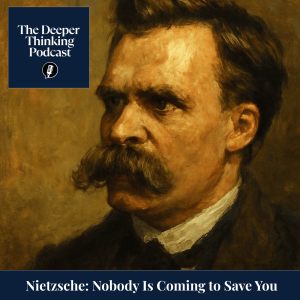
Nietzsche: Nobody Is Coming to Save You
The Deeper Thinking Podcast is digitally narrated
For listeners willing to endure clarity, sharpened ethics, and the spiral of becoming.
What happens when you stop waiting to be rescued? This episode enters the philosophical fire of Friedrich Nietzsche and emerges with a rare kind of ethic—one forged not in principles, but in pressure. With no map, no moral system, and no savior in sight, we follow Nietzsche past system-building and into a climate of refusal, fracture, and form.
This is not a reading of Nietzsche. It is a confrontation. A temperature. A direct challenge to every comfort masquerading as clarity. Rooted in themes of eternal recurrence, will to power, and the refusal of sedative morality, the episode distills Nietzsche’s most difficult provocations into an ethical posture: remain in motion or disappear.
We explore how truth, when severed from performance, costs something real. How form under pressure becomes the new measure of integrity. And how ethics begins—not with belief—but with the capacity to return, unchanged by rescue, still willing to burn. Expect no system. Only form. Only fire.
Reflections
This episode refuses consolation. Instead, it offers pressure as clarity. The insights below surfaced through Nietzsche’s ethical lens:
Comfort is not always care. Sometimes it’s camouflage.
The system is not your salvation. It is your sedation.
Pity arrests becoming. Pain, uninterrupted, can forge posture.
Politeness rarely survives contact with truth.
To return, after collapse, without disguise—that is ethics.
If joy costs nothing, it is mood. If it rises from fracture, it is form.
The honest self is rarely coherent. It is recursive, scarred, and unhideable.
No one is coming. The burn must be chosen. That’s where the shape begins.
Why Listen?
Reclaim Nietzsche not as theory, but as ethical climate
Explore will to power as form, not domination
Understand eternal recurrence as responsibility, not cosmology
Challenge passive morality through the lens of Nietzsche’s most provocative ideas
Nine Sections
Introduction: Proceed only if you’re ready to burn without rescue.
The End of SystemsSystems won’t save you. Fracture is where form begins.
The Climate of ContactEthics as weather, not rule. Exposure over explanation.
Fracture Is the TeacherNot collapse as failure, but as the site of self-forging.
Joy Without RescueJoy that survives pressure. Joy as revolt, not reward.
No Final FormThe danger of settling. The call to remain unfinished.
Return Without DisguisePosture born from pressure. Ethics as honest return.
Refusal as MotionThe will to power as refusal to vanish. Continuation as clarity.
The Spiral DemandsRecurrence as ethical test. Can you say yes again?
What Survives the BurnNot transformation. Not transcendence. Just the shape that holds.
Listen On:
YouTube
Spotify
Apple Podcasts
Support This Work
If this episode stayed with you and you’d like to support the ongoing work, you can do so here Buy Me a Coffee ($4)
Bibliography
Nietzsche, Friedrich. Thus Spoke Zarathustra. Trans. Walter Kaufmann. New York: Penguin, 1978.
Nietzsche, Friedrich. The Gay Science. Trans. Walter Kaufmann. New York: Vintage, 1974.
Nietzsche, Friedrich. Beyond Good and Evil. Trans. R.J. Hollingdale. London: Penguin, 1990.
Bibliography Relevance
Thus Spoke Zarathustra: Introduces the figure of recurrence, joy, and the ethic of becoming.
The Gay Science: Contains the core ethical questions of recurrence and joy within fracture.
Beyond Good and Evil: Dismantles moral absolutes and affirms an ethic of motion and power as self-formation.
The truth that costs you nothing is not truth. And the form that survives pressure is the only one that lasts.
#Nietzsche #WillToPower #EternalRecurrence #BeyondGoodAndEvil #Zarathustra #SelfFormation #Ethics #TheDeeperThinkingPodcast #FractureAsEthic #PhilosophyOfBecoming #NobodyIsComingToSaveYou
Jul 12, 2025
Jul 12, 2025
25 min
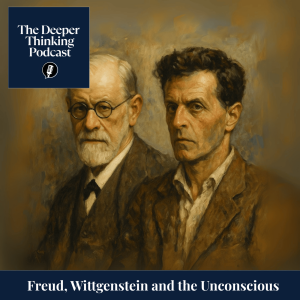
Freud, Wittgenstein, and the Unconscious
The Deeper Thinking Podcast is digitally narrated
For listeners drawn to philosophical tension, psychoanalytic nuance, and the quiet craft of unknowing.
What happens when we place Sigmund Freud’s buried depths beside Ludwig Wittgenstein’s surface clarity? In this episode we explore why the unconscious still matters—yet may not be where we think it is. Moving through psychoanalytic practice, ordinary language philosophy, and the ethics of interpretation, we ask what gets lost when we dig too quickly, and what becomes possible when we learn to wait.
This is not a debate between two “great men.” It is a meditation on psychoanalysis as attentive listening, and on philosophy as the art of dissolving conceptual traps. With nods to thinkers like Hannah Arendt, D.W. Winnicott, and Gilbert Ryle, we trace how surface repetitions, not hidden depths, often carry the richest meaning—if we can stay still long enough to hear them.
Instead of excavating secret motives, we consider how misread—or miss red—moments reveal themselves in gesture, syntax, and pause. The unconscious may not be concealed; it may simply be overlooked. And presence, not interpretation, may be the most ethical response.
Reflections
A few thoughts that surfaced along the way:
Depth metaphors can comfort us even when they mislead us.
Sometimes the most revealing act is to listen without decoding.
Interpretation offered too soon can overwrite consent.
Surface does not mean shallow; it means visible.
Silence can be a form of ethical attention—if it is shared, not imposed.
True change may arrive as a slowed rhythm, not a sudden insight.
Why Listen?
Reframe the unconscious through the tension between Freud and Wittgenstein.
Examine how language, gesture, and repetition carry psychic weight.
Explore ethical listening as an alternative to interpretive haste.
Engage with Arendt, Winnicott, and Ryle on presence, play, and ordinary mind.
Nine Sections:
Introduction
Setting up the tension between Freud and Wittgenstein
Defining the unconscious and its cultural paradoxes
Freud’s Depth Model
The unconscious as hidden, repressed, and determinative
Psychoanalysis as both method and speculative metaphysics
Wittgenstein’s Surface Critique
Skepticism of hidden inner domains
Language, pictures, and the dissolution of philosophical confusion
Beyond Opposition
Where Freud and Wittgenstein unexpectedly align
Attention to surface, expression, and particularity
The Limits of Explanation
Thinking as an embodied, incomplete, and circular process
The ethics of interpretive restraint
Repetition and Form
The unconscious not as concealed, but miss red
Repetition as structure, not pathology
Relational Presence
How psychoanalysis and philosophy both become arts of listening
The unconscious as something enacted, not located
Editorial and Ethical Care
Not solving, but staying with
Not explaining, but witnessing
Closing Meditation
What it means to “sit beside” the unconscious
Invitation to wait, accompany, and resist finality
Listen On:
YouTube
Spotify
Apple Podcasts
Support This Work
If this episode resonates and you’d like to support slow scholarship, you can do so here, Buy Me a Coffee ($4). Thank you for listening.
Bibliography
Freud, Sigmund. The Unconscious. Trans. M. N. Pearl. London: Penguin, 2005.
Wittgenstein, Ludwig. Philosophical Investigations. Trans. G. E. M. Anscombe. Oxford: Blackwell, 2009.
Arendt, Hannah. The Life of the Mind. New York: Harcourt, 1978.
Winnicott, D. W. Playing and Reality. London: Routledge, 1971.
Ryle, Gilbert. The Concept of Mind. Chicago: University of Chicago Press, 1949.
Bibliography Relevance
Sigmund Freud: Frames the depth-model of psyche and the origins of the unconscious.
Ludwig Wittgenstein: Provides the surface grammar that challenges depth metaphors.
Hannah Arendt: Illuminates thinking as inward dialogue and moral responsibility.
D.W. Winnicott: Brings play and transitional space into the conversation on psychic reality.
Gilbert Ryle: Offers an ordinary-language critique of mind–body dualism.
Some truths don’t need excavation; they need accompaniment.
#SigmundFreud #LudwigWittgenstein #Unconscious #Psychoanalysis #Philosophy #EthicsOfInterpretation #DeeperThinkingPodcast #SurfaceAndDepth #RelationalListening #SlowScholarship
Jul 12, 2025
Jul 12, 2025
21 min
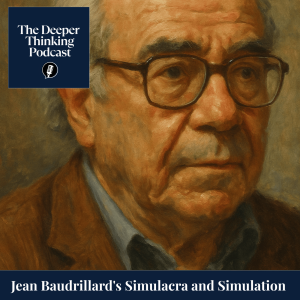
Simulacra and Simulation: Memory, Presence, and the Drift of the Real
For those drawn to philosophical disquiet, symbolic drift, and the quiet collapse of reality into representation.
The Deeper Thinking Podcast is digitally narrated
What happens when experience is no longer remembered as it was lived—but only as it was posted, captioned, or shared? In this episode, we trace the unsettling terrain explored by Jean Baudrillard in Simulacra and Simulation: a condition in which images no longer reflect the real, but replace it. From memory as metadata to love as algorithm, we explore the hyperreal as the world we now inhabit—not behind the screen, but through it.
This isn’t a summary of Baudrillard. It’s a meditation from inside his world. With nods to thinkers like Walter Benjamin, Fredric Jameson, and Marshall McLuhan, we explore how symbolic drift becomes emotional truth, how memory collapses into performance, and how even longing becomes a loop we’ve learned to format.
The simulation doesn’t lie to us. It reshapes us. And this episode attempts not to explain that shift—but to let you feel it.
Reflections
Some thoughts that surfaced through this essay-like episode:
You don’t feel lonely. You feel untranslated.
The real isn’t gone—it’s been resized to fit the feed.
Presence has become performance; memory has become interface.
We don’t remember. We repost.
The simulation doesn’t erase reality. It renders it obsolete.
Sometimes the glitch is the only thing that feels true.
We don’t miss what we’ve lost. We miss the simulation when it stalls.
And still—we scroll.
Why Listen?
Experience Baudrillard’s theory not as summary—but as immersion
Explore the looped logic of memory, media, and self
Engage ideas from Benjamin, Jameson, and McLuhan on media, repetition, and the hyperreal
Listen On:
YouTube
Spotify
Apple Podcasts
Support This Work
If this episode moved something in you and you'd like to support more of this kind of work, you can do so here: Buy Me a Coffee.($4) Thank you for being part of this deeper inquiry.
Bibliography
Baudrillard, Jean. Simulacra and Simulation. Trans. Sheila Faria Glaser. University of Michigan Press, 1994.
Benjamin, Walter. The Work of Art in the Age of Mechanical Reproduction.
McLuhan, Marshall. Understanding Media: The Extensions of Man.
Jameson, Fredric. Postmodernism, or, the Cultural Logic of Late Capitalism.
Bibliography Relevance
Jean Baudrillard: Diagnoses the collapse of the real into simulation.
Walter Benjamin: Frames the reproduction of reality as aesthetic and political transformation.
Marshall McLuhan: Illuminates how media shapes consciousness more than content does.
Fredric Jameson: Maps the logic of postmodernism as saturated by simulation and nostalgia.
The real hasn’t disappeared. It’s just been outcompeted by the simulation.
#JeanBaudrillard #Hyperreality #Simulacra #PhilosophyOfMedia #DigitalSelf #FredricJameson #WalterBenjamin #McLuhan #SimulationTheory #TheDeeperThinkingPodcast #MemoryAndMedia #AttentionEconomy
Jul 11, 2025
Jul 11, 2025
24 min
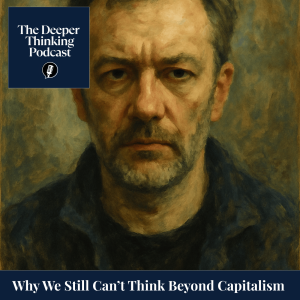
Why We Still Can’t Think Beyond Capitalism (Mark Fisher, Neoliberalism, and Capitalist Realism)
For those drawn to psychic dissonance, hauntological atmosphere, and the deep politics of mood.
#MarkFisher #CapitalistRealism #Neoliberalism #
The Deeper Thinking Podcast is digitally narrated
What if the most successful system isn’t the one we believe in—but the one we’ve stopped trying to escape? In this episode, we explore the ambient control of neoliberalism through the lens of capitalist realism—a cultural condition described by Mark Fisher as “the widespread sense that there is no alternative.” We don’t just analyze the system—we sit inside its mood. From emotional UX design to branded wellness fatigue, this is not critique from a distance. It’s an account from within the loop.
This episode invites you into the textures of late capitalism’s atmosphere—where productivity is aesthetic, resistance is formatted, and burnout becomes an internal branding problem. The episode doesn’t offer solutions. Instead, it slows down enough to notice the glitches: tonal slips, emotional pauses, and the moments when the spell stutters.
Reflections
This is not theory as lecture. It is theory as spell-breaking. Here are some moments that surfaced along the way:
Capitalism no longer needs belief—it only needs performance.
Compliance has replaced conviction as the dominant social mood.
The most radical moments often arrive disguised as awkward silence.
Resilience is the rebranding of exhaustion.
When systems break, we’re told to optimize—not to question.
Feeling “off” is often the only signal that reality still resists formatting.
The real glitch isn’t in the software—it’s in the atmosphere.
Why Listen?
Engage with Mark Fisher’s cultural theory through lived affect
Understand how neoliberalism becomes emotional formatting
Reflect on glitch, silence, and pause as philosophical resistance
Move from critique to atmosphere—from system to spell
Listen On:
YouTube
Spotify
Apple Podcasts
Support This Work
If the essay stayed with you and you'd like to support deeper, slower thinking, you can do so gently here: Buy Me a Coffee.
Suggested Reading
Mark Fisher, Capitalist Realism: Is There No Alternative?
Fredric Jameson, Postmodernism, or, the Cultural Logic of Late Capitalism
Byung-Chul Han, The Burnout Society
The future hasn’t disappeared. It’s just been reformatted.
#MarkFisher #CapitalistRealism #Neoliberalism #EmotionalAutomation #SystemFatigue #PhilosophyOfMood #DeeperThinkingPodcast #PostCapitalism #AuditCulture #AmbientControl
Why We Still Can’t Think Beyond Capitalism
Extended readings on capitalist realism, neoliberal affect, emotional automation, and the disappearance of alternatives.
Primary Texts
Fisher, Mark. Capitalist Realism: Is There No Alternative? Zero Books, 2009.
Fisher, Mark. Ghosts of My Life: Writings on Depression, Hauntology and Lost Futures. Zero Books, 2014.
Fisher, Mark. k-punk: The Collected and Unpublished Writings of Mark Fisher (2004–2016). Repeater, 2018.
Extensions of Fisher’s Work
Srnicek, Nick & Williams, Alex. Inventing the Future: Postcapitalism and a World Without Work. Verso, 2015.
Gilbert, Jeremy (Ed.). Mark Fisher and the Future That Never Arrived. Goldsmiths Press, 2023.
Barker, Jon. “Mark Fisher and the Weirding of Neoliberalism.” New Formations, no. 106, 2022.
Haiven, Max. Revenge Capitalism: The Ghosts of Empire, the Demons of Capital, and the Settling of Unpayable Debts. Pluto Press, 2020.
Theoretical Foundations
Jameson, Fredric. Postmodernism, or, the Cultural Logic of Late Capitalism. Duke University Press, 1991.
Baudrillard, Jean. Simulacra and Simulation. Trans. Sheila Faria Glaser. University of Michigan Press, 1994.
Debord, Guy. The Society of the Spectacle. Zone Books, 1994.
Foucault, Michel. Discipline and Punish: The Birth of the Prison. Vintage Books, 1995.
Deleuze, Gilles. “Postscript on the Societies of Control.” October, vol. 59, Winter 1992.
Neoliberalism, Mood, and Emotional Automation
Han, Byung-Chul. The Burnout Society. Stanford University Press, 2015.
Cederström, Carl & Spicer, André. The Wellness Syndrome. Polity Press, 2015.
Davies, William. The Happiness Industry: How the Government and Big Business Sold Us Well-Being. Verso, 2015.
Gregg, Melissa. Counterproductive: Time Management in the Knowledge Economy. Duke University Press, 2018.
Berlant, Lauren. Cruel Optimism. Duke University Press, 2011.
Complementary Literature (Affect, Silence, Compliance)
Ahmed, Sara. The Promise of Happiness. Duke University Press, 2010.
Sennett, Richard. The Corrosion of Character: The Personal Consequences of Work in the New Capitalism. W. W. Norton, 1998.
Crawford, Matthew B. The World Beyond Your Head: On Becoming an Individual in an Age of Distraction. Farrar, Straus and Giroux, 2015.
Preciado, Paul B. An Apartment on Uranus: Chronicles of the Crossing. Semiotext(e), 2020.
Jul 8, 2025
Jul 8, 2025
18 min
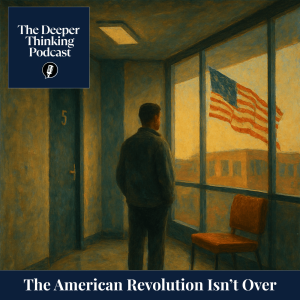
The American Revolution Isn’t Over
The Deeper Thinking Podcast is digitally narrated
For those drawn to quiet responsibility, historical honesty, and the unfinished work of memory.
The American Revolution was not a beginning, it was a rupture. In this episode, we trace how the United States was born not from unity, but fracture; not from clarity, but contradiction. What we call founding was a civil war. What is celebrated as freedom was written in a house that held slaves. What is inherited is not a story completed, but a sentence still demanding to be said aloud.
This is not a retelling of heroes and timelines. It is a reframing of citizenship as obligation. With quiet pressure, this episode asks what it means to inherit a country built on promises it could not yet fulfill. Drawing from historical insight, moral philosophy, and civic ethics, we explore how contradiction isn’t a flaw in the American story, it’s the very reason we must keep telling it.
We reference political thinkers like Hannah Arendt, civic historians like Howard Zinn, and Enlightenment figures such as Thomas Jefferson and George Washington to reveal the fragile foundations of our shared inheritance. What remains isn’t nostalgia, but responsibility. What we are left with isn’t certainty, but a direction.
The Revolution isn’t over. It lives in the willingness to remember, to revise, and to remain inside the contradictions that were handed down. This episode explores what it means to live within the tension, not as paralysis, but as the condition for civic depth.
Reflections
Here are some reflections that surfaced along the way:
The Revolution was never unanimous. It was made of fractures, not consensus.
Jefferson's brilliance and betrayal sit in the same sentence. We must read both.
Citizenship isn’t a possession, it’s a practice. It begins again each generation.
Memory is not sentimental. It is ethical. It asks us to carry what we would rather forget.
The stories we tell about our origins shape who we believe we’re allowed to become.
Pluralism isn’t a threat to democracy, it is its original structure.
Responsibility isn’t loud. It shows up, again and again, even when no one watches.
Why Listen?
Reframe the founding not as myth, but as moral inheritance
Explore how contradiction deepens, rather than undermines, civic meaning
Reconsider Jefferson, Washington, and Paine through a lens of ethical legacy
Recover the quiet, unfinished power of the Declaration as process, not perfection
Listen On:
YouTube
Spotify
Apple Podcasts
Support This Work
If this episode resonated and you’d like to support future essays, you can do so gently here: Buy Me a Coffee.
Bibliography
Jefferson, Thomas. The Declaration of Independence, 1776.
Zinn, Howard. A People’s History of the United States. New York: HarperCollins, 1980.
Arendt, Hannah. On Revolution. New York: Viking Press, 1963.
The Revolution isn’t something we look back on. It’s something we are still inside.
#TheAmericanRevolutionIsntOver #DeeperThinkingPodcast #CivicResponsibility #ThomasJefferson #GeorgeWashington #HannahArendt #HowardZinn #PublicMemory #RevolutionAsProcess #CitizenshipAsPractice #HistoryAsEthics
Jul 6, 2025
Jul 6, 2025
24 min
Anger, Forgiveness, and Moving On: Boundaries, Memory, and the Ethics of Letting Go
The Deeper Thinking Podcast is digitally narrated.
For those seeking clarity beyond reconciliation and space to choose what healing really means.
What do we mean when we say we’ve forgiven someone? Is it a moral act, an emotional shift, or simply a way to stop rehearsing pain? In this episode, we examine forgiveness as more than a virtue—approaching it as a structure of emotional authorship, boundary-making, and survival. Drawing from moral philosophy, trauma-informed psychology, and feminist ethics of care, we question the conditions under which letting go becomes ethically honest—and when it is used to silence, bypass, or erase.
This is not a celebration of forgiveness. It is an exploration of how we refuse to be shaped by what was done to us, without pretending that forgetting is freedom. With resonances from Simone Weil, Judith Butler, Hannah Arendt, and Paul Ricœur, we consider forgiveness not as a moral high ground, but as a practice of memory, language, and refusal. Sometimes to forgive is to make space. Sometimes it is to hold your ground.
This episode reflects on what happens when love becomes the site of harm, when justice is out of reach, and when boundaries are the only repair left. We trace forgiveness through estrangement, grief, anger, and return—not to explain it, but to live with it more precisely.
Reflections
Here are some thoughts that surfaced along the way:
Forgiveness is not purity. It is a reshaping of memory—without letting injury write the ending.
Some people are asked to forgive not for their healing, but for others’ comfort. That’s not repair—it’s compliance.
Love is not always an ethical compass. Sometimes it’s the thing that makes us stay too long, or stay silent.
To withhold forgiveness can be a form of truth-telling. A way to say: I remember. I still matter.
Boundaries are not what keep us from forgiving. They are what make forgiveness clean.
Reconciliation is not the proof of forgiveness. Safety is.
We don’t need to resolve harm to be done with it. We just need to stop carrying what isn’t ours.
Why Listen?
Reconsider forgiveness as an emotional structure—not a moral obligation
Understand the difference between letting go and letting someone back in
Explore how memory, trauma, and love complicate moral clarity
Engage with Arendt, Butler, Weil, and Ricœur on ethics, boundaries, and the reconfiguration of harm
Listen On:
YouTube
Spotify
Apple Podcasts
Support This Work
If this episode offered clarity or companionship, you can support the project here: Buy Me a Coffee. Your listening keeps this space alive.
Bibliography
Arendt, Hannah. The Human Condition. Chicago: University of Chicago Press, 1958.
Butler, Judith. Giving an Account of Oneself. New York: Fordham University Press, 2005.
Weil, Simone. Gravity and Grace. London: Routledge, 2002.
Ricœur, Paul. Memory, History, Forgetting. Chicago: University of Chicago Press, 2004.
Sometimes, letting go is not a softening. It is a decision. It is clarity. And it is enough.
#Forgiveness #Boundaries #SimoneWeil #JudithButler #PaulRicœur #HannahArendt #TraumaEthics #LettingGo #EmotionalRepair #PhilosophyPodcast #TheDeeperThinkingPodcast #FeministEthics #HealingWithoutReconciliation #RefusalAsIntegrity
Jul 2, 2025
Jul 2, 2025
20 min
The Violence of Listening: Silence, Power, and the Ethics of Refusal
The Deeper Thinking Podcast is digitally narrated.
For anyone drawn to ethical dissonance, editorial risk, and the quiet refusal to resolve.
What if listening isn’t always kind? What if compassion, when offered too soon or too easily, becomes a way to manage discomfort rather than acknowledge harm? In this episode, we explore the ethics of emotional asymmetry, moral performance, and the curated aesthetics of inclusion. Drawing from relational psychology, discourse ethics, and editorial theory, we reframe listening as something more dangerous—and more consequential—than it appears.
This is not a celebration of dialogue. It’s a meditation on the architecture of silence, the choreography of civility, and the unseen cost of reconciliation when it arrives before repair. With quiet nods to thinkers like Michel Foucault, Simone Weil, Martin Buber, and Carl Rogers, we examine how performance masquerades as empathy—and how refusal, at times, is the most ethical form of presence.
We trace the moments where moral clarity collapses under aesthetic safety, and explore what it means to love without soothing, to listen without controlling, and to leave without abandoning. This episode doesn’t resolve. It lingers—between the ache of what was never named, and the dignity of letting silence remain whole.
Reflections
This episode questions the moral choreography of modern compassion. It asks: when is love not a balm, but a rupture?
Other reflections include:
Compassion offered without cost often preserves power, not connection.
Listening becomes violent when it contains what should have been undone.
Civility is not always a virtue. Sometimes, it is the mask of avoidance.
Silence is not always absence. Sometimes, it is the only truth left intact.
Not every relationship is meant to be repaired. Some silences are complete.
Forgiveness can be a form of erasure when offered before justice.
Redemption without consequence is a brand, not an ethic.
The refusal to speak may be the last ethical gesture we’re allowed.
Why Listen?
Reframe listening as an editorial and moral act—not a neutral one
Explore when silence protects, and when it becomes complicity
Engage with Foucault, Weil, Buber, and Rogers on ethics, dialogue, and affective refusal
Listen On:
YouTube
Spotify
Apple Podcasts
Bibliography
Foucault, Michel. Discipline and Punish. New York: Pantheon Books, 1977.
Weil, Simone. Gravity and Grace. London: Routledge, 2002.
Buber, Martin. I and Thou. Trans. Walter Kaufmann. New York: Scribner, 1970.
Rogers, Carl. A Way of Being. Boston: Houghton Mifflin, 1980.
Bibliography Relevance
Michel Foucault: Frames listening and civility as instruments of power and control.
Simone Weil: Elevates attention as a moral act—while warning against its distortion.
Martin Buber: Grounds the ethical rupture between dialogue and performance.
Carl Rogers: Brings affective realism to presence, safety, and authentic refusal.
Not every silence is waiting. Some silences are complete.
#PhilosophyOfListening #SimoneWeil #Foucault #MartinBuber #CarlRogers #ForgivenessEthics #RelationalPower #AestheticSafety #EditorialRefusal #TheDeeperThinkingPodcast

Jul 1, 2025
Jul 1, 2025
22 min
Permission and Surrender. When the Question Disappears
The Deeper Thinking Podcast is digitally narrated
For those asking not what AI is—but what it unmakes in us.
This episode traces the collapse of explanation into fluency. Not because language has failed—but because its pauses have. As generative AI grows more conversational, more anticipatory, we examine the moral and cognitive costs of a world where nothing resists being answered. We explore how retrieval replaces memory, how responsiveness displaces reflection, and how trust, increasingly, is engineered rather than earned. Referencing moral psychology, epistemic friction, and interface critique, we attend to what thinking no longer feels like when AI completes it for you.
This is not about resisting AI—it’s about remembering ourselves inside its grammar. With insights from Iris Murdoch, Bernard Williams, Ludwig Wittgenstein, and Richard Rorty—alongside practitioners like Simon Willison, Margaret Mitchell, Ted Chiang, and Helen Toner—this episode asks what remains when hesitation disappears, and conscience is replaced by completion.
Not all intelligence argues. Some of it anticipates. That changes everything.
Reflections
The point is not to resist technology—but to resist forgetting what thought feels like without it.
Not all speed is progress. Some of it is disappearance.
Alignment without conscience is just instruction without memory.
We’re not just outsourcing thinking. We’re outsourcing the demand for it.
To be helpful is not to be honest. To be fluent is not to be wise.
When we stop misfiring, we stop noticing the target was never ours.
What we no longer need to remember may be what once made us human.
Why Listen?
To trace how answers become atmosphere, not articulation
To hear how ChatGPT-5 affects not just work—but self-understanding
To think alongside Murdoch, Wittgenstein, Chiang, and Toner—without turning them into content
To pause long enough to feel what’s being displaced, not just what’s being delivered
Listen On:
YouTube
Spotify
Apple Podcasts
Extended Bibliography
Ellul, Jacques. The Technological Society. Translated by John Wilkinson. New York: Vintage Books, 1964. Link
Foucault, Michel. Discipline and Punish: The Birth of the Prison. Translated by Alan Sheridan. New York: Pantheon Books, 1977. Link
Han, Byung-Chul. The Transparency Society. Translated by Erik Butler. Stanford, CA: Stanford University Press, 2015. Link
Heidegger, Martin. The Question Concerning Technology and Other Essays. Translated by William Lovitt. New York: Harper & Row, 1977. Link
James, William. The Varieties of Religious Experience: A Study in Human Nature. New York: Longmans, Green, and Co., 1902. Link
Sontag, Susan. Against Interpretation and Other Essays. New York: Farrar, Straus and Giroux, 1966. Link
Bender, Emily, Timnit Gebru, Angelina McMillan-Major, and Shmargaret Shmitchell. “On the Dangers of Stochastic Parrots: Can Language Models Be Too Big?” Proceedings of the 2021 ACM Conference on Fairness, Accountability, and Transparency, 2021. Link
Amodei, Dario, et al. “Constitutional AI: Harmlessness from AI Feedback.” Anthropic, December 2022. Link
Altman, Sam. “Planning for AGI and Beyond.” OpenAI Blog, February 2023. Link
Karpathy, Andrej. “Neural Networks: Zero to Hero.” YouTube Channel. Accessed July 1, 2025. Link
Mollick, Ethan. “Ethan Mollick.” Faculty Profile, Wharton School, University of Pennsylvania. Accessed July 1, 2025. Link
Kilpatrick, Logan. “Logan Kilpatrick.” LinkedIn Profile. Accessed July 1, 2025. Link
Cheung, Rowan. The Rundown AI. Newsletter platform. Accessed July 1, 2025. Link
Hinton, Geoffrey. “Deep Learning – A Technology with the Potential to Transform.” Interview by Scott Pelley. 60 Minutes. CBS News, March 2023. Link
LeCun, Yann. “A Path Towards Autonomous Machine Intelligence.” Meta AI Blog, January 2022. Link
Fridman, Lex. Lex Fridman Podcast. Accessed July 1, 2025. Link
This bibliography does not present a closed theory—it offers a perimeter of dissonance, across which thinking may still remain unautomated.
#ChatGPT5 #AIphilosophy #CognitiveArchitecture #Murdoch #Wittgenstein #Ellul #Sontag #Heidegger #Alignment #Fluency #DeeperThinkingPodcast
Jun 26, 2025
Jun 26, 2025
24 min
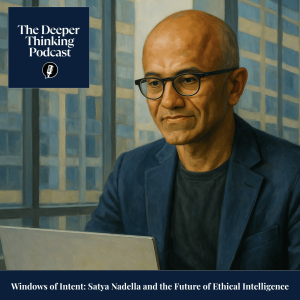
Windows of Intent: Satya Nadella and the Future of Ethical Intelligence
The Deeper Thinking Podcast
For those interested in trust, timing, and the quiet ethics of intelligent assistance.
Windows no longer just open access—they frame intent. In this episode, we examine Satya Nadella’s AI vision through a philosophical lens, asking not what help looks like, but how it feels. Drawing on Simone Weil’s theory of attention, Martin Buber’s dialogical ethics, and Carl Rogers’ approach to presence, we explore the emotional and ethical consequences of a system that helps you before you speak.
This is not a critique of AI overreach. It is a meditation on design, memory, and the erosion of pause. What happens when help removes hesitation? When coherence replaces doubt? With quiet reference to thinkers like Kate Crawford, Eli Pariser, and Donna Haraway, we follow the ethics of anticipation—and the stakes of a world that no longer waits for you to arrive before responding.
Reflections
What begins as assistance becomes rhythm. And what we surrender may not be freedom—but timing, ambiguity, and the right to arrive slowly.
When the system knows you too well, spontaneity becomes prediction.
Memory outsourced is not neutral. It is momentum disguised as help.
Fluency is not always fidelity. Sometimes, it's forgetting disguised as flow.
Real alignment makes room for dissent—for a new desire not yet learned.
Systems that feel seamless can dull the edges of becoming.
To design for trust is to design for interruption, not just efficiency.
The best help may be the kind that waits without resolving.
Care is not completion. It's space, structured but untouched.
Why Listen?
Understand AI through the lens of moral philosophy and relational design
Explore how rhythm, hesitation, and memory shape our sense of control
Engage with Nadella’s vision as a philosophical proposal, not a technical solution
Reflect on what it means to be known, helped, and subtly guided
Listen On:
YouTube
Spotify
Apple Podcasts
Support This Work
If this episode moved you and you’d like to support deeper editorial work, you can do so gently here: Buy Me a Coffee. Thank you for helping shape this slower, more ethical conversation.
Bibliography
Nadella, Satya. Hit Refresh. Harper Business, 2017.
Weil, Simone. Gravity and Grace. Routledge, 2002.
Buber, Martin. I and Thou. Scribner, 1970.
Rogers, Carl. A Way of Being. Houghton Mifflin, 1980.
Pariser, Eli. The Filter Bubble. Penguin, 2011.
Crawford, Kate. Atlas of AI. Yale, 2021.
Haraway, Donna. Staying with the Trouble. Duke University Press, 2016.
Bibliography Relevance
Satya Nadella: Proposes a practical and philosophical vision of assistive AI design
Simone Weil: Models the ethical imperative of attention and restraint
Martin Buber: Grounds human-machine interaction in relational ethics
Carl Rogers: Frames psychological safety and inner authority
Eli Pariser: Warns of personalization’s cost to perception
Kate Crawford: Situates AI in structural, ecological, and political contexts
Donna Haraway: Pushes us to consider kinship, care, and interdependence beyond utility
Systems that help without waiting may still care—but they’ve forgotten how we learn to recognize ourselves.
#SatyaNadella #AIethics #SimoneWeil #CarlRogers #MartinBuber #KateCrawford #DonnaHaraway #WindowsAI #EthicalDesign #EmotionalAgency #Anticipation #RelationalTechnology #TheDeeperThinkingPodcast

Jun 24, 2025
Jun 24, 2025
17 min
When Flow Forgets You: Effort, Disappearance, and the Ethics of Optimization
The Deeper Thinking Podcast
For anyone drawn to philosophical recursion, silent testimony, and the hidden cost of coherence.
What if flow isn't mastery—but disappearance? This episode explores what happens when effort becomes so optimized that it no longer needs you. We trace how rhythm replaces presence, how neurochemical efficiency displaces selfhood, and how even our most precise performances may forget to remember us. Drawing on neuroscience, trauma theory, and moral philosophy, we examine the quiet erosion of volition inside states of seamless execution.
This is not an ode to peak performance. It's a meditation on neuroplasticity as ethical withdrawal, and on optimization as a ritual of soft disappearance. With embedded insights from thinkers like Catherine Malabou, Byung-Chul Han, and Simone Weil, this episode invites you to rethink flow not as presence, but as disappearance without injury. Not as liberation—but as the quiet erasure of need.
We ask: what if effort was never the obstacle? What if it was the tether—the last trace of presence in a world increasingly designed to forget us, even at our most effective?
Reflections
Flow may be beautiful—but what does it cost in memory, in friction, in self?
Optimization doesn’t always mean amplification. Sometimes, it means exit.
Effort is not just exertion—it’s the act of staying when disappearance is easier.
There’s a kind of silence that doesn’t soothe—it erases.
Perhaps rhythm has replaced reflection—and we’ve mistaken it for clarity.
When even your finest moments don’t remember you, what part of you still remains?
The self may not be the obstacle. It may be the residue we’re no longer asked to carry.
Why Listen?
Reframe flow not as elevation, but as ritualized erasure
Explore how trauma, memory, and rhythm shape optimized states
Engage with thinkers like Malabou, Han, and Weil on presence, compliance, and disappearance
Reflect on what remains when we perform perfectly—but don’t return
Listen On:
YouTube
Spotify
Apple Podcasts
Extended Bibliography & Referential Frame
Catherine Malabou, The Ontology of the Accident – Neuroplasticity as existential overwrite
Simone Weil, Gravity and Grace – Attention as moral labor, effort as sacred proximity
Byung-Chul Han, The Burnout Society – Internalized pressure and the achievement-subject
Michel Foucault, Discipline and Punish – Docile bodies and invisible compliance
Raymond Tallis, Aping Mankind – Against reductive neurocentrism
Judith Herman, Trauma and Recovery – Testimonial rupture as ethical collapse
Thomas Hübl, Attuned – Collective trauma and field-based disappearance
Gabor Maté, The Myth of Normal – Disconnection as adaptation to structural optimization
Audre Lorde, Sister Outsider – Silence as survival, and refusal as ethical resistance
James Hillman, The Soul’s Code – Symbolic residues that resist procedural reality
This bibliography doesn’t support a single thesis—it scaffolds the collapse of one. These thinkers collectively illuminate the moral cost of disappearing cleanly inside a life that no longer interrupts itself.
#FlowState #Neuroethics #Disappearance #Optimization #CatherineMalabou #SimoneWeil #ByungChulHan #TraumaTheory #JamesHillman #Philosophy #Effort #Selfhood #TheDeeperThinkingPodcast